March 2010


Our friends at China Digital Times have translated recent orders from China’s State Council Information Office to domestic news organizations and Web sites about how to handle the country’s ongoing dispute with Google. We’re posting an excerpt here, but please read the whole link. There’s a great discussion about government censors’ plans for monitoring social networking and microblogging sites.  

New York, March 31, 2010—News reports that the Yahoo e-mail accounts of reporters and others in China and Taiwan have been compromised are a reminder that journalists must be vigilant when communicating over the Internet, the Committee to Protect Journalists said today. CPJ called on Internet companies to reassess their business practices in countries where users’ communications cannot be adequately protected.

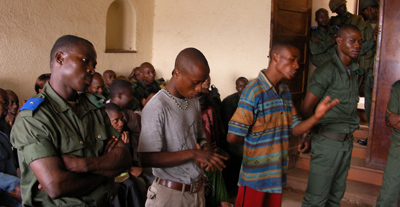
Some of the suspects in the Didace Namujimbo murder trial. (JED)

Didace Namujimbo, a journalist for Radio Okapi, was shot dead on the night of November 21, 2008. Now, after repeated delays, a military court in Bukavu, capital of the province of South Kivu in eastern Democratic Republic of Congo, is putting on trial a dozen people charged in connection with the murder.

We issued the following statement after learning that Belarusian authorities have stripped Pavel Sheremet, a prominent journalist living in Russia, of his Belarusian citizenship. In an interview today for the independent news Web site Belarussky Partizan, Sheremet said he received a notice about this from the Belarusian embassy in Moscow. Sheremet said the notice did not specify the reason.

New York, March 30, 2010--The Committee to Protect Journalists is concerned about the health and well-being of Emadeddin Baghia prominent Iranian journalist, author, and human rights activist who has been detained without charges in Tehran's notorious Evin prison since December 2009.

New York, March 30, 2010—The conviction on Saturday of four men, including three members of the military police, in the 2007 murder of Brazilian journalist Luiz Carlos Barbon Filho is an important step forward in the global campaign to combat impunity in journalists’ murders, the Committee to Protect Journalists said today.    

Dear President Arroyo and Chief Justice Puno: We are greatly concerned by the apparent lack of an effective government response to threats made against Marites Danguilan Vitug, one of the Philippines’ senior and most eminent journalists. Vitug said she believes your intervention will serve as a deterrent to whoever is trying to intimidate her, and, hopefully, to those who try to intimidate other journalists in the future.

New York, March 30, 2010—Kazakh authorities must thoroughly investigate a brutal attack in the city of Aktobe that left Igor Larra, a correspondent for the Almaty-based independent weekly Svoboda Slova (Freedom of Speech), with a concussion and other head injuries, the Committee to Protect Journalists said today.

New York, March 30, 2010—The Committee to Protect Journalists denounces the conviction of Venezuelan journalist Gustavo Azócar on trumped-up financial crime charges. Azócar, an outspoken critic of the Venezuelan administration, had been jailed since July 2009 and barred from speaking publicly about the case.

New York, March 29, 2010—An Ecuadoran appellate court should overturn the libel conviction of editor Enrique Palacio, and the country’s legislators should reform archaic defamation laws that do not meet international standards for freedom of expression, the Committee to Protect Journalists said today. Palacio was sentenced Friday to three years in prison in connection with a commentary about a senior government finance official.

A police officer conducts surveillance during a crime-fighting operation in Tegucigalpa. (AP/Eduardo Verdugo)

New York, March 29, 2010—The Committee to Protect Journalists urges Honduran authorities to fully investigate last week’s murders of two journalists, part of a month-long wave of lethal violence that has resulted in the slayings of five reporters over all and led to widespread self-censorship in the local media.

Marquez (AP)Midas Marquez, spokesman for the Philippine Supreme Court, has told local reporters that he considers death threats sent anonymously by text message to journalist Marites Dañguilan Vitug to be “funny” and “ridiculous.” Marquez was asked to comment in his official role because the threats began shortly after the release of Vitug’s new book, Shadow of Doubt: Probing the Supreme Court, which critiques the inner workings of the high court.

New York, March 29, 2010—The Committee to Protect Journalists condemns and calls for a thorough investigation into grenade attacks launched against two state-owned television news stations in Thailand. The attacks—one against army-run Channel 5, the other against the National Broadcasting Services of Thailand (NBT)—took place Saturday night in the capital, Bangkok

A bomb explosion injured three local journalists who were accompanying a convoy of security forces in the Lower Dir district of northwestern Pakistan on February 3, 2010, according to a statement by the Karachi-based Pakistan Press Foundation and international news reports.

We issued the following statement today in response to the murder of Honduran journalists Bayardo Mairena and Manuel Juárez, who were shot by unidentified gunmen aboard a vehicle, in the department of Olancho in eastern Honduras, according to local press reports...

A group of Palestinian journalists were assaulted on January 28, 2010, while reporting on olive tree planting in Burin village, south of Nablus in the West Bank. According to the Palestinian Center for Development and Media Freedoms (MADA), Israeli forces assaulted Rami Swidan, a photographer for Ma’an News Agency; Ashraf Abu Shawish, a cameraman for Palmedia, and Reuters photographers Abdel Rahim al-Qusini and Hassan Titi.

The New York Times Co. apologized on March 24, 2010, to Singapore’s prime minister and his two predecessors for a February 15 article that described the island nation’s leaders as a political dynasty, according to international news reports. The company and the article’s author, Philip Bowring, agreed to pay damages of 160,000 Singaporean dollars (US$114,000) in addition to legal costs, the reports said.

New York, March 25, 2010—Tunisian authorities banned journalists from attending two press conferences for the launch of local and international human rights reports this week, and is stepping up harassment of journalists overall, the Committee to Protect Journalists said today.

We issued the following statement in response to local and international press reports that Muhammad al-Maqaleh, editor of the Yemeni Socialist Party news Web site Aleshteraki, has been released for what the reports described as “health and humanitarian reasons.” Al-Maqaleh was kidnapped in September 2009 but appeared in government custody in February and alleged that he had been tortured. The release comes one week after CPJ called on President Saleh of Yemen to release a number of journalists who are in custody. At least two other journalists remain in custody...

Muaid al-Lami at a Baghdad hospital following an attack that wounded his driver. (Reuters)

New York, March 25, 2010Iraqi authorities must urgently investigate an assassination attempt Sunday against Muaid al-Lami, head of the Iraqi Journalists’ Syndicate, the Committee to Protect Journalists said today. 

Staffers at Sirasa TV confirmed media reports that about 200 people gathered outside the in-town office of the independent broadcaster and threw stones, breaking windows and injuring staffers on March 22, 2010. Some in the crowd carried posters in Sinhala and English protesting the station’s plan to broadcast a concert by pop singer Akon scheduled for April in the capital city, Colombo. One of the singer’s recent videos had included a statue of the Buddha in the background while poolside partygoers danced in the foreground. Most of Sri Lanka’s ethnic Sinhalese majority are Buddhist. Police were reportedly made a few arrests. 

Three unidentified men attacked the residence of an investigative reporter for the private news channel DawnNews TV, in the Pakistani capital city of Islamabad, on January 19, 2010 according to local news reports.

Your Excellency: On the fifth anniversary of the Tulip Revolution that brought your government to power on the promise of democratic reform, the Committee to Protect Journalists is writing to express alarm at your government’s backsliding on press freedom.

We issued the following statement after learning that Hisham Bashraheel, editor of the daily Al-Ayyam, who has been in custody since January 6, was released today for what colleagues described as “health reasons.” The release comes one week after CPJ called on President Saleh of Yemen to release a number of journalists who are in custody but have not been charged with a crime. At least three other journalists remain in government custody...

Esperat (CMFR)Five years ago today, a gunman strode into the home of muckraking Philippine journalist Marlene Garcia-Esperat, pulled out a .45-caliber pistol, and shot her once in the head. A columnist and radio host on the southern island of Mindanao, Garcia-Esperat had made plenty of enemies while exposing government corruption.

On Monday, Google made good on its promise to stop censorship of its Chinese search engine, Google.cn, by rerouting viewers to its unfettered Hong Kong site. According to the company’s chief legal officer, David Drummond, the move was “a sensible solution to the challenges we've faced—it's entirely legal and will meaningfully increase access to information for people in China.”

Of the 12 radio stations in the city Leogane, south of Haiti’s capital, Port-au-Prince, only five are back on the air more than two months after the earthquake. Most stations were seriously damaged and several broadcasters are struggling to restore transmission, the head of the Leogane Press Association (APL), Julmane Saint Fort, told CPJ. Saint Fort said that six radio stations were completely destroyed and five severely damaged while the rest suffered some minor material harm.

New York, March 23, 2010—The Belarusian Supreme Court has upheld a government order that will obstruct the work of the Belarusian Association of Journalists, the country’s most prominent press freedom and media support organization. The Committee to Protect Journalists denounced the ruling, which was handed down Monday.

Shubhranshu Choudhary trains villagers to use their phones to disseminate and receive news. (Sakhi/Flickr)

Violence against provincial journalists, self-censorship, and the rise of paid news were the leading press freedom concerns cited by editors and journalists that I met with during my recent visit to India. But for Shubhranshu Choudhary, known as Shu, it’s the ban on radio news that most concerns him. He believes the ban is fueling India’s long-simmering Maoist insurgency, and he’s fighting back, using mobile phone technology to bring independent news to the tribal regions where the Maoists operate.

New York, March 23, 2010—The Philippine government must vigorously pursue its investigation into a series of death threats received by Marites Dañguilan Vitug, editor-in-chief of the online news outlet Newsbreak, the Committee to Protect Journalists said today.

(El Meridiano de Cordoba)

New York, March 22, 2010—The Committee to Protect Journalists urges Colombian authorities to fully investigate the death of journalist Clodomiro Castilla Ospino, left, who was shot on Friday by an unidentified gunman in the northern city of Montería, according to local press reports.

New York, March 22, 2010—The Committee to Protect Journalists calls on Tunisian authorities to end the persecution and imprisonment of a critical journalist and to overturn a four-year jail sentence of another.

We issued the following statement today after Google announced it had stopped censoring its search engine in China:

Belarusian President Aleksandr Lukashenko, left, and Kazakhstan President Nursultan Nazarbayev at a November economic conference. (AP/Sergei Grits)

Belarus has been termed Europe’s last dictatorship because of its long intolerance of dissent and press freedom. So accustomed is the world to the clampdowns of President Aleksandr Lukashenko’s regime that neither a recently issued decree on Internet access, which requires that providers record users’ personal data, nor last week’s police raids at a number of independent news offices, came as much of a surprise to anyone. “Belarus—reliably repressive” would be the country’s bumper sticker were press freedom groups to make one.

New York, March 19, 2010At least five journalists were wounded while covering violent clashes between security personnel and protesters outside the capital, Kampala, on Wednesday. Scores of protestors and mourners came to Kasubi, a Kampala suburb, after a fire of unknown origin destroyed the historically significant royal tombs of the Buganda kingdom on Tuesday.   

New York, March 19, 2010A Turkish appellate court should overturn the unjust convictions of publisher and editor Haci Bogatekin, who faces several years in prison on various “insult” charges, the Committee to Protect Journalists said today.

A 2008 poster says: “Freedom for Genimet Zakhidov!” (CPJ)

New York, March 19, 2010—The Committee to Protect Journalists welcomes the release from prison on Thursday of Azerbaijani editor Genimet Zakhidov, who served more than half of a four-year term on fabricated “hooliganism” charges.

“We're relieved Azerbaijani officials released our colleague Genimet Zakhidov, who served 28 long months in prison in retaliation for his critical journalism,” CPJ Europe and Central Asia Program Coordinator Nina Ognianova said. “We call on authorities to build on this positive step by releasing editor Eynulla Fatullayev and video bloggers Emin Milli and Adnan Hajizade, all of whom have been imprisoned for their journalism.”

New York, March 19, 2010Ethiopia is preparing to jam the Amharic-language broadcasts of the U.S. government-funded Voice of America (VOA), Prime Minister Meles Zenawi declared Thursday in a press briefing with international media correspondents based in the capital, Addis Ababa. 

Sushma Swaraj, head of India's BJP party, says journalists encourage the "paid news" practice. (AFP) I just returned from India, where I spent a week meeting journalists and discussing press freedom concerns. One issue that emerged during my visit is what is known euphemistically as “paid news.”  Many media outlets routinely sell political advertising dressed up as a news article.

Gambia Press Union

For more than two years, U.S. Sen. Richard J. Durbin and a group of Senate colleagues have been pressing for the release of Gambian journalist “Chief” Ebrima Manneh, left. In July 2006, security agents arrested Manneh at his workplace at the Daily Observer and have since held him incommunicado and without charge. On Thursday, Durbin and four other senators sent a letter to Kamalesh Sharma, secretary-general of the Commonwealth of Nations, urging him to launch an investigation into the case. 

A Ugandan soldier quells a protest after fire destroyed the tombs of Bagandan kings. (Reuters)

It seemed like déjà vu. Another major protest erupts in Uganda and journalists face the wrath of authorities and the public alike. Tensions between the government and the traditional kingdom of the Baganda, the largest ethnic group based in central Uganda, flared again Tuesday evening after a fire of unknown origin ravaged the tombs of traditional kings, a UNESCO World Heritage site on Kasubi Hill near the capital, Kampala. Last September, a number of journalists were attacked or harassed while covering deadly clashes between the government and Baganda protesters.

March 2010

News from the Committee to Protect Journalists

Al-Bashir (AP)

New York, March 18, 2010Sudan’s official press regulator, the National Press Council, should drop its investigation of two editors accused of insulting President Omar al-Bashir, the Committee to Protect Journalists said today. 

Yass Omar al-Imam, editor-in-chief of the pro-opposition daily Rai al-Shaab, and Fayez al-Silaik, acting editor-in-chief of the independent daily Ajras al-Hurriya, were questioned Monday by officials with the National Press Council according to news reports. 

Dear President Rodríguez Zapatero: On the seventh anniversary of the Cuban government’s massive crackdown on dissidents and the independent press, the Committee to Protect Journalists calls on you as leader of the European Union to take the forefront in defending human rights by urging President Raúl Castro to immediately release 22 journalists now jailed in Cuba.

Mark Twain once said, “In our country we have those three unspeakably precious things: freedom of speech, freedom of conscience, and the prudence never to practice either.” In the witty genius’ land, the United States, such irony suggests that people should not to waste the opportunities that democracy offers. But in Cuba’s case any humorous comment is meaningless, since neither freedom of expression nor freedom of conscience exist … like almost all other freedoms. Any “imprudent” or brave attempt to act as if these freedoms were available is suppressed with direct brutality. Journalists and political dissidents who are jailed, tortured, and harassed serve as an example. 

Another year has passed and we are now remembering the seventh anniversary of the Black Spring. After seven years, have there been any changes? Yes and no. Law 88, a provision calling for the protection of Cuba’s national independence, is still in force. Known as the gag law, it is used to silence Cuban citizens, most notoriously in the cases of dozens of dissidents and journalists jailed for expressing their ideas freely in 2003.

There are those who say that time will ease the pain. But such a claim cannot withstand the human drama emerging from the prisons where 22 Cuban journalists remain jailed.

New York, March 17, 2010—The Committee to Protect Journalists called on Azerbaijani authorities today to thoroughly investigate a death threat made against imprisoned editor Eynulla Fatullayev, a 2009 recipient of CPJ’s International Press Freedom Award, and his family. 

New York, March 17, 2010The Committee to Protect Journalists is concerned about the arrest of an Israeli journalist on assignment in Egypt. Yotam Feldman was arrested Sunday near the Egyptian-Israeli border while reporting on African immigrants illegally crossing into Israel, according to news accounts

Your Excellency: The Committee to Protect Journalists is deeply concerned about the health of imprisoned journalists Hisham Bashraheel and Muhammad al-Maqaleh and calls for their immediate release.

New York, March 16, 2010—The Committee to Protect Journalists is disturbed by reports that the Kyrgyz government has pressured several radio and television stations to stop carrying programming from the Kyrgyz service of the U.S. government-funded Radio Free Europe/Radio Liberty (RFE/RL).

New York, March 16, 2010— Unidentified attackers gunned down Honduran journalist Nahúm Palacios Arteaga in the city of Tocoa on Sunday, the third deadly attack against the Honduran press in the last two weeks, according to news reports. Honduran authorities must put an end to the wave of deadly violence and ensure that the killers are punished, the Committee to Protect Journalists said today.

New York, March 16, 2010—The Committee to Protect Journalists condemns raids conducted today by Minsk police at the offices of the independent news Web site Charter 97, the independent newspaper Narodnaya Volya, and the home office of freelance reporter Irina Khalip.

Haiti’s sole newspaper published exclusively in Creole has disappeared under the rubble of the January 12 earthquake. The Port-au-Prince offices of the monthly Bon Nouvel (Good News) were destroyed, as were the facilities of its La Phalange printing unit, which specialized in the production of Creole-language books and documents. 

New York, March 15, 2010—The Jordanian State Security Court should reconsider its decision last week to ban news media from covering corruption allegations involving the Jordan Petroleum Refinery Company and several leading national figures, the Committee to Protect Journalists said today.

New York, March 15, 2010—Mexican reporter Evaristo Pacheco Solís was found shot to death on Friday in the city of Chilpancingo, in the crime-ravaged state of Guerrero, news reports said. Authorities must fully investigate the murder and bring those responsible to justice, the Committee to Protect Journalists said today.

Uganda’s anti-homosexuality bill has received considerable international attention, particularly concerning its harsh criminal sanctions, but another piece of repressive legislation threatens to criminalize the activities of another maligned group: the vibrant independent press in this East African nation at the confluence of Africa’s largest lake (Victoria) and the world’s longest river (Nile). 

Your Majesty: The Committee to Protect Journalists is disappointed by the government’s continued use of the courts to suppress freedom of expression, and it urges you to use your constitutional prerogatives to end the unjust imprisonment of our colleague Driss Chahtan. We also ask you to instruct authorities to end the practice of withholding accreditation from journalists working for critical foreign news outlets.

New York, March 12, 2010The Committee to Protect Journalists condemns Yemeni authorities’ seizure of equipment enabling the pan-Arab satellite news channels Al-Arabiya and Al-Jazeera to broadcast live from the country.

A tent city in the hard-hit town of Leogane. Journalists are among those living in such temporary shelters. (AP/Rodrigo Abd)

In the aftermath of the January 12 earthquake, Kerby Joseph stays on the job. He helps gather news for Amikal FM, a radio station that now broadcasts from a tent in the devastated Haitian town of Leogane, where most of the buildings have been damaged or destroyed. But the radio station lacks the money to pay Joseph's salary. So ever since the disaster, Joseph works for free, retiring at the end of the day to a camp where he shares a makeshift, tin-roofed shelter with 10 other people “I haven't been paid anything—not a cent,” Joseph said. “We just keep working for the community. Quite simply, that's why we do this.”

Photo: Diario Tiempo

New York, March 12, 2010—Unidentified gunmen killed radio journalist David Meza Montesinos on Thursday as he was driving in the Honduran city of La Ceiba, local press reports said. The Committee to Protect Journalists urged authorities today to fully investigate Meza’s killing and bring those responsible to justice.

Mourners in Dogo Nahawa. (Reuters)

New York, March 11, 2010An angry crowd of mourners attending a mass funeral in Dogo Nahawa, central Nigeria, assaulted state radio reporter Murtala Sani on Monday. Sani, a reporter for the Federal Radio Corporation of Nigeria, was assigned to cover the funeral of more than 40 people killed during a bloody March 7 attack on four villages in central Nigeria

ICFJNew York, March 11, 2010—The Committee to Protect Journalists condemns a court decision to sentence the popular and award-winning Egyptian blogger Wael Abbas, left, to six months in prison and calls on Egyptian authorities to put an end to years-long harassment leveled against him.

New York, March 11, 2010—A state official responsible for media regulation said Wednesday the government should require Chinese journalists to obtain official training to report the news, according to local and international news reports. Domestic journalists already need government-issued identity cards to work in China.  

Dear President Biya: We are writing to express our alarm at the harassment and abuse of at least a dozen journalists in Cameroon. These reporters each raised questions about your administration’s management of public finances, the progress of an anti-corruption drive dubbed Operation Sparrowhawk, and local government affairs. We call on you to hold members of the administration accountable for using security forces and criminal laws to settle scores with the media. We further urge you to initiate reforms that would refer matters of defamation to civil courts.

New York, March 11, 2010—The Committee to Protect Journalists is alarmed by a wave of drug-related violence in the Mexican city of Reynosa, near the Texas border, which is endangering the news media and causing widespread self-censorship. In the past two weeks, several journalists have been abducted and one reporter has died in unclear circumstances, according to press reports and CPJ interviews.

A rally in Paris seeks to publicize abductions. (AFP) What can we do to help liberate our colleagues? French journalists have been struggling with this dilemma since December 30, when two reporters of the public service TV channel France 3 and their three Afghan fixers were abducted by a group purportedly linked to the Taliban in the region of Kapisa, in eastern Afghanistan.

Having suppressed independent journalism relatively completely in the country, the authoritarian Uzbek regime has now turned to other sectors of society it perceives as threatening to its ideology. State appointed so-called “experts” on undefined Uzbek national traditions are being dispatched on a witch hunt against independent-minded individuals, including a filmmaker and an anti-HIV/AIDS activist. This dangerous policy is in full swing at home but has been concealed from the world ever since Uzbekistan slammed its doors shut to the international community in the aftermath of the 2005 Andijan massacre.

Dear Minister Barak: The Committee to Protect Journalists is alarmed by a recent spate of press freedom violations in the West Bank, including detentions, censorship, harassment, and physical attacks by Israeli soldiers. We ask that you ensure that the Israel Defense Forces (IDF) examine the cases outlined below and discipline any individuals who are found to have committed violations.

New York, March 10, 2010The Ethiopian Supreme Court reinstated fines on Monday against four newspaper publishing companies over their coverage of the disputed 2005 national election. The Committee to Protect Journalists calls on Ethiopian authorities to end their continuing pursuit of politically motivated charges related to the election.

APJournalists in Kigali are on tenterhooks after President Paul Kagame, left, made new accusations of their supposed involvement in a bomb attack in Rwanda. Just months before Rwanda’s presidential elections, Kigali was recently hit by two grenade attacks that killed two people and injured 30 others, according to news reports.

New York, March 10, 2010—The Committee to Protect Journalists expressed concern today at the continued criminal prosecution of five journalists with the Dagestani independent weekly Chernovik.

Colombo, March 10, 2010—In a meeting with a CPJ delegation today, Sri Lankan Attorney General Mohan Peiris said he was prepared to offer protection to any of the nation’s journalists who return to the country from exile.

We released this statement today after a Baku court upheld the convictions of Adnan Hajizade and Emin Milli, the two video bloggers imprisoned on a fabricated “hooliganism” charge...

New York, March 9, 2010—Kazakh authorities should immediately lift their ban on the distribution of the independent weekly Respublika-Delovoye Obozreniye, the Committee to Protect Journalists said today.

Nishioka (CPJ)

Kensuke Nishioka, 42, looked different from the other Japanese journalists I encountered in Tokyo during a February trip. Maybe it was the pink hair. “Don’t believe any journalist who says they’re at risk in Japan,” he declared, shrugging off the time, at age 32, when two members of a nationalist group cornered him in his office, broke his ribs, and injured three others in protest against an article he wrote. (Police arrested and charged the attackers.) Or the following year when the Japanese mafia, the yakuza, kidnapped him for a day and threatened him to stop reporting.

“Some have commented that this event should go down in media history.” So says Zhang Hong (in English translation on The Wall Street Journal’s China blog today), co-author of an unprecedented joint editorial published last week by 13 Chinese newspapers. The editorials, criticizing the hukou system, which registers individuals in their place of birth and limits their ability to find work and education elsewhere, quickly disappeared online.

More than 100 dissidents and journalists faced vague antistate accusations during a mass judicial proceeding in August. (AP)New York, March 9, 2010The number of journalists in jail rose in February as a relentless media crackdown continues in Iran. Authorities are now holding at least 52 journalists in prison, a third of all those in jail around the world, according to the latest monthly survey by the Committee to Protect Journalists.

New York, March 8, 2010—The Committee to Protect Journalists condemns a Kuwaiti court’s decision to fine a journalist and two newspapers for statements deemed offensive to the ruling family and the prime minister.

We issued the following statement in response to a report published today in the Dallas Morning News about the alleged abduction of eight Mexican journalists in the border area of Reynosa, near McAllen, Texas. One reporter died after a severe beating, two were released, and the rest are missing, according to the report...

Thousands of Haitians, including many journalists, have fled the country since the January 12 earthquake. Ronald Leon, a veteran journalist who worked with Haiti’s National Television station, Radio Caraibes and Tropic FM, has now settled in Florida, leaving behind his family and his journalism training school, Ameritech, which was destroyed in the earthquake. Its last class had 15 students.

On SaturdayTunis airport customs officials confiscated two copies of CPJ’s annual report, Attacks on the Press, as well as five copies of the Arabic-language translation of the Middle East and North Africa section of the book from Tunisian rights lawyer Mohamed Abbou and journalist Lotfi Hidouri on their return from Morocco, the two men told CPJ. 

New York, March 4, 2010Voice of America (VOAreported today that its transmissions to Ethiopia are being electronically jammed. The Ethiopian government denied responsibility.

Cabrera (La Tribuna)

New York, March 5, 2010—Honduran authorities must investigate a shooting of two journalists on Monday, the Committee to Protect Journalists said today. Unidentified gunmen in the capital, Tegucigalpa, killed a reporter and seriously wounded a colleague, according to local reports.

Joseph Hernández Ochoa, who hosted an entertainment program on TV station Channel 51, was driving his colleague Karol Cabrera home around 8 p.m. when two unidentified gunmen in a car shot at them in a Tegucigalpa neighborhood known as El Chile, the Honduran press reported.

Courrier International

The French weekly Courrier International opened its columns on February 4 to Haitian print media journalists in a special edition being circulated worldwide. The paper’s managers did it to express solidarity with Haitian journalists following the earthquake, which completely paralyzed the publication of the country’s dailies.

The two dailies in Haiti’s capital, Port-au-PrinceLe Nouvelliste and Le Matin, were honored in the special edition. Haiti Liberté, a Haitian weekly based in BrooklynNew York, also participated. 
Fariñas on his most recent hunger strike. (EPA)

New York, March 4, 2010—A week after the death of jailed Cuban dissident Orlando Zapata Tamayo, a journalist on a hunger strike is seriously ill while health conditions of imprisoned reporters remain dire. As the seventh anniversary of the massive crackdown on dissidents approaches on March 18, the Committee to Protect Journalists renews its call for the Cuban government to immediately and unconditionally release all jailed journalists.

At the Casablanca Appeals Court, left to right: Driss Chahtan's lawyer, Said Ben Hommani; Al-Mishaa's Mustapha Rayhan; Kamel Labidi; Al-Mishaal's Hassan Ain al-Hayat; Chahtan's wife, Sihem, and daughter, Saberina. (CPJ)

Two weeks ago, Mohamed Abdel Dayem, CPJ’s Middle East and North Africa Program Coordinator, and I were in Morocco to hold meetings with government officials as well as journalists. In some ways the trip was a success, but in other ways it left much to be desired from a country that claims to be “at the forefront of liberalization in the region,” to borrow language used by Morocco’s Communication Minister Khalid Naciri in his meeting with CPJ on February 19.

New York, March 3, 2010—Investigators in Tabasco State should continue to investigate the 2007 disappearance of Mexican journalist Rodolfo Rincón Taracena despite the recently publicized alleged confessions of five suspects in custody.
Nepalese riot police block journalists during a protest against the killing Arun Simhaniya. (AP/Binod Joshi)

New York, March 3, 2010—Police in Nepal must immediately investigate Monday’s fatal shooting of publisher and business owner Arun Singhaniya, the second murder of a media executive in the country in a month, the Committee to Protect Journalists said today.

New York, March 2, 2010—The Committee to Protect Journalists is concerned about the safety of two sports journalists, one South African and one Nigerian, who were seized by unidentified gunmen in military uniforms on Monday. The gunmen stopped a bus carrying 21 crew members of M-Net’s SuperSport channel, a South African private satellite television station, and took the three journalists hostage, local journalists told CPJ. Another Nigerian journalist was able to escape.

New York, March 2, 2010—The Committee to Protect Journalists condemns today’s court decision to release Ibragim Yevloyev, the high-ranking security officer who shot and killed independent Ingush publisher Magomed Yevloyev (no relation to the killer) in police custody in August 2008.

New York, March 2, 2010—The Afghan government should allow full coverage of terrorist attacks, the Committee to Protect Journalists said today, following reports that intelligence officials had privately issued a ban on live coverage to news outlets on Monday.

The Committee to Protect Journalists issued the following statement today in response to Iranian and international press reports that at least four journalists have been released from Iranian prison on bail, including Mashallah Shamsolvaezin, journalist and spokesman for the Iranian Committee for the Defense of Freedom of the Press. Shamsolvaezin is also the recipient of CPJ’s International Press Freedom Award in 2000 for courage and independence in reporting the news.

Hizumi (CPJ)Kazuo Hizumi holds his hands up before him, shoulder-width apart. He is demonstrating the size of the blade he kept under his pillow when sleeping at the bureau in his days as a rookie reporter in Osaka in 1987. The journalism community was still reeling from a shooting attack on Asahi Shimbun’s Osaka bureau the month before, which had left one writer injured and another, Tomohiro Kojiri, killed. No one was prosecuted for that murder and the statute of limitations for initiating legal proceedings has passed. 
Manyere (IRIN)

New York, March 1, 2010—A Zimbabwean freelance journalist was arrested today for the third time this year—this time for taking footage of prisoners outside a courthouse in the capital, Harare, according to local journalists.

New York, March 1, 2010—The Committee to Protect Journalists today called on Egyptian authorities to drop the charges against blogger Ahmad Mostafa, who is facing up to one year in prison pending the outcome of his ongoing trial in a military court.

Abdulmutallab studied at this Arabic-language school in Sana’a, Yemen, before he tried to blow up a plane in the U.S. (Reuters)It is possible that so-called “Christmas Day bomber” Umar Farouk Abdulmutallab came to Yemen for Al-Qaeda terrorist training because it was out of the limelight. Until now, international media has sent in journalists intermittently to cover stories on Somali refugees or the Houthi rebellion in the North, but few foreign journalists are based here and the majority of coverage had come from local stringers or freelancers.

New York, March 1, 2010The Committee to Protect Journalists issued the following statement today in response to Azerbaijani press reports that the isolated detention of imprisoned editor Eynulla Fatullayev, a 2009 recipient of CPJ’s International Press Freedom Award, on a new trumped-up charge of drug possession, has been prolonged by two months.

New York, March 1, 2010—In response to the brutal crackdown against journalists, writers, and bloggers in Iran, a coalition of leading press freedom and free expression groups have launched a petition drive calling for the release of those imprisoned. More such professionals are now in prison in Iran than in any other country in the world—at least 60, 47 of them journalists.

Dear Prime Minister Brown: We last wrote to you on November 5 to urge you to authorize the Ministry of Defence to carry out an investigation into the September 9, 2009, military operation that rescued British-Irish journalist and New York Times correspondent Stephen Farrell and unfortunately led to the death of his Afghan colleague, Sultan Munadi. In our November 5 letter, we offered our condolences on the loss of British Parachute Regiment Cpl. John Harrison, but also pointed out that many questions about the operation remain unanswered. Among them is whether Munadi’s rescue was a central objective, what circumstances existed when he was killed, and why his remains were left behind after British forces withdrew.