New York, February 25, 2011–The Committee to protect Journalists documented additional attacks today in Iraq, Yemen, and Libya as journalists tried to cover anti-government protests. Iraqi authorities cracked down on media: Security forces stormed a satellite TV office, detained dozens of journalists, and confiscated equipment, according to local journalists and news reports. In Yemen, at least four journalists were detained today, according to local journalists, and Al-Jazeera reported that its crew was prevented from covering demonstrations in Sana’a. Libyan border patrols confiscated cameras and SIM cards of journalists entering Libya from Tunisia, according to news reports.
“The media in the Middle East have long been under pressure from authoritarian governments but what we are witnessing now is a marked escalation in repression,” said Robert Mahoney, CPJ’s deputy director. “We are particularly disturbed that a democratically elected government such as that of Iraq would attempt to quash coverage of political protests. We call on Baghdad to honor its commitments to respect media freedom.”
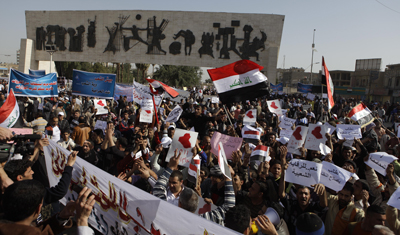
Security forces prohibited cameras from entering Baghdad’s Tahrir Square, where there were thousands of people protesting, according to news reports and local journalists. Police confiscated tapes that reporters managed to shoot in the square, according to Al-Jazeera.
Al-Jazeera reported that dozens of journalists were detained in central Baghdad today. Four journalists for Iraqi news outlets, Husam Serail, a reporter for Al-Sabah newspaper, Ali Abdul Sada, a reporter for Al-Mada newspaper, Hadi al-Mahdi, an anchor for Radio Demozy, and Ali Sumerian, an editor for Al-Sabah, were arrested, according to news reports. They were taken to an unknown location, local journalists told Al-Sumaria News website. The journalists said “a military force raided Al-Taraf restaurant in downtown Baghdad and arrested the four journalists after beating them.”
Military and security forces detained Al-Sumaria News photographers Ali Jasem and Safa Hatim, and correspondents Sinan Adan and Idriss Jawad while they were covering demonstrations in Baghdad, according to Al-Sumaria News. Anti-riot forces also raided the offices of Al-Diyar satellite TV station in Baghdad and detained 10 of its staff members for three hours, according to Al-Diyar’s website. In the afternoon, anti-riot police stormed the office for a second time, prohibited the staff from entering the building, and detained at least three more employees.
Niyaz Abdulla, a correspondent for Radio Nawa and a volunteer for Metro Center, a local press freedom group, was assaulted today while covering demonstrations in Erbil. “I was on the air when a plainclothes security officer came and started threatening me,” she told CPJ. The officer threatened to call over men to attack her, alluding to a potential sexual assault. “I stayed calm but it was very disturbing,” Abdulla said. She added that two of her colleagues had their cameras confiscated while they were covering the demonstration.
In Karbala, anti-riot forces attacked Afaq and Al-Salam satellite channels crews, according to news reports. “They were beaten and cursed at while they were covering the march in Karbala,” Jihad Jaafar, a correspondent for Afaq channel told Noun news website. He added that the tapes of the crews were confiscated.
In Yemen, security forces attacked an unidentified cameraman for Suhail opposition TV channel and detained at least four journalists while they were covering demonstrations in Al-Mansoura in Aden Governorate, local journalists told CPJ. Security forces detained freelance journalists Marzouq Yasin, Abdel Rahman Anis, Bassim al-Shaabi, and Fares al-Jalal, while they were covering protests in Mansoura for various websites. Security forces also prevented an Al-Jazeera crew from reaching the demonstrations near Sana’a University, the Qatar-based station reported.
In Libya, foreign journalists entering the country from Tunisia tweeted that their cameras, hard drives, and SIM cards were confiscated by border patrol guards. Paul Danahar, a BBC journalist reporting from Tunisia-Libya border, said that Suresh Kothia, “an Indian who just arrived from Libya,” told him that “at the last checkpoint the Libyan army took everyone’s phone SIM cards and computer hard drives to stop images of the uprising getting out.” Kothia told Danahar that equipment was broken and thrown to the ground.