|
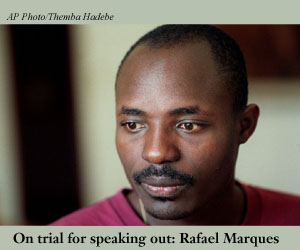 New York, March 31, 2000 — A Luanda court today convicted Angolan journalist Rafael Marques of defaming President José Eduardo dos Santos in an October 1999 article. Marques was sentenced to six months in prison, but the sentence was suspended pending appeal, sources in Luanda told CPJ. New York, March 31, 2000 — A Luanda court today convicted Angolan journalist Rafael Marques of defaming President José Eduardo dos Santos in an October 1999 article. Marques was sentenced to six months in prison, but the sentence was suspended pending appeal, sources in Luanda told CPJ.
Marques was released on US$200 bail to await a Supreme Court ruling on the appeal filed by his lawyer, Anacleta Perreira, alleging due process violations. It is not clear when the court will issue its ruling.
Aguiar dos Santos, the publisher of Agora and Marques’ co-defendant, was sentenced to two months in prison and fined approximately US$6000. He is free on bail pending appeal. The third defendant in the case, Agora staff reporter Antonio José Freitas, was cleared of all charges.
Marques was arrested on October 16, 1999, at his Luanda home, and charged with defamation in connection with an article titled “The Lipstick of Dictatorship,” which ran under his byline in the July 3, 1999, edition of the independent weekly Agora. In the article, Marques charged that Angolan president José Eduardo dos Santos was responsible for “the destruction of the country . . . (and) for the promotion of incompetence, embezzlement and corruption as political and social values.” Marques also referred to dos Santos as a “dictator.”
While in jail, Marques was denied access to a lawyer and to his family. He went on hunger strike for eight days to protest his illegal detention and was finally released on bail on November 25, on condition that he not leave Luanda, contact journalists, or make public statements.
Presided over by former secret service officer Joaquim de Abreu Cangato, the Marques trial opened on March 6 and proceeded in near-secrecy throughout the month. On March 22, defense lawyer Luis Nascimento walked out of the courtroom to protest the unfairness of the proceedings. Judge Cangato subsequently ordered that Nascimento be disbarred for six months, even though such a decision can legally be taken only by the Angolan Bar Association.
Marques, 28, began his career in 1992 at the government-owned Jornal de Angola, which he left in October 1998 for the independent paper Folha 8. Besides his work as a free-lance journalist, Marques is Angola coordinator for the Open Society Institute. He is also a stage actor and a poet. His first collection of Portuguese poems, In the Heart of The Enemy, was published in 1998.
PREVIOUS BULLETINS IN THE MARQUES CASE
Prosecution witnesses claim Marques conspired to destroy regime
New York, March 29, 2000 — Prosecution witnesses in the trial of Angolan journalist Rafael Marques claimed yesterday that Marques had humiliated the government of President Eduardo dos Santos, tarnished the honor and dignity of the president himself, and demoralized the Angolan army, all by publishing an article in which he described President dos Santos as a “dictator,” according to CPJ’s sources in Luanda.
The Marques trial resumed yesterday and continued today in the Provincial Criminal Court of Luanda. It will probably conclude on March 31, sources in Angola told CPJ. Presided over by Judge Joaquim De Abreu Cangato, yesterday’s hearing lasted from 11 a.m. to 10:15 p.m. without a break.
Marques is being tried in secrecy and without benefit of legal representation. On March 23, Judge Cangato illegally disbarred Marques’ lawyer, Luis Nascimento, after Nascimento walked out the courtroom to protest the judge’s refusal to hear an appeal he had filed to the Supreme Court of Angola on account of procedural irregularities in the trial. Nascimento has not been allowed back into the courtroom since then.
During yesterday’s closed hearing, Marques was allowed to call just one witness, Fernando Macedo, an Angolan human rights activist, according to sources inside the courtroom. Judge Cangato quickly dismissed Macedo’s deposition, which questioned the constitutionality of the charges against Marques. The judge subsequently ordered Macedo to leave the courtroom and “discuss those issues elsewhere.”
Testifying for the prosecution, José Leitão, director of President dos Santos’s cabinet, and Aldemiro Vaz de Conceiçao, the president’s spokesman, stated that Marques’ criticism of the head of state had gone “beyond the limits of free expression.” They charged that the journalist had tarnished the honor and dignity of the president and had humiliated the Angolan regime.
The two government officials further accused Marques of belonging to an international conspiracy obsessed with destroying the dos Santos government, and claimed that Marques’ writings have had the effect of “demoralizing the army” in its war effort against UNITA rebels led by Jonas Savimbi.
The prosecution also submitted as evidence a letter that Marques sent earlier this year to the president of the Angolan Parliament, protesting death threats issued against him by Mendes de Carvalho, a legislator from the ruling MPLA party. Carvalho had publicly warned that Marques, 28, would not live to the age of 40 if he continued to criticize the regime.
In his closing argument, Rui Ferreira, a lawyer for President dos Santos, urged Judge Cangato to be tough in his ruling since Marques had shown no signs of regret for his actions and had refused to “cooperate” in court. Ferreira recommended that “destabilizing the army” be added to the charges and that Marques be imprisoned for the longest time possible.
Marques trial lawyer walks out after being denied right to read appeal motion
March 23, 2000 — The trial of Angolan free-lance journalist Rafael Marques, which resumed today in the Provincial Criminal Court of Luanda, was again adjourned to March 28 amid ominous signs of miscarriage of justice, sources in Angola told CPJ.
On March 22, Marques’ lawyer Luis Nascimento appealed to the Supreme Court of Angola on grounds of procedural irregularity. In court this morning, however, Nascimento was denied the right to read the appeal for the record. In protest, he walked out of the courtroom.
Judge Joaquim de Abreu Cangato, who apparently has no legal training, subsequently ruled that Nascimento be disbarred for six months, despite the fact that only the Angolan Bar Association can legally make such decisions.
Marques, who refused to answer questions without legal representation, was offered the option of a public defender, which he declined. Judge Cangato then ordered an unnamed court official, who also has no legal training, to take over Marques’s defense with or without Marques’ approval, CPJ sources said. The judge then adjourned the proceedings until March 28, when the prosecution is scheduled to present its witnesses, even in the absence of the defendant.
Marques trial adjourned to March 23 amid growing doubts about fairness
New York, March 21, 2000 — The trial of Angolan free-lance journalist Rafael Marques, which was last adjourned on March 10, resumed today at 9:30 in the Provincial Criminal Court in Luanda, sources in Angola told CPJ.
After 30 minutes, Judge Joaquim de Abreu Cangato excluded the public from the courtroom. Officials from the US and Portuguese embassies, several human rights activists, and journalists were among those in attendance, until they were all forced to leave. Judge Cangato has no legal training, according to CPJ’s sources.
The trial continued all day in secrecy. At the end of the hearing, a visibly exhausted Marques told friends and reporters outside the courtroom that the trial had been adjourned until Thursday, March 23.
Judge Cangato has been presiding over the Marques trial since it began in early March. A former member of the Angolan secret police, Cangato has apparently never studied law or any related discipline.
Marques’ judge has no legal training, sources say
New York, March 20, 2000 — Judge Joaquim de Abreu Cangato, who has been presiding over the trial of Angolan free-lance journalist Rafael Marques since it began in early March, has no legal background, according to CPJ’s sources in Luanda.
Cangato, a former member of the Angolan secret police, has never studied law or any related discipline, CPJ’s sources say.
Marques and two co-defendants have been charged with criminal defamation for writing critically about President José Eduardo Dos Santos. His trial resumes tomorrow in the Provincial Criminal Court of Luanda.
The trial was adjourned on March 10, after lawyers for Marques’ co-defendant Aguiar Dos Santos, publisher of the independent newspaper Agora, argued that they had not been given sufficient time to prepare their client’s defense. Dos Santos, who is not related to President Dos Santos, failed to appear at the hearings. The third defendant in this case is Antonio José Freitas, an Agora staff reporter.
Marques trial adjourned until March 21
New York, March 10, 2000 — The trial of Angolan free-lance journalist Rafael Marques, which began yesterday in Luanda before a packed audience of local and international observers, was adjourned until March 21 pending a Supreme Court ruling on an appeal filed by the defense, sources in Luanda told CPJ.
The trial was supposed to take place in the Supreme Court. But when the defendants arrived at the Supreme Court yesterday morning, they were informed that their case had been referred back to the Provincial Criminal Court in Luanda.
The appeal, initially rejected by a Luanda criminal court, was filed to the Supreme Court of Angola by lawyers for Aguiar Dos Santos, Marques’ co-defendant and publisher of the independent weekly Agora. Dos Santos’ lawyers argued that they had not been given sufficient time to prepare their defense, a right guaranteed by the Angolan Constitution. Dos Santos did not appear at the hearings. [Aguiar Dos Santos is not related to President José Eduardo Dos Santos.]
Criminal Court judge Joaquim de Abreu Cangato, who appeared nervous throughout the hearing, agreed to adjourn the trial. He dismissed the prosecutor’s argument that the defendants were not entitled to normal constitutional protections because they were accused of an exceptional “crime against the state,” under Article 46 of the 1920 press law, for defaming President José Eduardo Dos Santos. The judge also ruled that the hearings will be held publicly, against the wishes of the prosecutor and President Dos Santos’ attorney, who had argued that defendants charged with defaming the head of state must be tried in secrecy.
Marques and his two co-defendants were forced to stand throughout the two-hour hearing. The Supreme Court is expected to rule on the Aguiar Dos Santos appeal next week.
Marques’ lawyers will offer “truth defense” in tomorrow’s trial
New York, March 8, 2000 — Defense lawyers for Angolan free-lance journalist Rafael Marques, whose trial on defamation charges begins tomorrow in the Supreme Court, will raise both substantive and procedural arguments for dismissal, according to CPJ’s sources in Luanda. Marques is the defendant in a lawsuit brought by President José Eduardo Dos Santos.
On the procedural front, defense lawyers will seek to nullify the proceedings on the grounds that neither Marques nor his two codefendants have been duly instructed of the charges that they face. In particular, the prosecution has never specified what part of Marques’ writings are allegedly libelous. Nor do the charges specify the legal provisions under which the three defendants are being charged.
If this argument fails, Marques is expected to offer a detailed explanation of his writings, in order to support the argument that his work was intended solely to criticize the political behavior of Angola’s ruler, and that no opinion was expressed about Dos Santos’ moral behavior as an individual. In other words, Marques’ criticisms were directed at the president’s performance of his public duties, and not at his honor as a private Angolan citizen.
In blaming widespread corruption and incompetence in the Angolan administration on President Dos Santos’ leadership, Marques was simply exercising his constitutional right to express political opinions. In the unlikely event that the president accepts Marques’ explanation, the trial will be over.
If the president does not accept Marques’ explanation, the defense is expected to argue that Marques’ descriptions of the president’s corrupt and incompetent administration are not libelous because they are true. The defense will submit as evidence, among other items, many writings of President Dos Santos in which the plaintiff denounces corruption in Angola, and ask that he take the stand to testify on the issue. In the even more unlikely event that the president agrees to testify, he will also be asked to comment on the verbal abuse of Marques by several government officials, and to state whether he condones these attacks.
Angolan legal experts say it is doubtful that the court will accept this “truth defense,” since Angolan press law forbids defense by truth when the plaintiff is the president. The defense may then argue that this provision is incompatible with the Angolan Constitution as well as Article 19 of the Universal Declaration of Human Rights, which states that everyone should have the right to freedom of expression and access to information. At the very least, truth must be a defense in the case of writings that address the president’s political behavior and performance, as opposed to his personal life.
Marques trial to begin Thursday
New York, March 6, 2000 — Freelance journalist Rafael Marques is preparing to stand trial for criminal defamation, because he dared to describe President José Eduardo Dos Santos as a “dictator.” Marques, whose trial date has been repeatedly postponed, most recently from March 7 to March 9, has been charged under Angola’s notorious Law 7/78, also known as the Law on Crimes Against State Security, which was widely used against anti-colonial militants before independence in 1975.
Under Law 7/78, according to Angolan legal experts, hearings on libel proceedings may be held in secrecy, under the rationale that giving the allegedly defamatory writings more publicity would be a further invasion of the plaintiff’s right to privacy. Marques’ lawyers have argued that because the plaintiff is not an individual, but rather the Office of the Presidency, the issue of privacy does not arise.
Law 7/78 further stipulates that when the victim is a public official, as in this case, the truth of the allegations is not a valid defense against libel charges. This means that Marques’ lawyers will not be allowed to submit evidence in support of the allegations for which he has been charged. These rules are clearly inconsistent with minimum standards for due process, including presumption of innocence. If they are applied, the Marques trial will be a travesty of justice.
The trial has attracted a number of journalists, jurists, NGO and human rights activists to Luanda. It is not yet clear whether international observers will be allowed to attend the trial. The Supreme Court’s decision on this matter will further test the legitimacy of the trial itself.
CPJ will be monitoring developments closely, with the assistance of correspondents in Luanda.
|