July 17, 2000– Earlier this month, CPJ Vice Chairman Terry Anderson visited Moscow as a member of an international delegation of press freedom advocates. The delegation met with a consortium of Russian journalists and officials to voice concern over the increasing number of attacks on the Russian media.
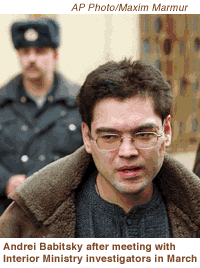
On July 12, Anderson spoke with Russian reporter Andrei Babitsky. Anderson, former chief Middle East correspondent for The Associated Press, was held in Lebanon in captivity for nearly seven years. Early this year, Babitsky, who reports for Radio Liberty, was captured and held for 40 days, as a result of his reporting on the war in Chechnya. Babitsky is now in Moscow, but authorities are restricting his travel. On July 4th, he was formally charged with carrying a false passport, and he is expected to go on trial in August.
[For more background concerning the Babitsky case, read Robert Coalson’s article for CPJ.]
The two journalists spoke about their common experiences of war reporting and of being kidnapped and held in captivity.
Anderson: First of all, we’re very pleased that you were released. Your case caused an enormous outcry because it was so patently unfair and ridiculous. It embarrassed the Russian government very much, I think, overseas. I’m glad you’re free.
What is your judgment of where things are going at the moment?’ 
Babitsky: In my opinion, [Russian President Vladimir] Putin’s political nature has yet to be fully defined. It’s my impression that he’s a person who lacks the ability to see the human consequences of his actions. The Chechen war, in my view, has had an enormous impact on the general atmosphere of the state, because of the fact that the many crimes which were committed there have been covered up by the authorities. There have been no open investigations, no prosecution of the guilty parties, of those who carried out extremely serious crimes, such as mass killings of civilians. Everything has been kept from the general public.
In such conditions, it’s natural that the military feels it can act with impunity, without fear of punishment, and to a great extent the power structures also feel they can act outside the law. What happened to me was characteristic of this atmosphere; force was the method used against me, I was forced out of the country. All this is something we haven’t seen for many years, not since the days of the Soviet Union.
Anderson: You were, of course, accused by the administration of being a Chechen sympathizer, a traitor. What do you say to that charge?
Babitsky: How are we to understand patriotism – as giving the state the right to murder innocent civilians? That is not an understanding of patriotism that I feel close to.
Anderson: What are your personal circumstances now? I understand that you can’t work, that you’re still living under restrictions. What is happening to you now? Do you have any financial means of support?
Babitsky: I’m continuing to work at Radio Liberty as an analyst. It’s not exactly my genre, though I have in the past worked for quite a long time as an analyst, and I have also tried other journalistic genres. The investigation is now over, and the charges are in place, and there should be a trial in a month and a half. The lightest of the charges is likely to be that I used a fake passport – but that passport was given to me.
Naturally, I’m not able to work as a reporter at the moment, because Chechnya is closed to me, and I also have serious problems with Russian officials who all have a similar opinion of me, since the president called me a traitor in public. However, I do think this period will pass.
Anderson: Has this episode changed anything about your attitude towards your job? You’ve said you’re a reporter, not an analyst. Do you still feel as committed to reporting in the field as you always were?
Babitsky: Something has changed. I always had a sense that even colossal, dramatic events could change if a journalist were to tell the truth about what is happening. I’ve been witness to certain things which I cannot call other than crimes. I won’t list them, but I have seen with my own eyes mass killings of peaceful civilians, and what I have witnessed has shocked and shaken me. I thought the authorities were capable of change, I thought perhaps they simply didn’t know the truth, and that if they knew what they were doing, if they knew how the messages which they were sending were being put into action, then perhaps slowly things would change. But now I see that the authorities are simply trying to hide their annoyance at the fact that the “truth” which they formulated is so clearly at odds with the reality, with the truth of the victims of this war.
Perhaps it can be explained by the youth of the authorities. I feel very sad, and I don’t know if I’m completely right, but I have the feeling that this is a state which does not have a sense of the value of human life, that it thinks that the state can only become strong through cataclysms and tragedy. A high price for this will be paid, however. Sooner or later the authorities will have to bear responsibility for the crimes which have been committed. Otherwise, Russia will never emerge from its current situation where it is ruled by force.
Anderson: What about you, though? Would you do it again, if there was another war, God forbid? Would you cover it?
Babitsky: To be honest, I’m not really a war correspondent. I just went there. I was in Chechnya for the second time because I understood that what happened there had a direct impact on the future of my country, and I did not want blood to be spilled on its far borders, because I understood that spilled blood produces a certain chain reaction. I don’t find war reporting particularly interesting. There are other subjects that arouse my curiosity far more, and I shall be looking into those possibilities.
Anderson: When I came home from Lebanon, I decided not that I did not love journalism any less, or think it was less important, but that I wanted to do other things, that I wanted to be less of an observer and more of a participant. Do you have that feeling?
Babitsky: My story is not yet over. To a great extent my fate is still directed by the authorities. Of course, my views and my impressions of life are my own, but my personal fate is in the hands of the authorities. The trial hasn’t yet taken place, and I am without vital documents, so I’m in a difficult position, and I shall probably think about my future later when the final act has at last been played out.