Twenty years after the Khmer Rouge genocide, Khmer journalism is showing signs of life.
Phnom Penh — Recently, the Kingdom of Cambodia’s biggest daily newspaper splashed three photographs on its front page. Two were of corpses: an eight-year-old girl who had been murdered by robbers for the equivalent of US$10, and a municipal official killed in a dispute with a local company. The third image showed 17 young thugs who had been arrested for gang-raping a female market vendor.
When asked why he ran such gruesome pictures, the editor of Rasmei Kampuchea (“Light of Kampuchea”), which is widely considered among the most responsible newspapers in the Kingdom, answered that his main competitor always ran graphic picture spreads to attract readers. (Cambodian editors often buy their grisly images from the police.) Unless he followed suit, he said, his circulation would drop. 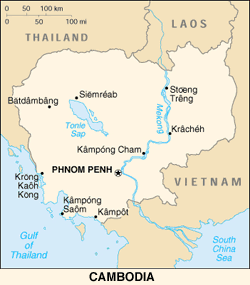
On the same day that the pictures mentioned above appeared in Rasmei Kampuchea, Khieu Khanarith, a former communist-era newspaper editor who is secretary of state for information in the ruling Cambodian People’s Party (CPP) government, threatened to suspend two newspapers for alleged violations of the country’s tough press law. It was the first time since 1998 that the government had issued such threats against the press. Not coincidentally, both papers were aligned with the opposition Sam Rainsy Party.
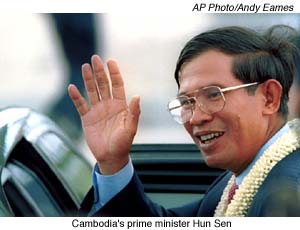
On his own authority, Khanarith ruled that articles in each of the two papers had insulted the government and the King and had the potential to incite race riots. Samlong Yuvachon Khmer (“Voice of Khmer Youth”) suggested in a news story that Prime Minister Hun Sen was either a “Vietnamese dog” or a “Chinese dog.” Monseaksekar Khmer (“Khmer Conscience”), ran an editorial complaining that Vietnamese immigrants thought Cambodians were lazy. “If Khmers are lazy, the Khmer king is lazy, too,” the editorialist wrote.
The articles were not unusually irresponsible by the journalistic standards of Cambodia, where opinion and invective often pass for news. Most observers in Phnom Penh agree that the dominant pro-government media frequently print equally questionable stories but are rarely, if ever, sanctioned. The threats were dropped, at least for the time being, after both papers formally apologized to the government. Even so, the incident highlights the continued vulnerability of the Cambodian press.
In the last two years, Cambodia’s 20-year nightmare of violence, spawned by the spillover of the Vietnam War, has largely abated. Reporting from Phnom Penh on Cambodia’s newfound political stability, New York Times reporter Seth Mydans noted that “many people here see glimmers of hope as the government–both aided and pressured by foreign donors–begins to lay the groundwork for change. An active and liberal civil society has begun to take root, a functioning government administration is being mapped out, and the traumas of the past are beginning to be tentatively addressed.”
The Cambodian press has suffered its share of traumas. As part of their genocidal campaign to impose radical agrarian socialism on Cambodia, the Khmer Rouge killed most of the country’s intellectuals between 1975 and 1979, including almost all journalists. In 1995, the president of the Khmer Journalists Association said that he knew of only ten living Cambodian journalists who had worked as journalists before 1975, the year Pol Pot seized power.
The Cambodian press today may not be particularly responsible, but it is lively and largely fearless. Given the recent history of Cambodia, this is an achievement in itself.
Dark past, shaky present
After a Vietnamese invasion ousted Pol Pot in 1979, the country struggled through 12 years of civil war and Leninist rule under the communist regime of Hun Sen. The 1991 Paris Peace Accords mandated that the international community should oversee Cambodia’s transition from a totalitarian to a more democratic society, giving the United Nations Transitional Authority in Cambodia (UNTAC) a broad mandate that included keeping the peace and administering democratic elections in 1993. To date, this transition has been rough and incomplete.
Starved for talent after years of civil war and emerging from the shadows of one of history’s darkest regimes, Cambodia’s press was in dire straits in 1991. The few practicing journalists had either worked for state-owned media under the strict guidance of the communist government, or been part of the partisan opposition press, much of it based abroad or in refugee camps along the Thai border and backing various armed factions opposed to the CPP.
Pnomh Penh boasts a number of printing presses now, but there was no media infrastructure to speak of in 1991. Newspapers had to be printed in Thailand and shipped into Phnom Penh. And a communist culture of control had to be reformed almost overnight with few guidelines beyond the 1993 Constitution’s UN-imposed press freedom provision. 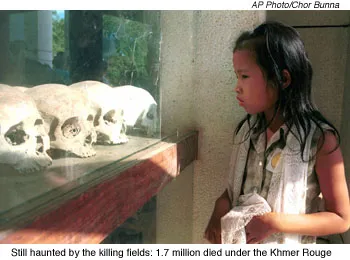
That same year, UN-sponsored elections brought Prince Norodom Ranariddh’s National United Front for an Independent, Neutral, Peaceful and Cooperative Cambodia (FUNCINPEC) to power in an uneasy coalition with Hun Sen, who served as second prime minister under Ranariddh.
In July 1997, Hun Sen ousted Ranariddh in a coup, negating the results of the 1993 election. After the coup, dozens of pro-opposition journalists fled the country. At the same time, Cambodia’s most widely-recognized press organization, the Khmer Journalists Association, effectively ceased to exist when its chairman, Pin Samkhon, went into exile. That year also saw the pullout of the United Nations Transitional Authority in Cambodia (UNTAC), the body that the 1991 Paris Accords mandated to keep the peace and administer democratic elections.
Somewhat paradoxically, UNTAC was also supposed to establish a free press. Since 1991, the international community has spent millions of dollars to train local journalists and encourage free expression in Cambodia. Even so, local media are rarely professional or independent by international standards. Radio and television are essentially controlled by the state, and there is no functioning press association to promote editorial independence and establish ethical guidelines.
Most observers believe wild headlines and unsourced stories contributed to the political tension that very nearly plunged Cambodia back into the darkness of its political past, especially during the Ranariddh/Hun Sen coalition period from 1993 to 1997. “Ranariddh Is Three Times as Stupid As Hun Sen Twice a Day,” blared one famous headline a couple of years ago. “Don’t Invest in Cambodia Because Hun Sen is the Biggest Thief,” countered a headline from the same period. To this day, pro-opposition papers routinely describe CPP politicians as crooks and tools of the Vietnamese, while pro-CPP papers accuse opposition leaders of being stupid and corrupt.
But Cambodian hacks are not to blame for the broader problem of impunity in a country where corrupt courts and judges allow many crimes to go unpunished. Although the 1993 Constitution guarantees press freedom, no one has ever been prosecuted for killing a journalist in Cambodia, and many reporters live in fear of being attacked for what they write.
In 1994, unknown gunmen killed the editor of Samlong Yuvachon Khmer, Nun Chan, after government officials made a series of public threats against him. In 1995, the paper was suspended for several weeks and its new editor arrested after he published articles critical of Second Prime Minister Hun Sen. Since then, four more journalists have been killed in Cambodia. Many others have survived violent attacks, and several newspapers have been closed by state fiat.
Broadcast blues
Cambodian newspapers may not be particularly responsible, but they are unbridled to a degree rarely seen in most countries. Broadcast media, however, remain under firm state control. And while most analysts agree that print media have remained free in large part due to international pressure, that pressure has yet to yield results in radio and television.
 The Hun Sen government exercises formal and informal control over electronic media, withholding licenses from its opponents and granting them to its allies. With the exception of one very low-power radio station in Pnomh Penh, run by the Women’s Media Center, and businessman Mam Sonando’s iconoclastic Radio Beehive, Cambodia’s airwaves are dominated either by the government or by its allies. Meanwhile, the Sam Rainsy Party, the principal opposition voice in Cambodia, has repeatedly been denied permission to open a radio station.
The country’s six television stations once carried innovative public affairs programming, including one program on state TV that allowed callers to question government ministers on the air. That show was cancelled in 1995, and today self-censorship rules the airwaves. Local broadcasters even ignore major news stories such as the 1998 death of Pol Pot, which was splashed in local newspapers but went unreported on Cambodian radio and television, according to Michael Hayes.
This electronic vacuum is partly filled by Khmer-language short wave broadcasts from the BBC and the Washington-based, U.S. government-funded Voice of America and Radio Free Asia (whose Cambodian programming director is Pin Samkohn, the exiled former head of the Khmer Journalists Association). While the Hun Sen government has been more tolerant of such broadcasting than neighboring Vietnam and Laos, there are limits to its patience. Earlier this year, for example, the Ministry of Information abruptly cancelled a deal that would have given Radio Free Asia an FM transmitter site in Cambodia.
The bottom line
The Cambodian press is deeply politicized because most newspapers depend on the patronage of political actors for their survival, “No Khmer [-language] paper makes money, so everything is subsidized by somebody,” says Michael Hayes, the American publisher of the biweekly, English-language Phnom Penh Post. There are 200 licensed publications in the country, and some 30 newspapers that publish regularly in Phnom Penh. But only a few papers raise significant sums from advertising. Norbert Klein of Open Forum Cambodia, an NGO that monitors the local press, estimates that 99 percent of local advertising revenue goes to just ten newspapers. Rasmei Kampuchea alone accounts for 23% of the Cambodian newspaper industry’s total ad sales. 
Rasmei Kampuchea launched in 1993 as a joint venture between a Thai media group and Theng Bun Ma, a powerful businessman and Hun Sen ally. But when the Asian economic crisis forced the Thais to give up their investment in 1997, the paper was strong enough to continue on its own. While Rasmei remains pro-government, it is arguably the closest thing Cambodia has to a balanced Khmer-language broadsheet. Its editor, Pen Samithy, is credited with trying to train a professional newsroom staff. Samithy freely acknowledges his personal links to the old CPP (he was trained in journalism in Moscow in the 1980s). But he also claims that he is now free to criticize the CPP, and that he has done so in print.
By all accounts, the general standard of Cambodian journalism has improved in recent years, although reading the morning paper can still be a hair-raising experience. Several Khmer-language newspapers have openly accused Hun Sen’s wife of being a former prostitute and a murderer. Recently, a Cambodian paper ran a so-called investigative story that falsely accused Vietnam and Thailand of supplying Cambodia’s anti-AIDS program with HIV-impregnated condoms. “I’ve never seen a country where the word enemy is used so often,” Hays says.
Despite progress in the Khmer-language press, two foreign-owned, English-language publications continue to serve as de facto newspapers of record and training grounds for Khmer journalists. The Cambodian Daily, technically owned by an NGO and able to attract some outside funding, was started in 1994 by Bernard Krisher, a former Newsweek correspondent based in Tokyo. Krisher has attracted an eager staff of young expatriate journalists who work long hours for low pay in exchange for the chance to build a reputation by covering an exciting story. The paper maintains high editorial standards, prints a few pages in Khmer, and employs a handful of local journalists.
Along with the Phnom Penh Post, which launched in 1993, the Daily is must- reading for expatriates and Cambodian intellectuals in Phnom Penh. The Post, which is operated as a private concern, may be the only newspaper in Cambodia that is completely supported by advertising and newsstand sales. It has also been a training ground for local and foreign journalists, and has built an international reputation for breaking important stories. Both papers are relics of a more optimistic era, when foreign companies thought there was money to be made in Cambodian media, but their persistence has been crucial in providing a source of fair-minded reporting in a politically charged environment.
Both papers have also had an uneasy relationship with the government; as recently as late 1998, Khieu Khanarith threatened to shut them down and expel their journalists from the country. International pressure, including vocal protests from the Committee to Protect Journalists and the direct intervention of the U.S. ambassador to Cambodia, prevented the government from acting on the threat.
Happy days ahead?
In the years following the Paris Peace Accords, armed conflict continued in many parts of the country, occasionally flaring into open warfare, either between the Khmer Rouge and the central government or between FUNCINPEC and the CPP, as happened for several months following the 1997 coup.
After the death of Pol Pot in late 1998, the Khmer Rouge collapsed. As a result, Cambodia is at peace for the first time in more than 30 years, and that fact alone gives local journalists grounds for hope. “I hope the peace lasts,” says Ker Muntit, a leading Cambodian reporter who works for The Associated Press in Phnom Penh. “I am so tired of reporting on the Khmer Rouge.”
Several months after the disputed elections of July 1998, Prime Minister Hun Sen formed a coalition government that allowed him to consolidate the power he had seized in the 1997 coup. Prince Ranariddh, currently president of the National Assembly and a potential successor to the throne of his ailing father, King Norodom Sihanouk, has reached a personal compromise with Hun Sen. As a result, the media proxy fights of the recent past have died down.
Given the strides made in expanding free expression in Indonesia and Thailand in recent years, the Cambodian government’s restrictive media policies seem increasingly anachronistic. The regional Southeast Asian Press Alliance (SEAPA), which includes press organizations from Thailand, the Philippines, and Indonesia, has opened informal discussions with Khmer journalists aimed at assisting in the development of an independent press association. And a new weekly newspaper, Sakarach Thmei, has drawn attention for its attempts to maintain a politically independent editorial line. “We have to have an independent press,” says Ham Hak, the paper’s young editor.
A. Lin Neumann is based in Bangkok as a consultant on Asian issues to the Committee to Protect Journalists. He is also an advisor to the Southeast Asian Press Alliance.