The UN and the Indonesian government both think they know who killed two journalists in East Timor last year. So why aren’t the suspects on trial?
November 3– On Nov.1, a little more than a year after the murder of freelance journalist Sander Thoenes in East Timor, friends and colleagues gathered for an afternoon of personal and professional remembrances at Hampshire College in Amherst, Mass.
Thoenes, one of 34 journalists killed because of his work last year, was a 1992 graduate of Hampshire College. He built a career as a freelance foreign correspondent, reporting from Russia, Kazakhstan, Uzbekistan, Turkmenistan and Afghanistan. At the time of his death, he was the Jakarta correspondent for the Financial Times; he also wrote for other media, including the Christian Science Monitor, which in March published an investigative series on an Indonesian military battalion allegedly responsible for at least 20 killings and disappearances in East Timor — including the murder of Sander Thoenes. (Here is the link to the CSM series: http://www.csmonitor.com/atcsmonitor/specials/timor/index.html.)
“Sander was a seeker after truth. He had a strong sense of justice and injustice,” his Financial Times editor, Quentin Peel, told the gathering. Jay Rosen, chair of New York University’s Department of Journalism and Mass Communication, said Thoenes “was willing to be outraged by injustice, violence, arrogance, corruption. He was also willing to hope that they weren’t necessary for society to advance.” Others who offered perspectives on Thoenes and dangerous assignments for journalists were: Hampshire professor Stephen Jones; Thoenes’ fellow students Andrew Forsyth, Hasok Chang, and Sandy Wolofsky; Susan Bennett, director of Asian and European Programs for The Freedom Forum; and Ann Cooper, executive director of the Committee to Protect Journalists.
Cooper outlined the findings of “Justice Delayed,” a CPJ examination of the Thoenes case and the murder of Asia Press International reporter Agus Muliawan, who was killed in East Timor four days after Thoenes.
NEW YORK, — Just over a year ago, on September 21, 30-year-old free-lance reporter Sander Thoenes arrived at the airport in Dili, the capital of East Timor. That same afternoon, he was gunned down by men wearing Indonesian army uniforms.
Four days later, on September 25, armed men executed nine civilians at a roadblock near Los Palos. Among the dead was Agus Muliawan, a Balinese reporter for the Tokyo-based news agency Asia Press International. He was 26 years old.
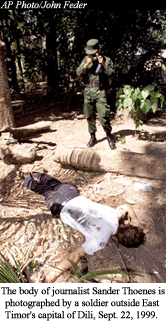 In the past year, United Nations and Indonesian government investigators have accumulated substantial evidence indicating that soldiers from Indonesia’s notorious Battalion 745 murdered Thoenes, a Dutch reporter who contributed to The Christian Science Monitor and The Financial Times. Equally strong evidence is said to link members of the Indonesia-backed East Timorese militia Tim Alfa to Muliawan’s murder.
Although a United Nations commission announced in January that an international criminal tribunal should be authorized to investigate and prosecute war crimes in East Timor, UN secretary general Kofi Annan has favored giving Indonesia time to carry out its own prosecutions. But the United Nations Transitional Authority in East Timor (UNTAET) has not abandoned its own legal proceedings, with the result that parallel justice efforts are being pursued in Indonesia and East Timor.
In Indonesia, a high-profile effort led by Attorney General Marzuki Darusman has been held up by military intransigence and the sluggish pace of legal reform. Meanwhile, international efforts in East Timor have been stalled for most of the year, as the United Nations, which is administering the territory in the interim period before full independence, builds up legal institutions from scratch.
Death in East Timor
Thoenes and Muliawan were among more than one thousand victims, according to UN estimates, of lethal violence that erupted after East Timor’s August 30 vote for independence from Indonesia. As anti-independence militias went on the rampage with support from the Indonesian military, journalists covering the historic vote were forced to flee, ensuring that the outside world missed much of the violence. Attacks against journalists were clearly part of a cynical campaign to blind the international community to the horrors committed in East Timor.
Two eyewitnesses to Thoenes’ murder, the journalist’s motorcycle taxi driver and a local farmer, have said that soldiers wearing the insignia of Indonesian army battalion 745 fired on Thoenes in the Dili suburb of Becora during the afternoon of September 21. When the motorcycle driver, Florindo da Conceicao Araujo, swung around to retreat from a spray of bullets, both men fell off the bike. As Araujo fled on foot, he looked back and saw Thoenes lying in the middle of the road.
 Becora farmer Alexandre Estevao, who witnessed the incident from a hiding place, told The Christian Science Monitor that the soldiers shot at Thoenes and later dragged him off the road. Peacekeeping troops found the reporter’s body the next day. Thoenes died of a gunshot wound through the back, but the killers had also sliced off his left ear and made several cuts in his face, according to an Australian coroner’s report released on January 27, 2000. This mutilation is said to be a signature of Battalion 745, which was active in the area at the time of Thoenes’ murder.
The view from Jakarta
Indonesia’s attorney general designated Thoenes’ murder as one of five top-priority cases for a special investigations team formed on April 19, 2000, two-and-a-half months after Indonesia’s National Commission on Human Rights (Komnas-HAM) issued its report on abuses in East Timor. Though the team questioned Battalion 745 commander Lt. Col. Yacob Sarosa, he flatly denied any involvement in Thoenes’ death.
On September 1, the team released a list of “possible suspects” to be questioned about their alleged roles in the post-referendum violence, though no one was formally indicted. Conspicuously absent from this list of initial suspects was General Wiranto, then supreme commander of the Indonesian armed forces. Wiranto had been ousted from the Cabinet by President Abdurrahman Wahid in February, shortly after Komnas-HAM implicated him in the East Timor violence.
Also missing from the list was any mention of Battalion 745.
The head of the investigation team, M.A. Rahman, told reporters at a press conference that those on the list were only “initial suspects,” and that new names may be added as more evidence is gathered.
But this process is further hampered by the military’s recalcitrance and the Indonesian investigators’ limited clout. Military officers, militia leaders, and key witnesses identified by the investigations team all routinely ignore summons for questioning. Perhaps more disturbing, in mid-August, army leaders used still-substantial political muscle to help push through a constitutional amendment that forbids the retroactive application of any laws, under any circumstances. Advocates fear the amendment may be used to protect the old guard from prosecution for crimes against humanity and other offences that are only now being incorporated into Indonesia’s legal code.
Back in Dili
Meanwhile, UN authorities in East Timor, mindful of the legal and political uncertainties that complicate Indonesia’s investigative efforts, are pursuing the Thoenes case independently. UNTAET general prosecutor Mohamed Claude Othman told CPJ that the case could be prosecuted in Dili if Darusman’s investigation breaks down.
Earlier this year, UN investigators tried to locate and interview Battalion 745 soldiers who might have witnessed Thoenes’ murder. “In Indonesia they have all the perpetrators, but the judicial system is traditionally known to be quite corrupt,” said Patrick Burgess, head of UNTAET’s human rights unit. “The people who gave the orders are going to be out of reach.”
The Muliawan case
Othman is also investigating the murder of Agus Muliawan, who was filming a documentary about the pro-independence East Timorese guerrilla group Falintil at the time of his death. Muliawan was traveling in a van with a group of nuns, priests, and aid workers. They were shot at close range by members of the Tim Alfa militia, who dumped their bodies into the Raomoko River near Los Palos.
Tim Alfa has acknowledged that it executed Muliawan: militia leader John Marquez told UN investigators that Indonesian soldiers pressured him to kill the journalist. “We believe… this was not a random assassination,” said Othman. “Obviously our viewpoint is that crimes against humanity were committed here… but we need to show the pattern, the linkages with [the military].”
Marquez and 70 other suspects in last year’s violence are currently imprisoned in Dili awaiting trial. Some have been jailed since December, mainly because East Timor only recently assembled the institutional framework needed to try them. Othman hopes to begin prosecutions by the end of the year, and he says the Muliawan case will be among the first to be tried.