CPJ documents Milesovic’s attempts to throttle the independent media. Including breaking news, bulletins, and background.
Background
Text of Serbian Information Law
Back to CHOKEHOLD main page
FILIPOVIC LINKS:
Institute for War and Peace Reporting: Filipovic case notes
CPJ Co-Founds International Committee To Support Jailed Serb Journalist
New York, August 29, 2000—In an effort to focus global attention on the plight of imprisoned Serb journalist Miroslav Filipovic, the Committee to Protect Journalists (CPJ) has joined with several other international press-freedom groups to form the Friends of Filipovic Committee. The new group will pressure Serb authorities to revoke the journalist’s conviction on espionage charges and release him from prison. It will also raise money to support Filipovic and his family.
Other founding members of the Committee are: the Institute for War and Peace Reporting (IWPR), the Index on Censorship, the Freedom Forum’s European Center, the National Union of Journalists (U.K.), and Reporters Sans Frontires. Several journalist groups from Serbia are also associated with the Committee, which is being chaired by former BBC war correspondent Martin Bell, an independent member of British parliament. (See the Friends of Filipovic Committee press release.)
On July 26, a Serb military court sentenced Filipovic, a leading Serb investigative journalist with the Belgrade independent daily Danas and a contributor to Agence France-Presse and the London-based IWPR, to seven years in prison on charges of espionage and dissemination of false information for his coverage of atrocities allegedly committed by Yugoslav Army soldiers in Kosovo.
Earlier this month, CPJ nominated Filipovic for the World Association of Newspaper’s Golden Pen of Freedom Award, which is awarded annually to an individual, group, or institution who exhibits an outstanding action, in writing or deed, in the cause of freedom of the press. “[We are] nominating Miroslav Filipovic for his courage and because his case highlights the fate of Serbian journalists who stay true to their profession and in so doing defy their government,” said CPJ’s nominating letter. “Filipovic is facing the consequences of his decision to write the truth, and he and his colleagues deserve support and solidarity from the outside world for their efforts in the cause of press freedom.”
Filipovic’s Sentence Appealed
Both Filipovic’s defense lawyer and the Nis military prosecutor have appealed the journalist’s prison sentence. Filipovic’s attorney argues that the evidence does not support the charges against Filipovic, and has asked the Military Supreme Court in Belgrade to annul the sentence. Meanwhile, the prosecutor has demanded that the sentence be increased by at least two years. The court announced it would consider the appeals during the first week of September.
Filipovic continues to be in poor health. During the past month of his detention, Filipovic has twice been admitted to military hospitals with heart trouble. His family says he needs surgery that is not available in Yugoslavia, according to IWPR.
Another Serbian Journalist Jailed for “Spreading False News”
New York, August 18, 2000—Serbian journalist Zoran Lukovic, a former reporter for the banned Belgrade daily Dnevni Telegraf, was jailed August 15 on an old charge of spreading false information, local and international media reported.
On March 8, 1999, Lukovic, the paper’s owner and publisher Slavko Curuvija, and another reporter, Srdjan Jankovic, were found guilty under Article 218 of the Serbian Criminal Code and sentenced to five months in prison. A month later, Curuvija was murdered by unknown assassins in Belgrade. Jankovic is currently living and working as a journalist in Montenegro, where Serbian law does not apply.
The charges arose from a December 5, 1998, Dnevni Telegraf article that linked prominent politician Milovan Bojic, then Serbian deputy prime minister and director of the Dedinje Institute for Cardiovascular Diseases, to the murder of Aleksandar Popovic, one of the institute’s physicians.
Since then, Lukovic has twice been granted a deferment of his prison sentence, his wife Ivana told the local news agency Beta. On January 23 of this year, Lukovic filed another petition to postpone the sentence, but received no response from the authorities. The journalist was detained on Tuesday when he went to the police station to register his car, his wife said. He was then transferred to Padinska Skela prison near Belgrade, where he will serve his sentence.
According to media reports, Lukovic returned to Serbia some time ago after spending a few months in Montenegro and Bosnia’s Republika Srpska.
Dnevni Telegraf, Serbia’s first private daily newspaper, was very critical of President Slobodan Milosevic’s regime. The paper was shut down on October 13, 1998, under an October 8 government decree on “Special Measures in Circumstances of NATO’s Threats With Military Attacks Against Our Country.” Dnevni Telegraf resumed publication a week later after re-registering and printing in Montenegro, where the decree did not apply.
Rather than submit to government-mandated censorship, Curuvija shut down operations altogether after the NATO bombing began on March 24, 1999. On April 11, 1999, two unknown gunmen shot him to death near his home in Belgrade.
Filipovic Hospitalized Again with Heart Condition
New York, August 17, 2000—Serbian journalist Miroslav Filipovic was transferred from a military prison in Nis, where he is serving a seven-year sentence for espionage, to the city’s military hospital on Tuesday. He was admitted to the hospital with significant arrhythmia of unknown origin, the journalist’s lawyer Zoran Ateljevic told local media. This is the second time in ten days that Filipovic has been hospitalized with heart trouble; it is unknown how long the journalist will remain in hospital.
Filipovic has been in detention since May 22, and has lost 20 kilos (about 40 pounds) over that period. He was first examined for heart problems on August 3. The physician who examined him suggested he remain in hospital, but his supervisor decided against it, according to the independent Belgrade daily Danas, one of Filipovic’s employers. When his condition persisted, he was transferred to the Belgrade military hospital five days later where he underwent a three-day medical checkup before being sent back to jail.
According to local and international reports, Filipovic’s condition is very serious and increased stress may be fatal for him. Additionally, the journalist has developed skin allergy and flu accompanied by high fever.
“Filipovic’s shameful treatment proves that the Milosevic regime is not only undemocratic and abusive, but also inhuman,” said Ann Cooper, CPJ’s executive director. “We urge Serbian authorities to release Filipovic immediately, so that he can receive adequate medical treatment.”
Filipovic reported extensively on alleged Yugoslav Army atrocities in Kosovo during the 1999 NATO bombardment of Yugoslavia for Agence France-Press and the London-based Institute for War and Peace Reporting (IWPR). On July 26, after a one-day trial held mostly behind closed doors, a military court in Nis found him guilty of espionage and disseminating false information. His lawyers plan to file an appeal with the Supreme Military Court in Belgrade on August 18. The court is supposed to rule on the appeal within 90 days.
CPJ Joins Petition Drive For Miroslav Filipovic
New York, August 10, 2000—Amid reports that Serb investigative journalist Miroslav Filipovic’s health has deteriorated since he was sent to a military prison in Nis, the Committee to Protect Journalists (CPJ) has joined a petition drive demanding the immediate suspension of his sentence.
The petition was initiated and is being lead by Filipovic’s colleagues at the Belgrade independent daily Danas and the London-based Institute for War and Peace Reporting (IWPR). Filipovic, a Kraljevo-based reporter for Danas, was a regular contributor to IWPR and Agence France-Presse.
On July 26, 2000, after a one-day trial held mostly behind closed doors, a military tribunal found Filipovic guilty of espionage and spreading false information for his coverage of alleged atrocities committed by Yugoslav Army soldiers in Kosovo during the 1999 NATO bombardment of Yugoslavia. He was sentenced to seven years in prison.
Transferred To Hospital
On August 8, Filipovic, who has lost 20 kilos (about 40 pounds) since his imprisonment in May, was transferred from the prison in Nis to the Belgrade Military Hospital, where he was found to be suffering from arrhythmia, according to his lawyer, Zoran Ateljevic.
At the time of Filipovic’s sentencing, CPJ executive director Ann Cooper said, “The court’s decision … once again proves that the Milosevic regime’s campaign to stifle independent journalism in Yugoslavia is unconstrained by law, shame, or good sense.”
So far, the petition has been signed by more than 700 journalists from Yugoslavia and other countries.
Journalist or Spy?
An eyewitness report from the Filipovic trial in Nis, Yugoslavia
by Vesna Peric Zimonjic
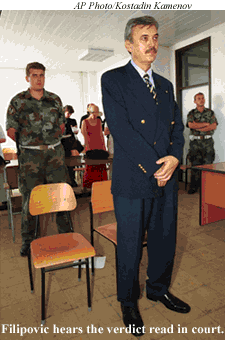 Nis, July 27, 2000—A military court in the southern Serbian town of Nis sentenced Serb journalist Miroslav Filipovic, 49, to seven years in prison yesterday for espionage and spreading false news.
The verdict and sentence against Filipovic were pronounced by the presiding judge, Col. Radenko Miladinovic, who said, “It was established beyond any doubt that Filipovic collected, processed, and sent military information, described as military secrets, to foreign organisations, which means that he engaged in espionage.”
Since the sentence exceeds five years in prison, Filipovic is to remain in custody while the Supreme Military Court in Belgrade hears his appeal.
According to the court decision, Filipovic was found guilty of “deliberately collecting, processing, and sending sensitive military material to foreign organisations—namely the Institute for War and Peace Reporting (IWPR) in London and Agence France Presse (AFP) in Paris.” Judge Miladinovic added that Filipovic had written about alleged Yugoslav Army atrocities against ethnic Albanians in Kosovo during last year’s NATO air strikes in Yugoslavia, and that he had described Yugoslav military strategy as “the tactics of killing and burning.”
Filipovic specifically alleged that army and Serbian police forces had looted deserted Albanian villages and killed Albanian women and children, Judge Miladinovic said.
The judge claimed that these reports, along with Filipovic’s articles on the situation in the Serbian territory of Sandzak, which is populated predominantly by Muslims, were “all false” and contained “great untruths” about the army.
 The judge also rejected as untrue Filipovic’s reports that the army had surrounded Muslim villages with tanks, sometimes evicting villagers from their homes or burning the villages.
Judge Miladinovic also cited Filipovic’s reports on the situation along the border between Serbia and the Serbian province of Kosovo, which has been under United Nations control since June 1999. In particular, the judge quoted Filipovic’s descriptions of Yugoslav Army and Serbian police efforts to destabilise the area around Bujanovac and Presevo by intimidating the local ethnic Albanian population. (The territory belongs to Serbia, but is mainly populated by ethnic Albanians.)
Such reports, some of which appeared in the independent Belgrade daily Danas, could have caused “disturbance and dissatisfaction” among the public, the judge said.
At the same time, the judge ruled that other military information included in Filipovic’s articles (dealing with army organisation, movements, and other activities) was “all exact and true.”
“The degree of secrecy of the material that Filipovic obtained … was not important for this court,” the judge said. “The important thing is that such information was sent to foreign organisations.” Commenting on the defence argument that Filipovic merely published information that had already appeared in other media, the judge said: “We did have a dilemma about the fact that many of those things were already available to the public. But there will be time for those others who were responsible for publishing such information.”
After the verdict was pronounced, Filipovic’s wife Slavica was allowed 15 minutes in private with her husband. No one besides her and the defence attorneys was permitted to speak with Filipovic.
Slavica Filipovic then told journalists that the case against her husband was clearly political. “I am not surprised by the sentence, since the court was obviously put under pressure,” she said. “My husband is not guilty and the court did not say what he really did. This sentence is a message to Miroslav’s colleagues not to work for foreign media or for Danas.”
Serb journalists present at the court agreed with this assessment, saying that they now fear being forced into self-censorship.
Filipovic’s attorney Oran Ateljevic told journalists that he would use all legal means at his disposal to prove his client’s innocence. After receiving the written verdict, the defence has 15 days to file an appeal with the Supreme Military Court in Belgrade, which must rule within 90 days.
“The harsh sentence was not based on law and is groundless,” Ateljevic said. “Filipovic did not do the things the court said he did. Is it really espionage if a journalist publishes signed articles about matters that are already known to the public?
Filipovic Sentenced to Seven Years for Espionage
CPJ protests “outrageous” court decision New York, July 26, 2000—Miroslav Filipovic, a leading Serbian investigative journalist charged with espionage and spreading false information for his coverage of alleged atrocities committed by Yugoslav Army soldiers in Kosovo during the 1999 NATO bombardment, has been found guilty and sentenced to seven years in prison, according to CPJ’s local sources and international news agencies.
A military tribunal in the town of Nis announced the verdict on Wednesday after one day of court proceedings, mostly held behind closed doors.
“We are outraged by the court’s decision,” said CPJ executive director Ann Cooper. “It once again proves that the Milosevic regime’s campaign to stifle independent journalism in Yugoslavia is unconstrained by law, shame, or good sense.”
Filipovic Espionage Verdict Due Tomorrow
New York, July 25, 2000—At the end of the first day of Miroslav Filipovic’s trial on charges of espionage and disseminating false information, Judge Colonel Radenko Miladinovic announced that the verdict would be pronounced tomorrow at 1 p.m. local time, according to CPJ’s Belgrade sources and international news reports.
Most of the session, which lasted from 9 a.m. to 5 p.m., was held behind closed doors, due to the alleged sensitivity of the charges. During the closed session, according to CPJ’s sources, the court heard testimony from a Yugoslav military expert, Blagoje Ljubisavljevic, on whether Filipovic’s journalism constituted espionage.
During the open part of the proceedings, the court heard written testimony from three witnesses whom Filipovic had interviewed about the war in Kosovo and other Yugoslav military activities.
During closing arguments, deputy military prosecutor Captain Aleksander Kalicanin asked the court to find Filipovic guilty of espionage and spreading false information. Defense lawyers argued that the charges were groundless, since Filipovic had merely published information that was common knowledge.
According to a Reuters report, Filipovic demanded that the court release him. “I am a family man and I miss my wife and my children,” he told the court. “I haven’t escaped or evaded the court or police during the investigation. If I wanted to run away, I could have done so a number of times before.”
The court denied his request. If found guilty at tomorrow’s sentencing hearing, Filipovic will have the right to appeal.
Filipovic Trial Starts Tomorrow in Belgrade
Serbian Investigative Reporter Charged with Espionage, Spreading False Information
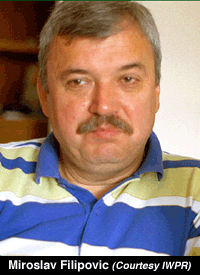 New York, July 24, 2000—Starting tomorrow, a military court in the city of Nis (235 kilometers south of Belgrade) will hear the case of Miroslav Filipovic, a leading Serbian investigative journalist charged with espionage and spreading false information.
The trial is expected to last two days, according to CPJ’s local sources. The verdict should be issued immediately upon the completion of the proceedings, before the court begins its August recess.
Filipovic is a Kraljevo-based reporter for the Belgrade-based independent daily Danas and a regular contributor to Agence France-Presse and the London-based Institute for War and Peace Reporting (IWPR). The case was apparently triggered by his coverage of the activities of Yugoslav security forces in Kosovo and southern Serbia for the IWPR.
One of Filipovic’s IWPR pieces described atrocities allegedly committed by Yugoslav Army soldiers in Kosovo during the 1999 NATO bombardment, based on the soldiers’ own accounts. Serbian authorities seem also to have been angered by Filipovic’s account of Serbian police repression in southern Serbia, by his eyewitness report on a rebellion by Yugoslav Army reservists, and by his exclusive article about the smuggling of Serbian agents provocateurs into Kosovo.
“Once again, the Milosevic regime has shown that it is prepared to use any means, no matter how illegal or absurd, to silence independent journalism in Yugoslavia,” said CPJ executive director Ann Cooper. “Miroslav Filipovic is obviously not a spy, but a well-respected reporter who is being prosecuted for informing the world about matters which, while embarrassing to the government of Yugoslavia, are nonetheless of vital public interest. We demand that Yugoslav authorities release him at once, and that all charges against him be dropped.”
Filipovic was initially detained on May 8, along with several other independent journalists and opposition activists, as part of a major crackdown on independent media and the anti-Milosevic opposition.
Serbian authorities claimed that they arrested Filipovic to prevent him from destroying or hiding “evidence” necessary for judicial proceedings, according to local and international sources. During the arrest, four plainclothes representatives of the Serbian State Security Service (RDB) confiscated his passport, address book, diary, computer hard disk, three floppy disks, and about a hundred pages of printed text, all without a proper warrant.
Filipovic was then sent to a military prison in Nis. He was released four days after the arrest when a military prosecutor decided there was insufficient evidence to indict him on espionage charges. However, Filipovic was re-arrested on May 22 and has been in custody ever since.
On June 14, the Nis military court finally charged Filipovic with espionage and spreading false news. The court rejected a request from Filipovic’s lawyers that he be released to prepare his defense, claiming that the journalist might flee the country or seek to influence witnesses. (There is no bail system in Serbia.)
Filipovic has been charged with espionage under Clause 128 of the Yugoslav Criminal Code and with the lesser offense of spreading false information under Clause 218 of the Serbian Criminal Code. If convicted, he faces from three to fifteen years in jail.
Governtment Pressure on Independent Media is Relentless
New York, May 26, 2000—Serbian authorities, who last week took over the main opposition television station in Belgrade, moved closer to shutting down all independent media in Belgrade. Popular independent Radio-Television Pancevo is now off the air in Belgrade, and the printing house that produces several independent newspapers is facing eviction.
Serbian police entered the Belgrade facilities of RTV Pancevo May 18, and dismantled the station’s radio transmitter, according to news reports and CPJ sources in Belgrade. RTV Pancevo is an independent station based in the town of Pancevo, some 12 miles north-east of Belgrade, and was a popular station in the Serb capital. As a result of the raid, listeners in Belgrade no longer hear news and information broadcasts on the RTV Pancevo airwaves, but rather folk music and World War II partisan songs. In addition, CPJ sources report, RTV Pancevo’s television signal is being jammed from an unknown location, and is very weak in Belgrade.
ABC Produkt, which owns the independent daily Glas Javnosti, received an eviction order from the financial police May 19, according to the Beta news agency. In addition to Glas Javnosti, ABC Produkt prints the independent weeklies Vreme and NIN.
ABC Produkt was reportedly given eight days to leave its premises in Vlajkoviceva Street in downtown Belgrade. The company has appealed the ruling, which was made by the Economic Court in the Serb capital.
Meanwhile, the independent Belgrade daily Danas received a court summons May 25 for violating Serbia’s notorious information law. The plaintiff is Serb deputy prime minister Vojislav Seselj, who charges that the paper violated his rights when it published a May 24 article accusing Seselj of plagiarizing Vladimir I. Lenin’s famous work, “What is to be Done?” This is Seselj’s third suit against Danas, and he is seeking the maximum fine under the law. Those fines amount to 300,000 dinars ($25,800) against the daily, and 150,000 dinars ($12,900) against individual members of the management of both the paper and its publisher, the firm Dangraf.
Independent Serb journalists say Belgrade is becoming an information vacuum, as non-state sources of news become more and more scarce. CPJ Europe Program Coordinator Emma Gray said “The Yugoslav government is using every means at its disposal — violence, confiscation of equipment, and outrageous legal proceedings, to intimidate the independent media. We utterly condemn these despicable tactics, and wholeheartedly support the local independent media who are resisting with such courage and dedication.”
Serbian Journalist Imprisoned Again; Charges Unclear
New York, May 22, 2000—A leading Serbian investigative journalist, Miroslav Filipovic, was imprisoned again today, following a hearing at a military court in Nis in southern Serbia. Filipovic was interrogated for four hours, according to local sources, after which military prosecutors announced that they were launching a judicial inquiry.
Filipovic’s lawyers, Goran Draganic and Zoran Ateljevic, are banned from speaking about the case, and it is unclear what charges may have been filed against their client at today’s hearing. CPJ sources in Belgrade said Filipovic could be detained for up to 30 days while court investigations are conducted. The next hearing is set for 10 a.m. local time on Wednesday, May 24.
Filipovic was arrested May 8 in his hometown of Kraljevo in central Serbia. Three days later, the Nis military court charged him with espionage and spreading false information. He was released from prison May 12, however, when military authorities decided not to proceed with the investigation because they had been unable to collect sufficient evidence of espionage within the 48 hours stipulated by Serbian law.
Upon his release, Filipovic reported that he had been accused of “collecting data important for the country’s defense and providing them to a foreign organization which does intelligence work,” namely the London-based Institute for War & Peace Reporting (IWPR). According to the IWPR, the articles were based on Filipovic’s investigative reporting about sensitive topics such as Serbian atrocities in Kosovo and Serbia’s relations with Montenegro.
Under Serbian law, the penalty for espionage is a prison sentence of up to 15 years. If convicted on charges of “spreading false information'” Filipovic could face devastating fines.
In addition to his contributions to the IWPR, Filipovic writes for Agence France-Presse and is a correspondent for the independent Belgrade daily Danas.
“CPJ joins other press freedom organizations from around the world in condemning this unjust hounding of a professional journalist,” said CPJ Europe program coordinator Emma Gray. “We believe that Miroslav Filipovic is being persecuted for doing his job, and we demand that Serbian authorities immediately withdraw the charges against him.”
Police Storming of Four Media Outlets in Belgrade Sparks International Outrage
New York, May 17, 2000—This morning’s police raid on four independent media outlets housed in a Belgrade office building has outraged journalists and opposition forces in Yugoslavia and prompted a storm of international condemnation.
“The Serb journalists we spoke to are more angry than afraid,” said CPJ Europe program coordinator Emma Gray. “They have vowed to continue reporting the news independently, even in these dire circumstances. We will continue to support their efforts.”
Representatives of the independent and opposition media in Belgrade issued strongly-worded statements about the storming of the offices of the TV station Studio B, Radio B2-92, Radio Index, and the daily newspaper Blic. (TV Maldenovac, a Studio B station in the town of Maldenovac, was also closed in a separate police raid this morning.)
“This is a complete prohibition of free speech,” said Veran Matic, general manager of B2-92 and president of the Association of Independent Electronic Media (ANEM). Matic also made an urgent appeal to the public to do everything possible to help prevent a complete media blackout and open dictatorship in Serbia.
In an interview with the independent Beta news agency, Dragan Kojadinovic, Belgrade Studio B’s former director and editor-in-chief, described the takeover as “an act of state terrorism.”
Vuk Obradovic of the opposition party Social Democracy condemned the raid as “a declaration of war on the democratic opposition in Serbia,” while Vladan Batic of the opposition Democratic Christian Party described it as “an invitation to civil war.”
International condemnation of the raid was swift and sharp. In Europe, the OSCE’s Representative on Freedom of the Media was among many public figures who expressed concern and dismay at the takeover. The U.S. State Department said that the police action “smacks of desperate, communist-era oppression,” adding that Secretary of State Madeleine Albright would consult with European allies “to determine what joint actions we will take in response to this blatant attack on the independent media.”
Shortly after the raid, the government dismissed the management of Studio B, replacing it with a production team from the state-run Radio and Television Serbia. The new acting editor-in-chief of the station is an RTS employee, Ljuboslav Aleksic, according to Beta. Since early this morning, Studio B has been broadcasting mostly music, along with occasional state television news bulletins, according to local news reports and CPJ sources in Belgrade.
Radio B2-92’s regular frequency is now under state control and is broadcasting music, but staffers have managed to broadcast via satellite and on the Internet from an undisclosed location, and local stations are picking up the reports for re-broadcasting. Student Radio Index is completely off the air. The staff of the daily Blic moved to the offices of the opposition newspaper Danas, and produced a four-page special edition later in the day.
Around ten thousand protesters gathered in front of the City Assembly building this evening, according to news reports from Belgrade. Police reportedly used tear gas to prevent the demonstrators from reaching the city center, and an eyewitness told CPJ that three demonstrators were beaten up. Opposition politicians have called for country-wide protests, though local journalists point out that this morning’s seizure will make it difficult to spread the message.
A decree signed by Serbian deputy prime ministers Vojislav Seselj and Milovan Bojic stated that the authorities had shut down Studio B because it called repeatedly for “the toppling of the constitutional order and the violent overthrow of the legitimate authorities.” The decree also claimed that since Studio B was state-owned the state had simply decided to take direct control of “its own property.”
The Serbian Renewal Movement (SPO), which runs the Belgrade city government and had control of Studio B until this morning’s raid, called for civil disobedience in response to the raid, according to the Beta news agency.
Yugoslav Authorities Storm Four Media Outlets
New York, May 16, 2000—Shortly after two this morning, hundreds of Yugoslav police raided the offices of Serbia’s largest opposition television station, the Belgrade-based Studio B. The 23-story Beogradjanka building in central Belgrade also houses three other independent media outlets: Radio B2-92, the student-run Radio Index, and the independent daily newspaper Blic.
The raid was carried out by plainclothes and uniformed police, some wearing black masks, who prevented staffers from all four media from entering their offices. In an interview with CPJ, a Blic editor said the police carried no warrant and gave no reason for their actions.
In a later statement, Serbian government authorities said that the action against Studio B was taken in response to the station’s alleged calls for “an uprising” in the country and for “the violent overthrow of the legitimate authorities.” The statement, which was signed by Vojislav Seselj and Milovan Bijic, both Serb deputy prime ministers, did not mention the other media outlets.
After the raid, Studio B aired music videos and news from state television, according to the Beta news agency. Local sources told CPJ that radio B2-92 is currently broadcasting its own programming via satellite and on the Internet, and that local independent stations are picking up the reports for rebroadcast. Journalists with Blic, meanwhile, are working out of the offices of the opposition newspaper Danas, and plan to put out a special edition later today.
The government also announced that it was dismissing the management of Studio B and had appointed a new editor-in-chief, Ljuboslav Aleksic. News reports quoted the station’s former director and editor-in-chief Dragan Kojadinovic as saying the take-over amounted to “the beginning of a state of emergency,” and calling on people to resist the government. Two protest demonstrations were scheduled to take place today in central Belgrade.
Today’s Serbian government statement also argued that Studio B was state-owned and that the state had simply decided to take direct control of “its own property,” according to local reports. Studio B had been run by the Belgrade municipal government, which is currently controlled by the Serbian Renewal Movement (SPO). The SPO, which is headed by Vuk Draskovic, is the largest opposition party in Serbia
“This is a dark day for press freedom in Yugoslavia,” said CPJ Executive Director Ann Cooper. “Once again, the Serbian authorities have shown their contempt for democratic principles, among them the right of all people, including journalists, to express themselves without fear of harassment and intimidation.”
Journalist Freed, But May Still Face Charges
New York, May 12, 2000—A leading Serbian journalist who was arrested May 8 and charged with espionage three days later in a military court has been released, according to news reports and CPJ sources in Belgrade. The military charges against Miroslav Filipovic have been dropped, according to his lawyer, but the journalist could still face criminal charges in a civilian court for “spreading false information.”
Filipovic is a correspondent for the independent Belgrade daily Danas, and a regular contributor to Agence France-Presse and the London-based Institute for War and Peace Reporting (IWPR). His arrest seems to have been prompted by recent articles for the IWPR that contained explosive accounts of the actions of Yugoslav security forces, including atrocities committed by Serb soldiers against ethnic Albanians in Kosovo.
Military authorities in the southern town of Nis decided not to proceed with the investigation because they were unable to collect sufficient evidence of espionage within the 48 hours stipulated by Serbian law. According to Filipovic’s lawyer, Milan Nikolic, his client could still face criminal charges in the central Serbian city of Kraljevo, where Filipovic was arrested at his home earlier this week.
The charges carry a maximum penalty of three years imprisonment, but sources familiar with the case said it was more likely that a fine would be imposed.
Upon his release, Filipovic reportedly said there were no grounds for charging him with espionage, according to CPJ sources in Belgrade who are in touch with the journalist’s family. “A person who spies is hardly likely to write articles and sign them with his own name,” Filipovic added.
Detained Journalist to be Transferred to Military Court
New York, May 10, 2000—A Serb journalist who was detained in a wave of arrests on May 8 may face charges of espionage, according to news reports and CPJ sources in Belgrade. Miroslav Filipovic, a correspondent for the independent Belgrade daily Danas, was one of at least eight journalists arrested in a crackdown on independent and opposition journalists.
Filipovic was arrested at around 5 p.m. local time on May 8 in the central Serbian town of Kraljevo. According to family members, plainclothes representatives of the Serbian State Security Service (RDB) spent three hours in the journalist’s apartment, questioning Filipovic and searching through his professional and personal documents. The officers took three floppy discs and the hard drive from his computer, and almost 100 pages of documents. They also confiscated the journalist’s passport, address book, business cards, his diary, and other personal papers.
According to local news reports, the investigating judge at a hearing held yesterday at the Kraljevo Municipal Court ruled that Filipovic’s case be transferred to a military court in the southern town of Nis. In an article in the Belgrade daily Danas, Filipovic’s lawyer, Goran Draganic, was quoted as saying that authorities may bring charges against his client for “endangering the constitutional order and security of Yugoslavia.” Other news sources report that Filipovic could face charges of espionage and spreading lies.
Filipovic is a regular contributor to Agence France-Presse and the London-based Institute for War and Peace Reporting (IWPR). He is also associated with the Helsinki Committee for Human Rights in Serbia. In recent contributions to the IWPR, Filipovic reported on the Yugoslav security services, army and police, including accounts of repression and atrocities by Serb soldiers against ethnic Albanians in Kosovo.
Wave of Arrests Includes Several Journalists
New York, May 9, 2000—Yugoslav authorities detained at least eight journalists overnight and early today, according to CPJ sources and local press reports. Six were released after police questioning, one was ordered to leave the city in which she was working, and one is still under arrest.
The arrests followed unrest in the city of Pozarevac, home town of Yugoslav president Slobodan Milosevic, where three members of the student opposition group Otpor (“Resistance”) were beaten up on May 1 by bodyguards of the president’s son, Marko Milosevic. Heavy fines were imposed on media outlets that reported the beating, according to local press reports. Opposition plans to hold a protest rally today were called off for security reasons following the wave of arrests of student activists, opposition politicians and journalists across the country.
Gillian Sandford, a British freelancer working for the London-based daily The Guardian, was arrested today in Pozarevac along with her Yugoslav translator, according to CPJ sources in Belgrade. They were taken into police custody for an hour and a half and then ordered to leave the city. Journalists Natasa Bogovic and Bojan Toncic of the independent Belgrade daily Danas were detained and taken to the police station in Zabari, near Pozarevac, last night. They were both released today after questioning.
A correspondent from the independent Beta news agency and the independent daily Blic, Mile Veljkovic, was also detained in Pozarevac. His wife told independent radio B2-92 today that police had searched their house from midnight to 3 a.m. The police seized 80 pages of written material and the hard drive from Veljkovic’s computer, and then arrested Veljkovic himself without explanation. The journalist was released at 10 p.m. local time.
Journalist Miroslav Filipovic remains in custody after his arrest last night in the central Serbian city of Kraljevo. Filipovic is the local correspondent for Danas, and also works for Agence France-Presse and for the London-based Institute for War and Peace Reporting (IWPR). According to Filipovic’s wife, Slavica, four plainclothes representatives of the Serbian State Security Service (RDB) followed her and her husband home yesterday afternoon. The officers spent three hours in Filipovic’s apartment, took three floppy discs and the hard drive from his computer, and almost 100 pages of documents. They also confiscated the journalist’s passport, address book, business cards, diary, and other personal papers.
Filipovic was taken to the police station yesterday evening, according to his son Sasa. Under Serbian law, suspects may be detained for up to 72 hours without a formal charge. Filipovic had not been released as of this writing.
So far the precise motives for Filipovic’s arrest are unclear. An IWPR alert issued today stated that the journalist’s explosive reporting, drawn from unique sources within the Yugoslav security services, had already prompted authorities to summon him for an “informative discussion.” In recent contributions to the IWPR, Filipovic had written about the Yugoslav security services, army, and police, including accounts of repression and atrocities.
Meanwhile, a total of twenty-five people, including several journalists, were also arrested in the Vojvodina capital of Novi Sad. The journalists were covering an opposition demonstration in front of a government building in the city. The opposition radio station B2-92 reported that police detained two reporters from the Novi Sad station Radio 201 and a cameraman from Television Montenegro, along with several other domestic and international journalists. All the detainees were released late in the afternoon.
The wave of arrests shows the Milosevic regime’s determination to limit the scale of popular opposition. Local journalists and international press freedom groups are particularly alarmed by the continuing detention of Filipovic, given the sensitive nature of the journalist’s reporting, and his case will be monitored closely.
CPJ executive director Ann Cooper condemned the spate of arrests. “The Yugoslav authorities’ attempts to intimidate and silence the independent press are escalating,” Cooper said. “We call on the authorities to stop their harassment of journalists.”
As Clampdown Continues, Some Refuse to Pay Fines
New York, May 8, 2000—Massive fines are threatening the survival of Serbia’s largest opposition television station, according to the Independent Association of Serbia’s Reporters and other CPJ sources in Belgrade. The fines, combined with increasingly aggressive jamming and threats of arrest are the latest tactics being employed by the Yugoslav government in its systematic effort to silence the independent media.
Jamming of Studio B, particularly its news programming, began last fall. The station’s director and editor in chief Dragan Kojadinovic was quoted last week in the private daily Glas Javnosti as saying “over 50 percent of the Belgrade population cannot monitor Studio B due to 12 powerful devices which interfere in its broadcasts.”
Over the past several months financial pressure has mounted on the station. A fine of 300,000 dinars ($25,800) was imposed on Studio B under the Public Information Law on April 10, and Kojadinovic was personally fined a further 150,000 dinars ($12,900). The fines stem from an item broadcast April 2 about a car crash in October in which four senior officials of the opposition Serbian Renewal Movement were killed and their leader Vuk Draskovic was badly injured.
Draskovic claimed at a December 3 press conference that the car crash was a botched attempt by the government to assassinate him. Media outlets (including Studio B) which covered Draskovic’s statements were fined for defamation on December 5. The April charges against the station were brought by Police Chief Branko Djuric, who claims he was slandered in a report which said that he was present at the site of the accident immediately after the crash, did nothing to apprehend the truck driver responsible for the accident, and was overheard at the scene to comment, “The scum is still alive.”
Kojadinovic has refused to pay either fine relating to the April charge, and says Studio B has received an official note stating that the 300,000 dinar fine would be collected from the station’s bank account. The Independent Association of Serbia’s Reporters and independent sources in Belgrade said that Studio B had had its phones switched off temporarily in retaliation for non-payment of the fine. The station has also been prevented from obtaining fuel, tapes, and other basic equipment
Under Serbia’s Information Law, non-payment of a fine can result in the removal of personal property and possessions from a station or individual.
Other media outlets which have been fined recently under the Public Information Law are also refusing to pay up. These include the Belgrade weekly magazine Vreme and the Nis daily Narodne Novine. Kojadinovic has described the fines as a Ôlegal circus’ in which he wishes to have no part.
Studio B has also received an official note from the state organs saying, “This media outlet could expect anything – from confiscation of broadcasting equipment to arrests.” More attacks followed on May 3, when Studio B was once again fined 300,000 dinars ($25,800) by a local felony court in Pozarevac, and Kojadinovic was hit with an additional fine of 150,000 dinars ($12,900) for the station’s coverage of a report about the alleged beating of three members of the opposition group ‘Otpor’ (‘Resistance’) by bodyguards of Marko Milosevic, son of the Yugoslav President.
Studio B in Belgrade is controlled by Draskovic, and the opposition Serbian Renewal Movement. The station produces its own programming including news, sports and entertainment, and also carries the opposition radio station B2-92 on one of its frequencies.