October 5, 2000 — Since this briefing was filed two days ago, Slobodan Milosevic has almost entirely lost control of state media, a main pillar of his power. Today, the state news agency Tanjug declared its independence from Milosevic and referred to opposition leader Vojislav Kostunica as the president-elect of Yugoslavia. Employees of the state television network RTS had already begun to resist broadcasting government propaganda before today, when protesters set fire to RTS headquarters in Belgrade, knocking the station of the air. Milosevic’s whereabouts are currently unknown.—Ed.
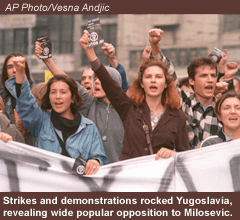
New York, October 3, 2000 — As opposition demonstrators strive to dislodge embattled president Slobodan Milosevic via a national strike, the regime is losing control over certain state media outlets, numerous local and international sources have confirmed.
Over the past decade, Milosevic has relied on state media to celebrate his own record and vilify his foreign and domestic opponents, while excluding all dissenting views. But in the past week, state broadcast and print journalists across Serbia have started demanding the right to cover current events with a degree of objectivity and editorial independence.
Seven state-owned local radio stations announced on Sunday and Monday that they would no longer re-broadcast news reports from the staunchly pro-government Radio Television Serbia (RTS). Radio Obrenovac, Radio Smederevo, Radio Novi Becej, Radio Zajecar, Radio Lazarevac, Radio Mladenovac, and Radio Sremcica stated that they would cover political developments “objectively.”
 On Sunday, 14 journalists from the state-controlled radio station Channel 3, which covers arts and cultural affairs, demanded international mediation to resolve the electoral crisis in the country. On Monday, 68 employees of Radio Belgrade issued a statement urging the station to change its “distorted” editorial policy.
Employees of some state-run television stations also began withdrawing their support from the Milosevic regime.
On Saturday, RTS general director Dragoljub Milanovic dismissed six employees who had formed a strike committee at Radio Television Novi Sad (RTNS), an RTS subsidiary, and called for changes in the management. Committee member Tatjana Vojtehovska told reporters on Monday that the strike committee wanted all RTS employees “to deny obedience to the company’s management and oppose the manufacturing of false information broadcast daily by the RTS.” Over 100 of the station’s employees signed a petition demanding more professional reporting that was sent to station management on Monday.
Also on Monday, approximately 20 state television employees in the town of Uzice went on strike over the network’s editorial policy. In the southern Serbian city of Prokuplje, authorities shut down the local state television station Monday afternoon after some 50 protesters stormed the building. Just before authorities cut its power supply, the station transmitted a pro-opposition statement.
Belgrade’s Studio B TV, a formerly independent station that the regime took over in May, started broadcasting some opposition press conferences on Friday, the Belgrade-based VIP news agency reported. On Monday, over 140 Studio B TV employees went on strike because the station’s management refused to change its pro-regime editorial policy, according to local media.
Meanwhile, Belgrade’s BK Television, which is owned by Bogoljub Karic, an influential businessman and former close associate of Milosevic, announced that its signal had been jammed when it tried to broadcast opposition press conferences, according to VIP.
Print rebellion
Print journalists at several state-owned publications also demanded editorial policy changes. On Sunday, around 50 journalists working for the state-controlled Belgrade daily Vecernje Novosti called on the paper’s editorial board to start running unbiased current affairs coverage within 24 hours. The board had not complied by Monday, when 25 employees in the newspaper’s computer center went on a protest strike.
That same day, approximately 55 journalists from the state news agency Tanjug signed a petition that called on management to “respect the principles of full, objective and truthful informing.”
Foreign journalists harassed
The growing unrest within the state media network has been accompanied by government harassment of foreign correspondents. On September 26, Yugoslav information minister Goran Matic warned that foreign reporters who reported inaccurate statements made by Yugoslav citizens regarding the September 24 election would lose their press credentials.
Rather than systematically cracking down on the foreign press corps, however, the government seems to have acted capriciously in denying visas and press credentials to individual reporters.
On Friday, September 29,Yugoslav authorities ordered BBC correspondent Jacky Rowland to leave the country within 48 hours, according to wire service reports. Rowland’s expulsion came one week after numerous journalists were denied visas and press credentials to cover the Yugoslav election.
A week earlier Interior Ministry officials told a group of 18 foreign correspondents who had entered Yugoslavia with valid visas and were waiting to receive press credentials at a Belgrade police station that their visas had been revoked and that they had 24 hours to leave the country. They were later allowed to re-enter the country, according to Reuters.
Also on September 22, Interior Ministry officials told Aija Kuge of the RFE/RL’s Russia service that she was forbidden to cover the elections, RFE/RL sources told CPJ. Alan Freeman of Toronto’s Globe & Mail was temporarily detained by Yugoslav authorities on Saturday, September 23, fined 3200 dinars (US$90 at the unofficial rate), and then allowed to resume his work, the newspaper told CPJ.