This Colombian warlord cultivates journalists. He also murders them. For Carlos Castaño, it’s all about image.
|
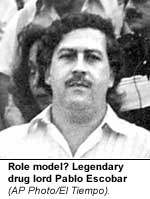
Since 1999, in fact, forces under Castaño’s command have been linked to the murders of at least four journalists, the abduction and rape of one reporter, and threats against many others, according to CPJ research. “Against the violent backdrop of Colombia’s escalating civil war, in which all sides have targeted journalists, Carlos Castaño stands out as a ruthless enemy of the press,” CPJ’s citation noted. This self-confessed murderer of journalists is now turning to the local press in an effort to rehabilitate his image in Colombia. To that end, Castaño has launched a uniquely Colombian public relations campaign, seemingly modeled after tactics employed by legendary drug lord Pablo Escobar. Not unlike Escobar, Castaño’s strategy combines a charm offensive with forthright acknowledgements of the AUC’s use of terror. In November 2000, Castaño granted an exclusive interview to the Bogotá weekly Semana. The reporter asked whether Castaño thought he deserved to be compared to the late Escobar. “There is no way you can compare me with a monster like that,” replied Castaño. “While he sought to destroy the country, I intend to save it.” Old war Since the 1980s, both right-wing paramilitaries and left-wing guerrillas have increasingly been supported by profits from Colombia’s burgeoning trade in illegal drugs. Carlos Castaño is Colombia’s top paramilitary leader as well as the country’s leading fugitive. He is currently wanted on multiple murder, kidnapping, and arms trafficking charges dating back to 1988. He is also “a major drug trafficker,” according to the U.S. Drug Enforcement Administration (DEA). Last April, U.S. ambassador to Colombia Anne W. Patterson told the Bogotá newspaper El Espectador that if Castaño is involved in drug trafficking, “and we think he is,” the United States might one day seek to prosecute him in the United States. Childhood memories Three years later, Carlos Castaño unified a number of regional rightist groups to form a national paramilitary organization called the United Self-Defense Forces of Colombia (AUC). In 1997, Castaño admits, he ordered the massacre of 49 peasants in rural Mapiripán, eastern Colombia. Since then, Castaño and his allies have committed about 80 percent of Colombia’s human rights abuses, according to Human Rights Watch. The Colombian Defense Ministry reports that rightist paramilitaries carried out three-fourths of the country’s massacres last year. “Guerrillas, whether in uniform or civilian clothes, remain a legitimate military objective,” Castaño said on camera on March 1, 2000, when he showed his face to Colombians and others for the first time. “I know this violates international humanitarian law.” AUC meets the press In June 1999, AUC members threatened Carlos Pulgarín, a reporter for Bogotá’s largest daily, El Tiempo, after Pulgarín wrote an article about paramilitary assassinations of indigenous activists. Pulgarín fled to Peru, where his movements were apparently monitored; he later received telephone threats in Lima. On September 16, 1999, two assassins on a motorcycle shot and killed Guzmán Quintero Torres, editor of the northern Colombian daily El Pilón. Quintero was investigating several AUC-linked murders at the time, including the 1998 slaying of television journalist Amparo Leonor Jiménez Pallares, who was killed after she reported that local paramilitary forces had murdered peasants. On September 9, 2000, AUC paramilitaries abducted and killed a rural community leader named Carlos José Restrepo Rocha, who ran two small regional publications. AUC fliers were left next to Restrepo Rocha’s bullet-ridden corpse, but the motive for this particular murder remains unclear. Later that year, AUC members threatened Eduardo Luque Díaz, of the daily La Nación, at his office and home, demanding that he reveal the whereabouts of a family he had mentioned in a story. One month after Bedoya’s death, the AUC tried unsuccessfully to bomb the Bogotá offices of La Voz. Castaño took responsibility for the incident a few days later. On October 31, 2000, rural community radio station director Juan Camilo Restrepo Guerra was summoned to a meeting by rightist paramilitaries who were apparently incensed by his sharp criticisms of the local administration. Restrepo Guerra’s brother drove him on a motorcycle to the rendezvous site. The paramilitaries shot Restrepo Guerra dead in front of his brother, who has since declined to testify and has gone into hiding. Journalists who choose to remain in Colombia despite Castaño’s intimidation privately admit that they censor their own reports to protect themselves and their families. “Of course I censor myself,” said one threatened journalist who elected to stay. “You have to tell the story, but there are some things I can’t include.” Carrot and stick “Carlos Castaño, Colombia’s fugitive paramilitary leader, unleashed a national stir when he stepped from the shadows and submitted to a ninety-minute, one-on-one interview, televised on March 1 [2000],” wrote then-U.S. Ambassador Curtis W. Kamman in a recently declassified U.S. embassy cable. “The 35-year-old Castaño appeared intelligent, articulate, well-poised, and, above all, very charismatic.” Nearly one in five Colombian adults watched at least half the program, about the same percentage that supports Castaño, according to opinion polls. Since that first television appearance, Castaño has made himself freely available to both domestic and foreign reporters. The Garzón murder The 39-year-old Garzón was a morning news host for the Caracol network and a regular columnist for the weekly magazine Cambio. But Garzón was best known for his work as a television comedian who used humor to criticize all factions in the civil conflict. He specialized in uncannily accurate impersonations of Colombian officials and other notables and was so popular across Colombia that in 1997, then-presidential candidate Andrés Pastrana Arango appeared live with other candidates on his TV show. Garzón regularly traded on his stature as a well-respected broadcaster to negotiate for the release of victims of guerrilla kidnappings. He also served on an independent commission that mediated between the government and the leftist guerrillas of the National Liberation Army (ELN). Two points emerge clearly from the Garzón case. First, some of Colombia’s most dangerous criminals work for Carlos Castaño; and second, not even famous and well-connected journalists are safe from him. On August 10, 1999, Garzón heard that Castaño was planning to kill him. The news was conveyed by a Colombian senator named Piedad Córdoba, who chaired the Senate’s human rights committee at the time. In late 1998, Castaño’s men kidnapped Córdoba and held her for nine months. During that time, Castaño told Córdoba that Garzón was on his list of targets. Castaño read her excerpts from what he said were transcripts of Garzón’s private telephone conversations. He claimed that the transcripts proved Garzón was really a guerrilla. After Córdoba was released in June 1999, she told Garzón that Castaño was planning to eliminate him. During the second week of August, Garzón learned that Castaño had ordered him killed by the end of that week. On August 10, desperate to get in touch with Castaño, Garzón visited La Modelo prison, a maximum-security installation in Bogotá where several important AUC figures are incarcerated. According to the charge sheet, Garzón met with Ángel Custodio Gaitán Mahecha, also known as “The Baker,” and with Jhon Jairo Velásquez Vásquez, also known as “Popeye.” Velásquez was an early 1990s Escobar loyalist who later transferred his allegiance to the AUC. Both were well-connected members of the Colombian underworld. Gaitán used his cell phone to call Castaño. He handed the phone to Garzón, who pleaded with Castaño to spare his life. Castaño called Garzón a son of a bitch who supported the guerrillas and added that he was a coward who didn’t have the guts to meet him face to face. Before hanging up, the two men arranged to meet the following Saturday, August 14. On August 13, a motorcycle-riding gunman shot Garzón dead at a traffic light just four blocks from his office. A few hours later, Castaño himself called Garzón’s radio show and denied responsibility on the air. Velásquez and Gaitán also claim they had nothing to do with Garzón’s death. The gunman who shot Garzón allegedly belonged to a criminal band known as La Terraza. In the past, La Terraza carried out attacks for the late Pablo Escobar. However, Castaño admits he has hired La Terraza to carry out a number of crimes in recent years, including kidnappings. The official government charge sheet accuses him of hiring La Terraza to kill Garzón. On August 3, 2000, three months after Castaño was formally charged with Garzón’s murder, he invited seven La Terraza leaders to a meeting in northern Colombia. Authorities later discovered all seven of their corpses near a local road. Meanwhile, Castaño issued a communiqué saying that the AUC had executed them for giving leaders like him a bad name. Three months later, several young men who claimed to be La Terraza members surfaced in Medellín. Wearing masks, they taped a television interview in which they claimed to have committed many kidnappings and murders on behalf of the AUC, including the Garzón assassination. During the interview, they claimed that Castaño was planning to kill them and their families with the help of local police and military forces. Castaño did not deny the accusation. In March 2001, he told El Tiempo that only one or two members of the band were still alive. War on El Espectador Gómez had just published a story that documented the Colombian Army’s collaboration with the AUC in the Mapiripán massacre. That same day, Gómez found an envelope with his name stenciled on it in his mailbox at work. The envelope contained a photocopy of a recent article by Jineth Bedoya, one of his colleagues at El Espectador. Bedoya had reported that La Modelo prison guards were allowing AUC inmates to keep guns in their cells even after clashes between them and other inmates that left 25 prisoners dead, 18 wounded, and an undetermined number missing, according to a United Nations report on the incident. Bedoya and her editor, Jorge Cardona, received identical envelopes. An hour and a half later, Bedoya’s telephone rang. Gaitán was calling from his cell in La Modelo. He offered Bedoya the opportunity to interview him at the prison at 10:00 a.m. the next day. He promised the 25-year-old reporter an exclusive and asked her to come alone. Cardona insisted on accompanying Bedoya and on bringing a photographer. The three El Espectador journalists arrived at La Modelo shortly before 10:00 a.m. on May 25. Prison guards told them to wait. The visitors waiting area is just inside the entrance to La Modelo, although many visitors prefer to wait in the street just outside the entrance. Cardona and the photographer walked to a nearby concession stand to buy sodas, leaving Bedoya standing in front of the prison entrance. She stayed within view and earshot of the waiting area in case the guards cleared them to enter the jail. Bedoya disappeared during the few minutes it took her colleagues to buy the sodas and return to the prison entrance. The prison guards claimed they had seen nothing. At 8 p.m., the police reported that Bedoya had been admitted to a police medical clinic in the city of Villavicencio, a three-hour drive from La Modelo. A taxi driver found her lying with her hands tied in a garbage dump on the outskirts of town. She had been drugged, brutally beaten, and sexually assaulted. Bedoya was found in a state of nervous collapse but eventually recovered from the attack and returned to work at El Espectador. During the assault, the men told her in graphic detail about all the other journalists whom they planned to kill, including her colleague Gómez. They did not explain why they chose to free her. A week later, Gómez fled to the United States. No suspects have been charged in the attack on Bedoya. Gaitán and Velásquez both denied any role in her abduction, as do La Modelo prison authorities. In a June 2000 interview with El Tiempo, Castaño also disclaimed responsibility for Bedoya’s ordeal. He acknowledged that Gaitán was his subordinate, but claimed that Gaitán had assured him he was not involved. On the evening of September 7, 2001, Gaitán was murdered in a prison called La Picota. He was apparently killed by leftist guerrilla inmates in retaliation for last year’s jailhouse massacre at La Modelo. The hunt for Castaño Yet U.S.-backed Colombian forces have so far been powerless to stop Castaño. As a result, he has enjoyed complete impunity for his crimes. The Attorney General’s Office was the only Colombian law enforcement agency that even tried to pursue Castaño. Earlier this year, its civilian agents launched a series of raids against the AUC. But they complained of working without the support of the military or other government bodies. “In this struggle…the Attorney General’s Office has been alone,” chief investigator Pablo Elías González told El Tiempo in June 2000. At that time, the AUC had just kidnapped seven members of González’s staff while they were exhuming the corpse of an alleged AUC victim in Cesar State. All seven investigators remain missing and are presumed dead at the hands of Castaño’s men. |
|
Carlos Castaño is by no means the only threat to the embattled Colombian press. The country’s two main leftist guerrilla organizations, the ELN and the FARC, have both threatened and kidnapped dozens of journalists in recent years. The FARC kidnapped seven journalists in October 1999 and held them for five days. El Tiempo editor Francisco Santos (who was once kidnapped by Pablo Escobar) has also been threatened by the FARC and is now living in Spain. And RCN television correspondent Claudia Gurisatti received FARC threats last year after the station aired her interview with Castaño. Both Santos and Gurisatti have since fled into exile. There are indications that FARC was responsible for the December 13, 2000, killing of radio station director Alfredo Abad López, according to reliable Colombian sources. Abad was the director of Voz de la Selva (“Voice of the Jungle”), an affiliate of the national Caracol radio network in the southern Colombian city of Florencia. Just before his death, Abad had conducted an on-air discussion on whether the government should renew its grant of a Switzerland-sized chunk of territory to the FARC. A majority of the callers apparently opposed renewal. The FARC has also been linked to the July 6 killing of José Duviel Vásquez Arias, who took over as news director of Voz de la Selva after Abad was murdered. Vásquez’s last broadcasts dealt with an AUC communiqué announcing changes in local leadership and promising to refrain from kidnapping and extortion. On May 23, 2001, FARC guerrillas briefly detained three employees of the Medellín daily El Colombiano, according to the Colombian press freedom organization FLIP (Fundación para la Libertad de Prensa). Correspondent Gustavo Gallo Machado, photographer Donaldo de Jesús Zuluaga Velilla, and driver Ramón Morales were held for several hours, and their vehicle was damaged. That same day, FLIP reported, an urban faction of the ELN distributed a pamphlet directed at all Colombian journalists, who were warned to avoid partiality. —Frank Smyth |
Frank Smyth is an investigative reporter and CPJ’s Washington representative. |
 “I would like to assure you that I have always respected the freedom and subjectivity of the press,” said the leader of the United Self-Defense Forces of Colombia (AUC), Colombia’s leading right-wing paramilitary organization. “But I have never accepted that journalism can become an arm at the service of one of the actors of the conflict. Over the course of its existence the AUC has executed two local journalists who were in fact guerrillas.” He no longer remembered their names.
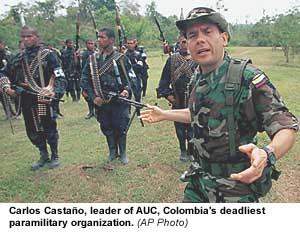 Eleven years after the fall of the Berlin Wall, the Cold War remains hot in Colombia. The U.S.-backed Colombian military has been fighting against various Marxist guerrilla organizations (
 According to DEA documents, MAS was founded in 1981 by Escobar’s Medellín cartel. But the Castaño brothers and Escobar later fell out. Fidel Castaño became chief of operations for a paramilitary strike force called “Los Pepes” (People Persecuted by Pablo Escobar). Following Fidel’s mysterious 1994 disappearance in northern Colombia, Carlos emerged as Colombia’s leading anti-communist militant.
 On May 30 of this year, Castaño issued a cryptic online communiqué announcing his resignation as military commander of the outlawed AUC. Days later, he announced that he was forming a nonviolent political organization, linked to the AUC, that would seek legal recognition in Colombia (none was granted). And he continued to grant interviews.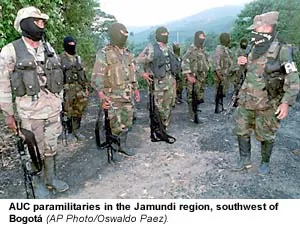
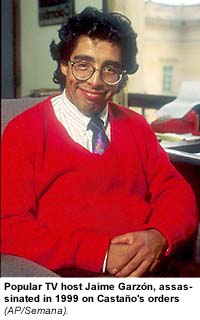 While Castaño has been linked to numerous attacks on the press, he currently faces just one criminal charge over an attack on a journalist. The charge, aggravated homicide, relates to the 1999 murder of Colombian television host Jaime Garzón. According to the official charge sheet, Castaño ordered Garzón’s murder because of the journalist’s role in negotiating the release of hostages held by leftist guerrillas.