With China’s press becoming more market-oriented, journalists are reporting more aggressively on crime and corruption-and are facing violent retribution for their work
as a result.
A Special Report by Sophie Beach
Photojournalist Tony Huang sits in a McDonald’s in Guangzhou, the capital of China’s southern Guangdong Province, distracted and nervous that he might be recognized. Part of a new breed of young Chinese journalists who investigate crime and uncover corruption, Huang has paid for his work many times, often at great physical expense. Huang pulls up a pant leg to reveal a long, gruesome scar, a reminder of one of those attacks, less than a year ago, when he was chased down and beaten by a criminal gang he was investigating undercover.
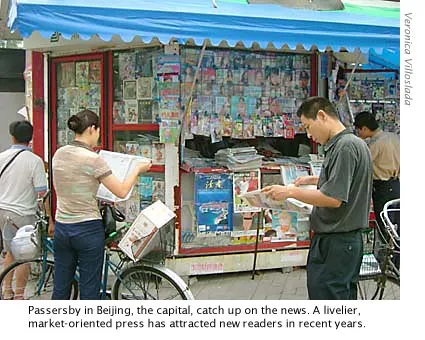
Censorship, detention, legal action, and arrest–the threats historically faced by journalists in China’s tightly proscribed media environment–have been long and well-documented by the Committee to Protect Journalists (CPJ) and other press freedom groups. Forty-two journalists are now in prison in China, most for revealing corruption among high-level government officials, advocating political reforms, or reporting on other banned topics.
But a CPJ investigation has found that as the media in China become market-oriented–and as journalists report more aggressively on crime and corruption–they face a new danger: violent retribution from individuals or groups implicated in their reports.
Violence against journalists is routine in other Asian countries such as Bangladesh and the Philippines. But in China, where the press has been tightly controlled since the Communist Party took power in 1949, these attacks are a new phenomenon. The government’s relaxation of social controls and the privatization of the economy have helped foster an environment where violent crime and lawlessness are increasingly common. With the rule of law still weak in China and the central government not prepared to actively defend journalists’ right to free expression, reporters have little recourse to defend themselves against attack.
 No nationwide statistics are available, but even partial evidence highlights the emerging problem of violence against journalists. CPJ has investigated attacks against more than 20 journalists since 2002, and many more cases have been reported in the Chinese media. Zhongguo Qingnian Bao (China Youth Daily) listed 19 cases of journalists being beaten in 2003 alone. And the trade association representing journalists says it has been contacted hundreds of times by journalists attacked or threatened. In response to the upsurge, some insurance companies in China now list journalism as the third most dangerous career in the country, after police work and coal mining.
In interviews with CPJ, Chinese journalists working for daily or weekly publications expressed deep concern about the threat of violence. This report is based on interviews conducted with more than 20 Chinese journalists during a CPJ research mission to China in May 2004. The report also draws on research conducted by CPJ staff during the last year, including interviews with Chinese journalists visiting or living in the United States. Most of the journalists interviewed spoke on condition of anonymity.
New Economy Fosters Changes
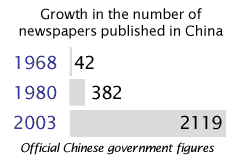
During the last 20 years, China’s media have undergone profound changes, resulting in more dynamic, aggressive, and prolific reporting on a wider variety of topics than ever before. While political reporting is still tightly controlled, Chinese journalists have transformed themselves from state propaganda workers and government mouthpieces into professional reporters who cover aspects of society, economics, and international affairs that would have been prohibited two decades ago.
The country’s economic reforms, initiated in the late 1970s by former paramount leader Deng Xiaoping, helped launch media reforms by decreasing government subsidies to the media and making publications and broadcasters more reliant on advertising and circulation fees to stay afloat.
Today, the government officially owns all media, but in 2003, the government initiated plans to formally allow private investment. According to news reports, the plan also stipulated that the central government would end its financial support of all publications except Renmin Ribao (People’s Daily), Guangming Daily, Jingji Ribao (Economics Daily), and Qiushi (Seeking Facts) magazine. The reforms were delayed after the 2003 SARS crisis, because officials stated that massive media reforms might disrupt social stability, but they are now back on the table.

Despite the lack of formal reform, private investment in the media is increasingly widespread through indirect, legally ambiguous channels. Several major official newspapers have launched tabloid-style dailies or weekend editions, often with private investment or advertising revenue, which become their primary income generator. As a result, these publications operate with relative independence.
As this commercialization of the media progresses, and editors learn that newspapers can be valuable money-making enterprises, journalists have been encouraged to report more aggressively on stories that comprise the bulk of tabloid journalism around the world: crime, low-level corruption, police brutality, celebrity gossip, and natural and man-made disasters. Local officials often tolerate this reporting, as long as it brings in revenue for the provincial or municipal government, and it doesn’t touch too closely on their own leadership.
The central government establishes media policy and censorship guidelines, primarily through the Central Propaganda Bureau, which is under the direct control of the Communist Party, as well as the State Press and Publications Administration and the State Administration of Radio, Film, and Television, organs of the State Council of the national government. Orders are usually filtered down to local propaganda bureaus in the provinces or municipalities, which notify local editors and journalists of banned or subscribed topics. Local authorities have tremendous leeway in how strictly, or in what ways, they enforce these often vague orders from the central government, leaving journalists largely at the mercy of provincial, municipal, or county officials.
Increasingly, the subjects of investigative reports rely on violence to send a message to the press about what stories will not be tolerated. Journalists have few means for legal recourse, and the central government seldom interferes to defend them.
Print journalists appear to bear the brunt of the violence because media reforms have affected the printed press faster than other sectors. Nevertheless, some television reporters have encountered violence, especially as investigative reporting shows become more common. Out of the 19 attacks on journalists listed by the Zhongguo Qingnian Bao, five incidents involved television journalists, including China Central Television reporters in Shanxi Province who were beaten while investigating environmental pollution by industry there.
A Growing Problem
Deadly violence against journalists is still rare in China compared with countries such as the Philippines or Colombia, where journalists are routinely assassinated with impunity. CPJ has documented the case of one Chinese journalist who was killed for his work: Feng Zhaoxia, an investigative reporter for the Gejie Daobao in Xi’an, Shanxi Province, who was killed in January 2001 after reporting on criminal gangs and their links to corrupt local politicians.
Nevertheless, threats of violence or physical attacks are commonly used against Chinese journalists. Zhang Weiguo, a former journalist with the Shanghai-based Shijie Jingji Daobao (World Economic Herald), which was closed after the 1989 democracy movement, says that, “This problem is getting more and more serious, and the severity of the problem lies in its universality. Since the 1990s, violence against journalists has existed in all areas of the country. … The incidents that are reported now only represent part of the problem.”
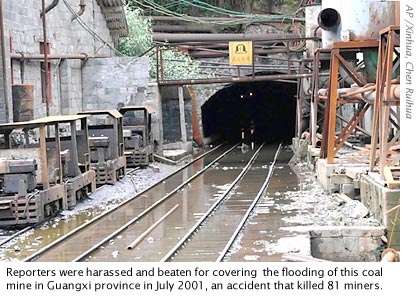 In recent years, a number of high-profile cases have brought the issue of violence against journalists to public attention and have inspired Chinese journalists to speak out in defense of their basic right to report. In July 2001, efforts by local officials to cover up a mining disaster near Nandan, Guangxi Province, received widespread media attention inside China and worldwide after it was revealed that journalists were beaten, threatened with death, and otherwise harassed for reporting on the accident, which killed at least 81 miners. After the central government finally intervened, the owner of the mines and 90 others were arrested for the disaster and for conspiring with local officials to conceal it.
Journalists point to a range of reasons for the upsurge in violent attacks. The rapid commercialization of the media has created a risky environment. Journalists working for the new, tabloid-style publications are more likely to be victims because those papers focus on stories that bring reporters into contact with corrupt local officials, criminal elements, or other people who do not want their activities publicized. As one editor based in Guangzhou told CPJ, “Journalists from more market-oriented papers are more likely to be victimized because they report on crime and corruption. As the media becomes more market-oriented, attacks on journalists will become more common.”
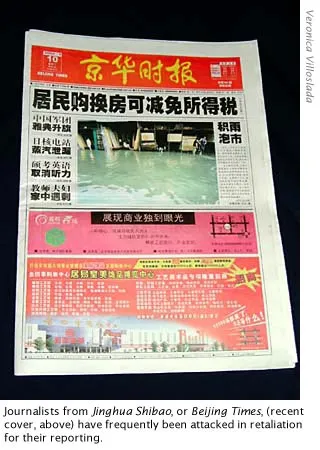 In Beijing, for example, the newspaper widely cited as having the most journalists attacked is the daily tabloid Jinghua Shibao (Beijing Times). According to an editor at another Beijing paper, Jinghua Shibao has earned this distinction by being the “most active media in Beijing, and being first on the scene” of breaking local news events. Jinghua Shibao was established in 2001 by the centrally controlled Renmin Ribao as a livelier, market-oriented, profit-generating subsidiary.
Journalists in major urban areas, such as the capital, Beijing, and Guangzhou, are more frequently targeted than their rural colleagues. The commercialization of the media has spread more quickly in major cities, where market reforms in the general economy have been implemented before they take hold in the provinces. A Guangzhou-based editor told CPJ, “In remote areas, journalists act more like officials, so they are less likely to be attacked. They can choose what not to report because they do not have market pressures.” Chinese journalists say that Beijing and Guangzhou are the sites of most attacks on journalists, followed by Chengdu and Xi’an, two other major metropolitan areas with active media.
Who’s to Blame?
While groups affiliated with government officials are responsible for many attacks against journalists, private individuals or groups are behind an increasing number of attacks. With the rise of private business in China, investigative reports into corruption, financial wrongdoing, or other sketchy business practices have become a lucrative and exciting new focus for journalists. A former editor at one of the newspapers with the prosperous and powerful Southern Daily Group told CPJ that the increase in attacks on journalists could be attributed to “the awakening of journalists’ consciences. They tend now to put more effort on muckraking reports, revealing illegal trades, commodities counterfeiting, dishonest entrepreneurs, and cronyism between businessmen and local officials, which offend both businessmen and officials, provoking assaults and violent attacks.”
Journalists say that hired thugs are responsible for many of the attacks. Tony Huang, the photojournalist in Guangzhou, says, “Plenty of people can be hired for 50 yuan [$US6] to beat someone up. So who can police arrest? They just run away and disappear.”
Huang’s experiences illustrate the dangers faced by young reporters excited by the prospects of exposing crime and uncovering the seedy underside of society. He works for one of Guangzhou’s numerous tabloid-style dailies. Guangzhou has the most liberal economy in China, as well as one of the highest crime rates and the most aggressive and independent media. This combination of factors makes it an exciting, but dangerous, place to be a journalist.
Huang lists the times he has been attacked during the last four years: A guard at an underground strip club gave him a concussion after discovering he was a reporter; while reporting on a man who had beaten his wife, the husband’s friends beat him and another reporter; he was beaten again by People’s Liberation Army soldiers while reporting on illegal activity at an entertainment hall.
He has landed in the hospital several times, and he knows other reporters have had similar experiences. “At least every month, I hear of a journalist who is attacked,” he says.
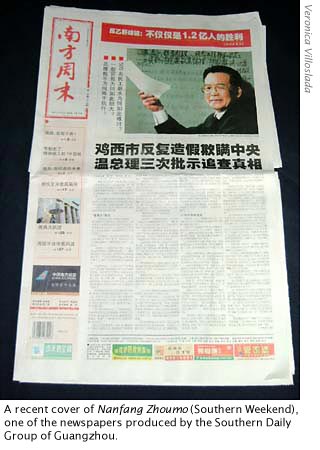
Security guards hired by both private citizens and public officials are responsible for most of the attacks on journalists that CPJ has documented. In one of the most widely publicized cases from 2003, security guards beat eight journalists from newspapers based in Nanjing who tried to attend a meeting at the provincial Jiangsu Education Bureau headquarters. A photographer from the Nanjing Chenbao (Nanjing Morning Post), Gao Aiping, was knocked unconscious and brought to a hospital. He later told reporters that it was the third time in a year he had been attacked while working. Another journalist told the Nanfang Zhoumo (Southern Weekend), “I have been a journalist for 34 years, but I have never encountered a case like this, in which so many journalists were beaten, and in the offices of a provincial-level department.”
 In the last year, the Chinese media have reported a number of cases of paparazzi-style journalists covering celebrities who have been beaten by private guards. In February 2004, Sina.com, one of China’s largest web portals, published dramatic photographs of three journalists being beaten while reporting on the set of a movie in Yunnan Province. More than 10 workers on the movie set surrounded and attacked the journalists and then threw them into a river. The assault came after the journalists began reporting on local villagers’ complaints about their treatment by the film company.
As in other places in the world, the more powerful the targets of journalists’ reports, the greater the risks. Wang Keqin is an investigative reporter who has earned a reputation as “China’s most expensive reporter” because of the price that has been put on his head as a result of his writing. In 2002, he conducted a large-scale investigation into corruption within the securities market in Lanzhou, the capital of northwestern Gansu Province. His reports led to the government closing more than 400 illegal firms in 26 provinces. After the reports were published, Wang received several death threats, and one businessman implicated in the reports offered 5 million yuan (US$600,000) for his head. Local officials in Gansu banned his reports, claiming he was inciting “instability,” but he moved to Beijing and has continued his investigations for Zhongguo Jingji Shibao (China Economic Times).
What Can Be Done?
|
CPJ’s Recommendations Over the past 20 years, Chinese journalists have begun to redefine themselves as independent and professional reporters. The responsibility now lies with the government to institute concrete measures to help society respect and understand journalists’ new role. Specifically, CPJ calls on Chinese authorities at both the central and local level to take the following steps to ensure journalists’ safety while reporting:
If journalists are going to be encouraged by the government and by their business owners to investigate corruption and crime, they deserve reassurance that they will not be risking their lives in doing so. |
A climate of impunity encourages would-be assailants to attack journalists. Because journalists have played the role of government propagandists for so long, the larger society is not accustomed to their evolving watchdog role. An editor at a weekly in Beijing told CPJ, “Government leaders say they want journalists to report, to supervise society, but there is no protection for journalists. The law doesn’t clarify journalists’ role. The public dislikes the media, and no one tells journalists what their rights are.”
Zhang Weiguo, the former Shijie Jingji Daobao journalist, attributes the rise in attacks to the general decline in law and order in Chinese society, as well as to the change in journalists’ status in society. “In the past, journalists were considered ‘state cadres’ and were part of the ruling apparatus. Apart from the limitations on speech, journalists in fact enjoyed certain special rights in society. With the market reforms in the media, this situation has changed, and journalists have lost their privileges,” he says.
The most powerful way to protest attacks on journalists is to report them openly. Journalists say their editors are largely supportive and realize that publicizing the incidents is often their only means for recourse. Unless high-level officials are implicated, journalists say there are few constraints on reporting on such attacks.
The All-China Journalists Association (ACJA) is the only national organization whose mission is to protect journalists’ rights. But it is a government institution, and regulations against the formation of independent, nongovernmental organizations prevent journalists from organizing outside official structures. Chinese journalists generally view the ACJA with derision as a weak, official organization that has the government’s interests at heart, not those of journalists. Nevertheless, after their reporters are attacked, editors sometimes file a formal complaint with the ACJA, to put it on the record.
The ACJA announced in November 2003 that it had been contacted more than 350 times since 1998 by journalists requesting protection. The chairman of the organization’s Committee to Protect the Legitimate Rights and Interests of Journalists said that while “quite a few of these cases were resolved satisfactorily with the committee’s support, statements, and active hard work…efforts to protect journalistic rights are still inadequate in many ways,” according to a report from Xinhua, China’s state-run news agency.
Occasionally, reporters or their editors file charges against assailants, but this has been successful in only a very few cases. In June 2003, two assailants were sentenced to one year in prison for beating Yang Wei, a photojournalist for the Jinghua Shibao who was attacked in March 2002 while investigating reports of mismanagement at a real estate company in Beijing. According to Renmin Ribao‘s Web site, the arrests marked the first ever conviction in Beijing in the attack of a journalist.
Chinese journalists almost universally acknowledge that attacks carried out by members of the military remain strictly off-limits for prosecution or even reporting. Although several journalists interviewed by CPJ recounted incidents in which soldiers had beaten them or their colleagues, such incidents are almost never publicized or reported to government authorities. Military affairs remains one of the most strictly controlled topics in the Chinese media, and editors know that too much risk is involved with reporting such attacks. “We’re not allowed to report on attacks by the army or other powerful groups,” one journalist told CPJ, “But the army is responsible for many attacks against journalists.”
In the mid-1980s, journalists launched a movement to get a media law passed that would spell out legal protections for a free press. After the military crackdown on the 1989 democracy movement, however, such legislation was sidelined. Journalists concerned with violence against their profession have called for a law to protect their “right to report,” though there is disagreement on how effective such a law could be or what purpose it would serve.
Proponents of such a law say they have not been able to make much progress in the legislative process because the topic is too sensitive. “A media law has been initiated several times by different legislators, but due to the sensitivity of the topic, which might include discussions of freedom of speech, it has never been seriously discussed,” one journalist said. Other journalists fear that such a law would be misinterpreted to further limit their rights. “The law in China is used for political power, not to reflect citizens’ rights. There’s a risk that [a media law] would turn into a law to limit journalists’ reporting,” an editor in Guangzhou told CPJ.
Some local legislators have taken steps to enact legal protections for journalists. Last year, the Yining County government in the Xinjiang Uighur Autonomous Region implemented “Regulations on Not Refusing Interviews by Journalists,” which states that “no department or work unit may…abuse or harass journalists or confiscate or destroy their reporting equipment.”
While violence is a deep concern for many reporters, several point out that the threat of attacks do not concern them as much as the overall environment in China, where free speech and a free press are not tolerated, and where journalists can be jailed or publications shuttered at any time. “The main problem remains not being able to write what we want to write,” an editor at one of Guangzhou’s most progressive and popular newspapers told CPJ.
This, too, may be changing. Yu Guoming, a journalism professor in Beijing, recently told the Chinese press that the rise in attacks on journalists represents “an increase in the frequency, power, and range of the media’s activity in society. For the development of the media, this is a mark of progress.”
Sophie Beach served as CPJ’s senior research associate for the Asia Program.