Unrest shatters press freedom gains in the Democratic Republic of Congo with attacks and imprisonments surging yet again.
A Special report by Julia Crawford
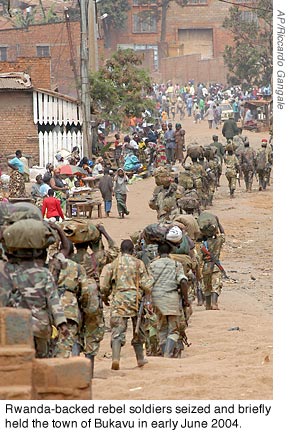
The fragile state of press freedom in the Democratic Republic of Congo was shattered when the eastern city of Bukavu fell briefly to Rwandan-backed rebels in early June. State-imposed restrictions and imprisonment, as well as rebel-backed threats and attacks, limited independent reporting. With the flow of information constricted, rumors flourished and apprehension spread throughout this central African nation of 53 million.
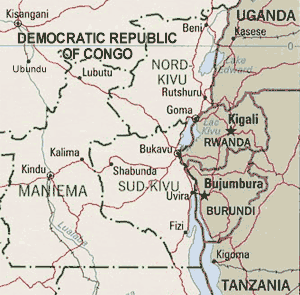 In a two-month period surrounding the unrest, the government issued at least three directives restricting coverage, authorities imprisoned at least four journalists, and attackers allegedly led by an army officer severely beat another journalist, an investigation by the Committee to Protect Journalists has found.
During that same time, CPJ found, rebels forced Bukavu’s three main community radio stations to close and threatened at least four journalists, forcing them to flee. Rebels were also blamed for killing the brother of radio station director Joseph Nkinzo, whom they mistakenly believed was the journalist.
A CPJ delegation traveled to the DRC in June, confirmed the deteriorating conditions for journalists, and met with government officials and press leaders. The new attacks against the press, CPJ found, reflect ongoing and fundamental obstacles to press freedom in the DRC. They are:
- The government continues to issue edicts to restrict and censor press coverage.
- Continuing violence and insecurity, especially in eastern parts of the country, threaten the safety of journalists.
- Abusive and outdated laws–the legacy of the late dictator Mobutu Sese Seko–are still used to imprison and silence journalists who dare offend government officials.
- The profession is chronically beset by economic problems and a lack of training.
Government tightens grip
Just weeks before the unrest, optimism had marked World Press Freedom Day (May 3) in the DRC, where journalists had been frequent targets for violence, harassment, and imprisonment during two civil wars in 1996-97 and 1998-2003.
Media groups noted that no DRC journalist was in prison and that reporters were working more freely and safely. Press conditions had gradually improved, they said, since the Kinshasa government of President Joseph Kabila and the main rebel groups signed an agreement in December 2002 to end years of civil war.
Their optimism soon evaporated. Two groups of Rwandan-backed rebels in the east, led by dissident army commanders Col. Jules Mutebusi and Gen. Laurent Nkunda, joined forces to take control of Bukavu on June 2 and hold the city for a week. The rebellion prompted violent demonstrations in Kinshasa and elsewhere against the United Nations, which had been unable to prevent Bukavu’s fall, and political parties participating in the transition. And on June 11, the government had to turn back an attempted coup by Maj. Eric Lenge, a member of the presidential guard. Lack of official information about the coup and Lenge’s whereabouts helped fuel more rumors and speculation.
With fighting around Bukavu in the east and political tensions running high elsewhere, the government sought to restrict the press and warned of sanctions against those who did not follow the government line. A May 27 communiqué signed by Vital Kamerhe, the press and information minister at that time, said that all TV and radio stations were “strictly forbidden to broadcast messages likely to aggravate the situation.”
On June 5, Kamerhe summoned editors of media outlets in Kinshasa and issued further warnings. According to CPJ sources, Kamerhe told them the country was on a war footing, that there should be no speech or images to discourage the population or the army, and that editorial lines should be patriotic. This was followed by a June 12 circular in which he cautioned the media against “words that might demoralize the Congolese Armed Forces” or “treating lightly the unfortunate events that threaten the peace process.” He again warned of sanctions.
Saying the minister’s note contained “barely veiled threats,” the local press freedom group Journaliste en Danger (JED) denounced “repeated attempts to muzzle the press or dictate the editorial line of press outlets.” JED said that since no state of emergency had been declared, the minister had no right to issue circulars that contravened articles 27, 28 and 29 of the transition constitution, which guarantee freedom of expression and of the press.
In a June 13 meeting, Kamerhe told CPJ that the directives were necessary because of the crisis and his belief that the press was capable of “inventing anything” to sell newspapers. As examples, Kamerhe said media reports had accused Vice President Azerias Ruberwa, head of the former rebel RCD party, of conspiring with Rwanda, and had accused the United Nations of plotting with rebel commander Mutebusi.
| CPJ’s RECOMMENDATIONS To the government of DRC:
To rebel forces:
|
“We are a young democracy to trust journalists 100 percent to censor themselves,” Kamerhe said. Under the 2002 peace accord, Kabila will remain in power until 2005 with four vice presidents from both the armed and unarmed opposition. In 2005, the DRC is to hold its first democratic elections since independence in 1960.
For now, dissent is not easily tolerated. On July 19, Lumbana Kapassa, director-general of private TV station RTKM, was summoned to the government security services office in Kinshasa and questioned for three hours.
The focus of the interrogation: an RTKM broadcast showing Honoré Ngbanda Nzambo ko Atumba, former defense minister and special security adviser to Mobutu, addressing exiled officers of the dictator’s former army. In his speech, shown in a recorded broadcast from Brussels, Ngbanda criticized the current regime in Kinshasa but urged the exiled soldiers to return to the DRC and join a new integrated army being created under the peace agreement, according to JED.
Interrogators threatened Kapassa and confiscated tapes of the broadcast, JED reported. Kapassa was told that RTKM should never again broadcast anything featuring Ngbanda.
Threats and assaults from rebels
Threats have come from rebels as well. Rebel forces that took Bukavu in June threatened and attacked three of the city’s main radio stations–Radio Maria, Radio Maendeleo, and Radio Sauti ya Rehema–forcing them off the air until government forces retook the town a week later. Joseph Nkinzo, director of Radio Sauti ya Rehema (Voice of Mercy), narrowly escaped an assassination attempt when rebels came looking for him and murdered his younger brother Mukamba Mwanaume, whom they thought was the journalist.
Ben Kabamba, director of Radio Maria; Kizito Mushizi, director of Radio Maendeleo; and Nkinzo had been receiving death threats by telephone since May 29. CPJ sources said the rebels began hunting for the three station directors shortly after taking the town. The rebels accused the stations of “genocidal ideology” against Congolese Tutsis known as Banyamulenge, but JED and other independent observers said they found no evidence of this. Nkinzo, Kabamba, and Mushizi took refuge in the U.N. compound in Bukavu and were then temporarily evacuated to Kinshasa, with the help of JED, CPJ, and others.
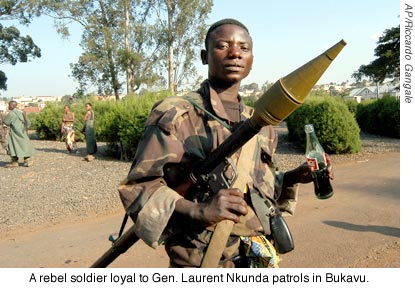
Although the rebels withdrew from Bukavu on June 9, there were continuing reports of clashes in eastern parts of the DRC and of rebel elements targeting journalists. Soldiers close to rebel army commander Laurent Nkunda began hunting for Déo Namujimbo, the Goma (North-Kivu Province, eastern DRC) correspondent for the France-based news agency Syfia, after an article he wrote denouncing a “reign of terror” by Nkunda’s men appeared on Syfia’s Web site on July 15.
In his article, Namujimbo claimed that “for the last month and a half, the population of Minova, not far from Goma, has been living in terror because of harassment by soldiers of Nkunda encamped in the region. Racketeering and rape are frequent.” His article was reprinted in newspapers in Kinshasa, including the July 17 edition of the daily Le Potentiel.
Namujimbo’s neighbors told JED that soldiers came looking for him on the night of July 17, asking when the journalist would return home. The next day, Namujimbo was forced to flee with his family to Bukavu and go into hiding.
At least one attack is allegedly linked to a government soldier. On June 20, 2004, Modeste Shabani, director of the community radio station Sauti ya Mkaaji (Voice of the Farmer) in Kasongo, eastern DRC, was severely beaten and later hospitalized in intensive care, according to JED. An army officer from the former rebel movement RCD, Col. Bokeone Alumba Okoko, allegedly led the attackers, according to JED. Sauti ya Mkaaji had broadcast reports denouncing alleged human rights abuses by Bokeone in Kasongo. The armed men stormed Sauti ya Mkaaji’s studio and threatened its staff before attacking Shabani.
JED reported that Shabani suffered hip and rib fractures and acute pain at the base of his neck. The day of the attack, a commission of inquiry launched by Maniema Provincial Governor Koloso Sumahili suspended Bokeone from his army post. Human rights activists are calling for the colonel to be prosecuted.
Outdated laws, new abuses
DRC legislation, notably the 1996 Press Law and the Penal Code, criminalizes a wide array of “press offenses” and allows journalists to be prosecuted under vague and outdated statutes introduced under Mobutu.
The charge most frequently invoked is defamation, which carries prison sentences of up to five years. The penal code defines defamation as attributing “maliciously and publicly” to a person “a precise fact which is of a nature to damage the honor or standing of that person or expose him to public humiliation.” It does not specifically say the “precise fact” must be untrue.
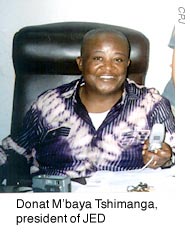 In a recent report, the local press freedom group African Media Institute (AMI) wrote: “By sentencing [journalists] systematically on the basis of defamation charges, the courts are in fact asking the press to avoid any words that could damage the honor and reputation of the politicians.” And JED President Donat M’baya Tshimanga told CPJ: “I think that wanting to protect people’s reputation over and above the public’s right to know, especially in the case of those in posts of public responsibility, is a violation of freedom of expression. I think it is a violation of the principles of transparency which should characterize the functioning of the state.”
Journalists in the DRC are often placed in so-called preventive detention–imprisonment without due process–as soon as charges are brought against them.
When the CPJ delegation arrived in the DRC, three journalists had been imprisoned on defamation charges in Kinshasa. Another was imprisoned on spying and trespassing charges related to filming for a story. And a fifth journalist had been sentenced to six months’ imprisonment, although he was free on appeal, for defaming a businessman.
CPJ and JED visited the four jailed journalists in Kinshasa Prison on June 6. The prison was overcrowded, and inmates complained of bad food and unsanitary conditions.
- Lucien-Claude Ngongo, deputy editor of the weekly newspaper Fair Play, was detained May 19 on defamation charges brought by wealthy expatriate businessman William Damseaux. Local journalists said he was questioned about articles denouncing Damseaux’s actions in a court battle with Berge Nanikian, another expatriate businessmen. Ngongo was released on July 28, after paying bail, according to JED. His trial began on August 2.
- Albert Kassa Khamy Mouya, former publication director of the weekly newspaper Le Lauréat, was imprisoned on May 27, after Damseaux’s lawyer brought defamation charges in connection with a March article, according to JED. The article also related to the legal battle between Damseaux and Nanikian. Kassa, who is diabetic, appeared to be in fragile health at the time of CPJ’s visit. CPJ and JED pressed for his release on health grounds. He was released on June 29, pending further proceedings, after being hospitalized a week earlier.
- Rakys Bokela,editor of newspaper Le Collecteur, was imprisoned on May 21 on criminal defamation charges. The former president of the Congolese boxing federation, Aimé Luvumbu, filed the charges in connection with a February 18, 2004, article in Le Collecteur that accused him of malfeasance when he was head of the federation. Bokela was released on June 13, pending further proceedings.
- Gustave Kalenga Kabanda, editor and director of the independent weekly La Flamme du Congo, was arrested on June 7 at his home in Kinshasa. He was jailed on charges of filming illegally at the Gemena residence of Jean-Pierre Bemba, one of DRC’s four vice presidents, after Bemba accused him of spying and trespassing. Gemena, in Equateur Province, northern DRC, is a stronghold of Bemba’s former rebel movement, the MLC. Kalenga had led a team of seven Congolese journalists who visited Gemena from May 29 to June 5. The journalists filmed plantations and property belonging to the Bemba family, including a luxurious new residence being built by the vice president. Kalenga was released from Kinshasa Prison on June 26 after paying bail.
On June 19, Nicaise Kibel-Bel-Oka, publisher and editor of the private weekly Les Coulisses in the northeastern town of Beni, was convicted of defamation, sentenced to six months in prison, and ordered to pay US$5,000 in damages. Intelligence agents arrested him that same day. The charges stemmed from a December 2003 Les Coulisses article that accused local businessman Jacques Kiangu of failing to pay taxes on goods he imported from Uganda, according to JED. On July 10, Kibel-Bel-Oka was granted a provisional release on appeal.
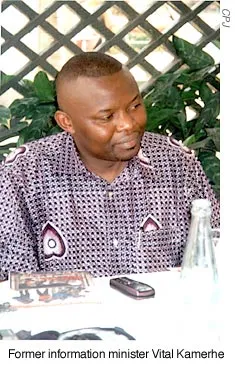
Kamerhe, who was information minister at the time of CPJ’s visit, told CPJ that the government’s policy was “zero journalists in prison.” Asked about the frequent jailing of journalists as soon as they are accused, he said it was an anomaly, and that the government would reform the 1996 Press Law.
“You are right,” Kamerhe told CPJ. “You shouldn’t start immediately arresting and locking up journalists without a legal hearing, just because they have been accused.”
Yet changes in government leadership threaten such assurances. In July, Kamerhe became secretary-general of the presidential party PPRD and was replaced at the Information Ministry by Henri Mova Sakanyi, who was until then the deputy minister of foreign affairs. Journalists and independent groups are still assessing the new minister’s positions.
Low standards and pay
Early this year, journalists in DRC launched a campaign for the removal of criminal sanctions for press offenses. Kamerhe told them that he supported this in principle but said he believed that it should be done in stages.
“That should not be the starting point,” he told CPJ, “because if you decriminalize completely in an environment where the culture of the journalist and his level of training are not the same as in the countries which have decriminalized, that might open the door to abuses.”
|
Media Regulatory groups in the DRC
Several media regulatory groups in the Democratic Republic of Congo have powers that include suspending programming and journalists’ press credentials. The three main bodies are: High Authority on Media (Haute Autorité des Médias, HAM) Congolese National Press Union (Union Nationale de la Presse Congolaise, UNPC, formerly UPC) Observatory of Congolese Media (Observatoire des Médias Congolais, OMEC) |
Poverty, he said, was a factor. “People are always saying that we have huge natural resources, that we are a potentially rich country, but the reality is that people are living in poverty comparable to that of Somalia,” Kamerhe said. “And somebody who lives like that, he might be using his pen just to get something to eat and will not hesitate to violate the rules of the profession.”
And though journalists believe that poverty is no excuse for keeping criminal sanctions for press offenses on the books, many who spoke with CPJ also expressed concerns about the quality of journalism in the DRC. They cited the weak economy, low salaries, and poor working conditions as threats to the independence of journalists and media outlets. According to Kabeya Pindi Pasi, president of the Congolese Press Union UNPC, most journalists do not have work contracts, and many lack training.
Some of these problems were evident during the crisis in Bukavu.
Anti-Rwanda and anti-U.N. articles were particularly prevalent following the fall of Bukavu. For example, the daily newspaper L’Avenir ran an unsubstantiated claim that the U.N. escorted Rwandan troops into Bukavu. This same article appeared at least twice on the paper’s front page, on June 3 and 7. The June 7 edition also carried an article on inside pages reporting unsubstantiated claims that Rwandan women had infiltrated Kinshasa to seduce and poison Congolese men.
A front-page headline in the June 3 edition of daily Le Palmarès claimed that Rwandan President Paul Kagame had sent 4,000 troops to help the rebels in Bukavu but gave no source for this information.
For some, the answer to these problems lies in professional regulatory groups, three of which have been created recently (see box above).
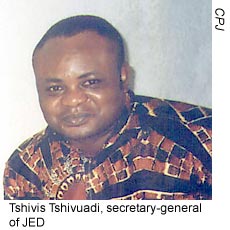
JED Secretary-General Tshivis Tshivuadi said the need to raise standards has been readily acknowledged and is being addressed. Now, he said, it is time for the government to ensure that journalists can report freely and safely.
“All the conditions have been fulfilled for the government to take a political step,” he said, “to give a signal to say that it wants to let the press work freely, instead of working always under the shadow of that fear, that pressure, of knowing you could go to prison at any moment.”
Julia Crawford is CPJ’s Africa program coordinator.