Go »
  Go »

Senegal

2009


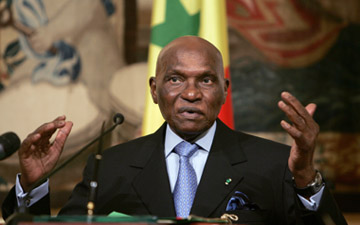
Senegalese President Abdoulaye Wade (AFP)

Senegalese President Abdoulaye Wade has written a response to a recent CPJ protest letter. While we welcome his attention to the issues we raised about press freedom last month, we note with great concern the president’s comments about the ongoing criminal case of two journalists assaulted by police in 2008.
September 23, 2009

His Excellency Abdoulaye Wade
President of the Republic of Senegal
c/o Permanent Mission of Senegal to the United Nations
238 E. 68th St.
New York, NY 10021

Via facsimile: (212) 517-3032

Dear Mr. President,

The Committee to Protect Journalists is heartened by your recent directive to the prime minister to renew consultations with the press on the decriminalization of press offenses in Senegal. Yet your directive came on the same day a judge in the central town of Kaolack imprisoned two journalists who reported allegations of local government corruption in the distribution of seeds—a reminder of the urgent need for press law reform.

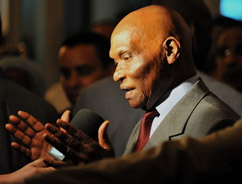
Abdoulaye Wade (AFP)

According to an official statement reported by the state-run Senegalese Press Agency, you asked the prime minister on Friday to start talks with the press. Also on Friday, Judge Mamadou Kane of the regional tribunal of Kaolack jailed reporters Papa Samba Sène of private daily L’As and Abdou Dia of Radio Futurs Médias, according to local news reports. Kane charged the journalists with defamation, publishing false news, and criminal conspiracy under Senegal’s penal code based on a complaint by the regional governor, according to local journalists.

We urge you now not only to decriminalize press offenses, but also to address a culture of impunity for those who attack journalists and to review the police’s practice of interrogating journalists who criticize your administration.

In prepared remarks to your delegation in Washington last week, which included the foreign minister and the Senegalese ambassador, U.S. Secretary of State Hillary Rodham Clinton encouraged the government to “fight corruption,” and “make every aspect of government policy and operation more transparent and accountable.” However, since 2004, when you publicly called for a reform of Senegal’s 1977 Penal Code, at least 12 journalists have been sentenced to prison on libel charges, while charges against four others were dropped, according to CPJ research. In recent years, government prosecutors have charged journalists with various penal code statutes, including threatening law and order” (Article 80), offending the head of state (Article 254), and publishing “false news” (Article 255). The administration has resisted the reform of press offenses, despite a comprehensive proposal submitted in December 2004 by civil society members and backed by UNESCO, according to our research.

Mr. President, we also ask you to review long-standing censorship and intimidation practices, such as interrogating journalists and blocking the distribution of information or views critical of your administration. This year for instance, a judge blocked the distribution of the June edition of the monthly newsmagazine L’Essentiel, ruling that its headlines, which criticized your government’s performance, risked “gravely disturbing public order,” according to news reports. On August 28, the Criminal Investigation Division of the Senegalese police interrogated three journalists of daily Le Quotidien for several hours, pressing them to reveal sources and retract stories critical of the administration, according to the same sources. 

Finally, we urge you to use your influence to address a pattern of impunity for those involved in harassing and attacking journalists for their coverage. For example, none of the policemen involved in the June 2008 beating of sports journalists Babacar Kambel Dieng and reporter Kara Thioune have been charged, according to local journalists. In fact, CPJ investigations found that members of your administration, supporters of your party, security forces, and followers of the politically influential Mourides Muslim brotherhood involved in incidents of physical and verbal abuse of journalists have seldom been publicly brought to account or prosecuted to the full extent of the law.

We would like to encourage you to continue to take positive steps toward restoring your country's reputation as a haven of press freedom. Thank you for your attention to this matter.

Sincerely,

Joel Simon
Executive Director

A year ago last week in Senegal, two reporters covering a soccer match were assaulted with tasers, handcuffed, and abused by police officers after the reporters refused to halt a post-game interview at Léopold Sédar Senghor Stadium in the capital, Dakar. A year on, Senegalese law enforcement has fallen short in bringing to account those responsible for this and other abuses against the media.

On April 24, 2009, journalist El Malick Seck, who was serving a three-year prison sentence over an editorial implicating President Abdoulaye Wade and his son in an alleged money laundering scandal, was released on presidential pardon, according to local journalists and news reports. The sentence had been upheld in February. He was first imprisoned on August 28, 2008.

An appeals court in the Senegalese capital of Dakar upheld a three-year prison sentence against imprisoned editor El Malick Seck on February 23, 2009, according to international and local news reports. The case involved an editorial implicating President Abdoulaye Wade and his son Karim in an alleged money-laundering scandal.

Conditions deteriorated in Senegal, once considered a haven for press freedom. With contemptuous rhetoric, threats, physical violence, and criminal prosecutions, supporters of President Abdoulaye Wade and members of his government retaliated against critical journalists. The June 21 beating of two sports journalists covering a World Cup qualifying match in Dakar symbolized the tensions and ignited a contentious national debate over press freedom.

« Previous Year: 2008 | Next Year: 2010 »

  Go »
Text Size
A   A   A
Contact

Africa

Program Coordinator:
Sue Valentine

Advocacy Coordinator:
Mohamed Keita

East Africa Consultant:
Tom Rhodes

West Africa Consultant:
Peter Nkanga

svalentine@cpj.org
mkeita@cpj.org
trhodes@cpj.org
pnkanga@cpj.org

Tel: 212-465-1004
ext. 117
Fax: 212-465-9568

330 7th Avenue, 11th Floor
New York, NY, 10001 USA

Twitter: @africamedia_CPJ

Blog: Mohamed Keita
Blog: Tom Rhodes
Blog: Peter Nkanga