Ecuador
2013
Janet Hinostroza Acceptance Speech
Arianna Huffington introduces Janet Hinostroza (Ecuador) with the Committee to Protect Journalists’ 2013 International Press Freedom Award. Janet Hinostroza. Teleamazonas, Ecuador. Acceptance Speech CPJ International Press Freedom Award 2013 . November 26, 2013. Waldorf-Astoria, 301 Park Avenue, New York City As prepared for delivery Thanks to CPJ for this award. I always wanted to be…
Honoring courage and defying repression
CPJ’s 2013 International Press Freedom Awards New York, November 13, 2013 — Four outstanding journalists who have endured and defied media repression in Ecuador, Egypt, Turkey, and Vietnam will be honored with the Committee to Protect Journalists’ 2013 International Press Freedom Awards, an annual recognition of courageous journalism. All have faced recrimination for their work,…
Honoring courage and defying repression
CPJ’s 2013 International Press Freedom AwardsNew York, November 6, 2013 — Four outstanding journalists who have endured and defied media repression in Ecuador, Egypt, Turkey, and Vietnam will be honored with the Committee to Protect Journalists’ 2013 International Press Freedom Awards, an annual recognition of courageous journalism. All have faced recrimination for their work, including…

News from the Committee to Protect Journalists, September 2013
Press freedom award winners announced Four journalists–Janet Hinostroza (Teleamazonas, Ecuador), Bassem Youssef (Capital Broadcast Center, Egypt), Nedim Şener (Posta, Turkey), and Nguyen Van Hai (Dieu Cay, Vietnam)–will be honored with CPJ’s 2013 International Press Freedom Awards in recognition of their courageous reporting in the face of severe reprisal.Upon receiving the news, Hinostroza told CPJ: “It will…
CPJ testifies on challenges to democracy in the Americas
Carlos Lauría’s testimony starts at 1:10 in the video. Carlos Lauría, CPJ’s Americas senior program coordinator, provided testimony before the Subcommittee on the Western Hemisphere of US House of Representatives on Tuesday. Lauría emphasized that violence and government harassment are the main emerging trends that illustrate the major challenges facing the press in the Western…

Ecuador loses investigative journal Vanguardia
Like the death of a loved one. That’s how Juan Carlos Calderón, editor of the newsmagazine Vanguardia, described the June 28 closing of the newsweekly that for eight years published hard-hitting investigations about public officials and faced frequent government harassment. Yet the final days of Vanguardia were almost as controversial as its stories.

Snowden travels trace a path of government hypocrisy
Edward Snowden’s global travels have highlighted the chasm between the political posturing and actual practices of governments when it comes to free expression. As is well known now, the former government contractor’s leaks exposed the widespread phone and digital surveillance being conducted by the U.S. National Security Agency, practices at odds with the Obama administration’s…
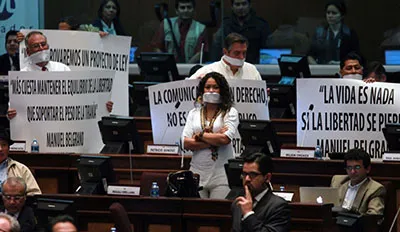
New Ecuadoran legislation seen as a gag on critics
After inspecting a hydroelectric project in northern Ecuador last year, President Rafael Correa complained about the scant press coverage of his visit and suggested it was part of a media blackout. “Did the Ecuadoran media conspire to ignore this important event? It seems like that is the case,” Correa told the crowd at a town…
CPJ dismayed by approval of media law in Ecuador
New York, June 14, 2013–The new Communications Law approved today by the Ecuadoran National Assembly represents a severe blow to freedom of expression, said the Committee to Protect Journalists. The law establishes regulation of editorial content and gives authorities the power to impose arbitrary sanctions and censor the press.

At OAS, a victory for human rights and free expression
By reaffirming the autonomy and independence of the regional human rights system and rejecting attempts to neutralize the work of the Inter-American Commission on Human Rights (IACHR) and its special rapporteur for freedom of expression, the Organization of American States (OAS) chose last week to discard proposals that would have made citizens throughout the hemisphere…