Go »
  Go »

Mexico

2012


Syrian violence contributed to a sharp rise in the number of journalists killed for their work in 2012, as did a series of murders in Somalia. The dead include a record proportion of journalists who worked online. A CPJ special report

A journalist dodges gunfire in the Syrian city of Aleppo. (AFP/Tauseef Mustafa)
(AFP/Pedro Pardo)

Almost half of the 67 journalists killed worldwide in 2012 were targeted and murdered for their work, research by the Committee to Protect Journalists shows. The vast majority covered politics. Many also reported on war, human rights, and crime. In almost half of these cases, political groups are the suspected source of fire. There has been no justice in a single one of these deaths.

Demonstrators clash with the police in Saturday's protest in Mexico City. (AFP/Pedro Pardo)

Mexico City, December 7, 2012--Mexican authorities must immediately release a freelance Romanian photojournalist who was detained on Saturday while covering a protest related to the presidential inauguration, the Committee to Protect Journalists said today.

The tortured and decapitated body of 39-year-old María Elizabeth Macías Castro was found on a Saturday evening in September 2011. It had been dumped by the side of a road in Nuevo Laredo, a Mexican border town ravaged by the war on drugs. Macías, a freelance journalist, wrote about organized crime on social media under the pseudonym "The Girl from Laredo." Her murder, according to the Committee to Protect Journalists, was the first in which a journalist was killed in direct relation for reporting published on social media. It remains unsolved.

Mexico City, November 15, 2012--A freelance journalist and his companion were shot to death Wednesday in the central Mexican state of Puebla shortly after the reporter had gathered information on a large-scale gasoline theft and then witnessed a stand-off between soldiers and gunmen, according to news reports and CPJ interviews.

Mexico City, November 8, 2012--Mexican authorities must thoroughly investigate the disappearance of journalist Adela Jazmín Alcaraz López, who was last seen nearly two weeks ago, the Committee to Protect journalists said today. 

Regina Martínez was killed in one of the most politically corrupt Mexican states. (AP Photo/Felix Marquez)

Veracruz is a beautiful, long, thin state on the Gulf coast of Mexico where many journalists are terrified not only of the rampant organized crime groups that kill and control, but also of the state government. Fear that state officials will order them murdered for what they investigate or write has forced about a dozen journalists to flee the state, claiming that fear also puts a clamp on coverage for those who remain. Many journalists still working in the state tell CPJ they agree.

As Venezuela's election nears, President Hugo Chávez has a clear advantage in media access because he has broken down the independent press with threats and regulations while building up a huge state media apparatus. (AP/Ariana Cubillos)

Violence and legal harassment: the two greatest obstacles to press freedom in Latin America today. That's the message that CPJ Executive Director Joel Simon is delivering this morning in Washington, D.C., at a briefing hosted by Congressman Sam Farr. Farr, a California Democrat, hosts a monthly series looking at emerging trends in the Western Hemisphere. The panel today also includes Commissioner Dinah Shelton of the Inter-American Commission on Human Rights and Delphine Halgand of Reporters Without Borders.

Mexico City, August 17, 2012--Mexican federal authorities should assume control of the investigation and prosecution of all cases of murdered and missing journalists in the state of Veracruz, the Committee to Protect Journalists said today. A state investigation into the murder of several journalists has raised numerous questions and concerns, CPJ found.

| Mexico, USA

Mexico must back up federal measure to protect press

Journalists protest the murder of a Mexican journalist earlier this year. (AFP/Sergio Hernandez)

Using guns, grenades, explosives, and other deadly means, criminals have assaulted four Mexican newsrooms in less than six weeks. One of the country's top journalists, Lydia Cacho, was the target of a chilling death threat last month. Journalists in Veracruz have gone missing or been killed this year. Press fatalities in Mexico remain among the highest in the world, leading to vast self-censorship. And the perpetrators? They are not only well organized and heavily armed, they enjoy near-complete impunity for their attacks on the press. Mexican lawmakers began to address the crisis this year, but now they risk losing the momentum.

Fire trucks park outside Sierra Madre. (Reuters/Daniel Becerril)

New York, July 30, 2012--Mexican authorities must immediately investigate an arson attack on the offices of a supplement owned by the daily El Norte, the third attack on an El Norte publication this month, the Committee to Protect Journalists said today.

Journalist Lydia Cacho, seen here in a 2006 conference, was threatened by unknown persons on Sunday. (Reuters/Henry Romero)

New York, July 30, 2012--The Committee to Protect Journalists is alarmed by a death threat made Sunday against Lydia Cacho, the Mexican investigative reporter and author, and calls on federal authorities to launch a thorough investigation.

New York, July 25, 2012--Mexican authorities must immediately investigate the disappearance of a crime photojournalist who was last seen on Thursday, the Committee to Protect Journalists said today. Miguel Morales Estrada worked in Veracruz, which has become Mexico's most dangerous state for the press, according to CPJ research.

Soldiers stand in front of the offices of a news outlet that was attacked early Tuesday morning. (AFP/Julio Cesar Aguilar)

New York, July 11, 2012--Unknown assailants using explosives, grenades, and guns attacked three news outlets in northern Mexico on Tuesday, causing property damage but no injuries, according to news reports.

Prominent Mexican journalist Sanjuana Martínez was arrested on July 5, 2012, in the state of Nuevo León under unclear circumstances related to a civil custody dispute, and was released from jail the following day, according to news reports. Martínez was detained by armed police, which is unusual in a civil case, the reports said.

New York, July 6, 2012--The Committee to Protect Journalists is concerned about the arrest of prominent Mexican journalist Sanjuana Martínez Thursday in Nuevo León under unclear circumstances related to a civil custody dispute. The judge who ordered the detention was the subject of critical reporting by Martínez in 2008.

Zeta reporter Sergio Haro in the film 'Reportero.' (Courtesy Quiet Pictures)

A week before Sunday's crucial presidential elections in Mexico, CPJ participated on a panel with filmmaker Bernardo Ruíz and Mexican journalist Sergio Haro about the perilous conditions for journalists in that country, where CPJ research shows 48 journalists have been murdered or disappeared since outgoing President Felipe Calderón took office in December 2006.

New York, June 22, 2012--Mexican crime journalist Stephania Cardoso, who had been missing with her son since June 8, is now under the protection of the federal government, a Mexican official has told CPJ.

Víctor
Manuel Báez Chino (AP/Milenio)

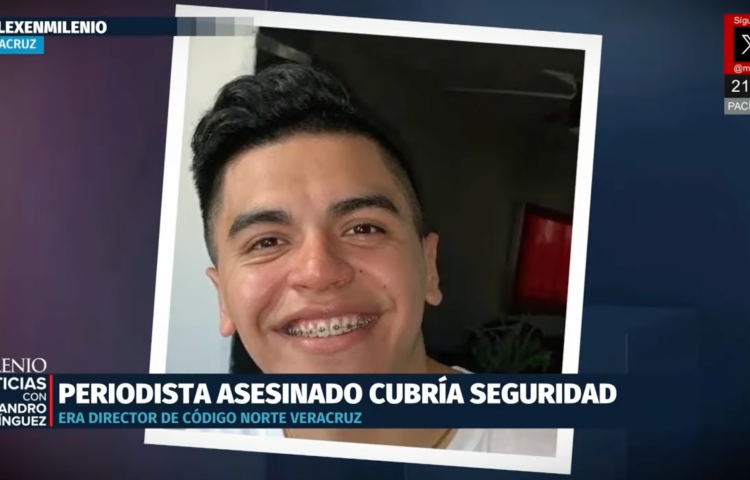
Mexico City, June 14, 2012--The body of Mexican journalist Víctor Manuel Báez Chino was found today in Xalapa, the capital of Veracruz state. He is the fourth journalist to be killed in Veracruz in the past two months.

Báez's body was recovered this morning near the main square in Xalapa, according to news reports. In a televised press conference, the state spokeswoman, Gina Domínguez, said officials received reports that three armed men abducted Báez Wednesday night at 11:30. Báez was the editor of the crime section for the state digital edition of the national newspaper Milenio and an editor of the website Reporteros Policiacos, which also covers crime, according to Milenio

Mexico City, June 13, 2012--Mexican authorities must immediately investigate the case of a journalist and her son who have been missing since Friday morning, the Committee to Protect Journalists said today.

New York, June 7, 2012--The Committee to Protect Journalists welcomes the final approval yesterday of a constitutional amendment that makes attacks on the press a federal offense in Mexico, a country where journalists are regularly targeted for their work.    

Investigators photograph graffiti implicating the Zeta cartel near where 49 corpses were found on the road near Monterrey, Mexico, on May 13. (AFP/Julio Cesar Aguilar)

They would tell you that the killers haven't let them cover real news for several years--if you call news serious information that's important to the public, like why the police didn't investigate so many murders or kidnappings or extortions. Or why drugs were sold so openly. Or that three former governors are being investigated for laundering money for the organized crime cartel that runs much of the state of Tamaulipas.

The body of Marco Antonio Ávila García was found on Friday. (Reuters/German Osuna)

New York, May 21, 2012--Mexican authorities must break the cycle of impunity in journalist murders by fully investigating the killing of police beat reporter Marco Antonio Ávila García and bringing the perpetrators to justice, the Committee to Protect Journalists said today.

Ávila's body, which showed signs of torture, was found on Friday on a dirt road near the city of Guaymas, in the state of Sonora, according to the state attorney general's office. An autopsy revealed that he had been strangled to death, news reports said. José Larrinaga Talamante, a spokesman for the attorney general, told reporters that a written message associated with organized crime had been left with the body, but he did not reveal any more details.

New York, May 18, 2012--The veteran crime beat reporter Marcos Ávila García was abducted Thursday afternoon in the Mexican town of Ciudad Obregón, in northwest Sonora state, according to news reports. Ávila reports for the local daily El Regional de Sonora, the newspaper said

Mexican journalists protest the murders of their colleagues. (AFP/Ronaldo Schemidt)

New York, May 4, 2012--The bodies of two Mexican news photographers who specialized in the crime beat were found along with the bodies of a former photojournalist and a fourth individual in a canal in the city of Boca del Río, in Veracruz state, according to news reports.

New York, May 3, 2012--The Committee to Protect Journalists condemns the murders of Mexican photographers Gabriel Huge and Guillermo Luna Varela, whose bodies were found today in La Zamorana canal in Veracruz state, according to news reports.

Safer mobile use is key issue for journalists

A journalist talks on his satellite phone outside the Rixos Hotel in Libya in August 2011. (AFP/Filippo Monteforte)

As the Internet and mobile communications become more integrated into reporters' work, the digital threats to journalists' work and safety have increased as well. While many press reports have documented Internet surveillance and censorship--and the efforts to combat them--mobile communications are the new frontline for journalist security.

The body of Regina Martínez Pérez was found in her home on Saturday. (Reuters)

New York, April 30, 2012--Authorities must immediately investigate the murder of Mexican journalist Regina Martínez Pérez, determine the motive, and ensure the perpetrators are brought to justice, the Committee to Protect Journalists said today.

The body of Martínez was found in her home on Saturday evening in Xalapa, the capital of the Gulf Coast state of Veracruz, according to news reports. She had been badly beaten around the face and ribs and had been strangled to death, news reports said. The state attorney general, Amadeo Flores Espinoza, said in a news briefing that it appeared her TV, cellphones, and computer had been stolen.


CPJ's María Salazar-Ferro names the 12 countries where journalists are murdered regularly and governments fail to solve the crimes. Where are leaders failing to uphold the law? Where are conditions getting better? And where is free expression in danger? (4:46)

Read CPJ's 2012 Impunity Index. And visit our Global Campaign Against Impunity and see how you can help.

CPJ’s 2012 Impunity Index spotlights countries
where journalists are slain and killers go free

The offices of El Siglo de Torreón after the November 2011 attack. (Courtesy El Siglo de Torreón)

It was 3 o'clock in the morning on Tuesday, November 15, 2011, when a car stopped in front of the offices of El Siglo de Torreón, the most widely read newspaper in the northern Mexican states of Coahuila and Durango. The driver pulled the vehicle onto the shoulder, stepped out, poured gasoline on it, and lit it on fire. From another car, AK-47 shots were fired at a window in the newspaper's offices across the street.

The attack lasted less than five minutes, enough time to complete the job without disturbance. Fortunately, the doors were locked and the staffers who remained inside were in the printing room, protected from the assault. We never found out who torched the car or shot at the windows. That November 15, we received calls from all types of authorities as well as promises of a thorough investigation that never happened.

New York, March 27, 2012--Mexican authorities must investigate attacks on a newspaper and TV station in the northeastern state of Tamaulipas and ensure the offices and its staff members are protected, the Committee to Protect Journalists said today. Both attacks occurred within the space of one week.

Defining who is a journalist, Mexican style

This month, the Mexican Senate approved an amendment to the country's constitution that would make attacks on journalists a federal crime in Mexico.

Days before the Senate approved the amendment, CPJ's Carlos Lauría met with Sen. José González Morfín, right, to speak about the risks that Mexican journalists face. (Ignacio González Anaya)

New York, March 13, 2012--The Committee to Protect Journalists hails the Mexican Senate's landmark approval today of a constitutional amendment that, if passed by a majority of states, would federalize anti-press crimes and transfer investigative powers to national authorities.

New York, March 13, 2012--The Committee to Protect Journalists welcomes the Mexican Senate's approval today of a constitutional amendment that makes attacks on the press a federal offense and calls on authorities to end the widespread impunity for crimes against journalists. 

The author, right, looks on as Sen. José
González Morfín, center, confers with CPJ Americas Senior Program Coordinator Carlos Lauría. (Ignacio González Anaya)

With near impunity in the murders of journalists a persistent reason for the terror and self-censorship among Mexican news organizations, legislators say the national Senate is on the verge of passing a constitutional amendment that would allow federal authorities to take over cases of crimes against freedom of expression. Passage would mean that the typically less corrupt and more effective federal police and prosecutors would move aside state authorities to tackle cases of murdered journalists or those living under threat.

Citizens, officials, and civil society groups joined journalists for Tuesday's discussion on the state of press freedom in Sinaloa. (Ron Bernal)

A unified front is crucial when facing a crisis in press freedom like that in the violent state of Sinaloa in Mexico, Colombian journalist and CPJ board member María Teresa Ronderos said this week. She was speaking to a packed room of print, radio, and television reporters; members of civil society groups; state legislators; union leaders; human rights activists; and even ordinary citizens, who had gathered for a discussion on the press in one of Mexico's most dangerous cities, Culiacán.

Online news sites as battleground for Mexican drug war

Danny O'Brien, left, consults with Carlos Lauría, senior program coordinator for the Americas, outside the offices of Noroeste. (Ron Bernal)

I'm in Culiacán, the capital of the Mexican state of Sinaloa. Part of my work here has been to investigate and highlight the cyber-attacks that the award-winning weekly local newsmagazine Ríodoce has encountered in its coverage of the violent drugs war here.

But discussing the experiences of online editors at other publications here has shown just how intertwined the Net, the work of reporters, and the drug war have become.

Police in Santiago seize a photographer during an anti-government demonstration. (Reuters/Carlos Vera)

Even as trade and new systems of communication turn us into global citizens, the information we need to ensure accountability often stops at national borders. New platforms like social media are valuable tools, but the battle against censorship is hardly over. By Joel Simon

CPJ awardee Natalya Radina.

How does one negotiate the choice to stay and report potentially dangerous news, rather than take a less risky assignment, leave the profession, or flee the country? The recipients of the 2011 International Press Freedom Awards explain. By Kristin Jones

The global rate of unpunished murders remains stubbornly high at just below 90 percent. Senior officials in the most dangerous countries are finally acknowledging the problem -- the first step in what will be a long, hard battle. By Elisabeth Witchel

A journalist crouches behind a cement block during clashes between Israeli forces and Palestinian protesters in the West Bank. (Reuters/Mohamad Torokman)

The danger of covering violent street protests has become a significant risk for journalists, alongside combat and targeted killings. Sexual assault, organized crime, and digital vulnerability are also hazards. The security industry is struggling to keep up. By Frank Smyth

Mexican President Felipe Calderón Hinojosa pledged action to deter anti-press attacks, but his government has accomplished little. (AP/Marco Ugarte)

The Mexican president promised to protect a besieged press corps with a federal protection program, a special prosecutor and new legislation making anti-press violence a federal crime. But Felipe Calderón Hinojosa has failed at nearly every turn. By Mike O'Connor

This video companion to Attacks on the Press recounts the story of Mexican journalist Javier Valdez Cárdenas, who works in one of the world's most dangerous places. (3:26)

Read the Attacks on the Press 2011 country profile on Mexico.

Murders decline, but fatalities rise during coverage of protests. Photographers and freelancers pay an especially high price. Pakistan is the world's most dangerous nation.

Criminal groups exerted extraordinary pressure on the press as they extended their control over virtually every sector of society. Journalists were killed or disappeared, media outlets were bombed and threatened. Pervasive self-censorship was a devastating consequence of this environment. In an information vacuum, journalists and citizens increasingly used social media to inform their communities. The murder of a Nuevo Laredo reporter was the first case documented by CPJ worldwide in which a person was killed in direct relation to reporting done on social media. At least three journalists were granted political asylum in the United States and Canada, and several others sought refuge in other countries. Several major news organizations agreed on a professional code in which they set protocols for journalists at risk and pledged not to be propaganda tools for criminals. But President Felipe Calderón Hinojosa's administration failed to implement effective reforms. Despite efforts to rejuvenate the office of the special prosecutor for crimes against free expression, anti-press violence went virtually unpunished. The government's new journalist-protection program was widely seen as ineffective. And while the Chamber of Deputies passed a bill to federalize anti-press crimes, the legislation remained pending in late year.

Brazil set to test Twitter's selective blocking policy

I've been telling reporters that Twitter's new national blocking policy was like Chekhov's gun. Its recent appearance inevitably prefigured its future use.

Mexican writer Eduardo Lizalde speaks out at a PEN International event. (Reuters/Henry Romero)

The leading American author Russell Banks set the tone on Sunday as he stood among international writers and their local colleagues in Mexico City: "A nation's journalists and writers, like its poets and story-tellers, are the eyes, ears, and mouths of the people. When journalists cannot freely speak of what they see and hear of the reality that surrounds them, the people cannot see, hear, or speak it either." Banks is among the leaders of a high-level PEN International delegation that is meeting with top Mexican officials to pressure them to improve law enforcement in the murders of journalists, and to change the law to bring more cases under the federal government's jurisdiction. 

For journalists, cyber-security training slow to take hold

For centuries, journalists have been willing to go to prison to protect their sources. Back in 1848, New York Herald correspondent John Nugent spent a month in jail for refusing to tell a U.S. Senate committee his source for a leak exposing the secret approval of a treaty with Mexico. In a digital age, however, journalists need more than steadfast conviction to keep themselves and their sources safe. Government intelligence agencies, terrorist groups, and criminal syndicates are using electronic surveillance to learn what journalists are doing and who their sources are.  It seems many journalists are not keeping pace.

« Previous Year: 2011 | Next Year: 2013 »

  Go »
Text Size
A   A   A
Killed in Mexico

28 journalists killed since 1992

25 journalists murdered

22 murdered with impunity

Attacks on the Press 2012

6 News offices attacked with gunfire, explosives, and grenades.

Country data, analysis »

Critics Are Not Criminals: Campaign Against the Criminalization of Speech
Contact

Americas

Senior Program Coordinator:
Carlos Lauría

Research Associate:
Sara Rafsky

clauria@cpj.org
srafsky@cpj.org

Tel: 212-465-1004
ext. 120, 146
Fax: 212-465-9568

330 7th Avenue, 11th Floor
New York, NY, 10001 USA

Twitter: @CPJAmericas

Facebook: CPJ en Español

Blog: Carlos Lauría

Blog: Sara Rafsky