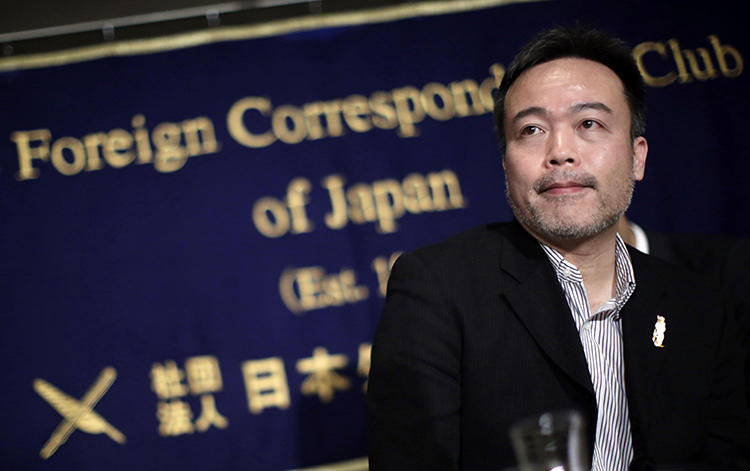
Japan prevents freelance journalist from traveling to report in Yemen
Washington, D.C., February 6, 2019–The Committee to Protect Journalists today called on the Japanese government to allow freelance journalist Kosuke Tsuneoka to leave the country to conduct reporting. Tsuneoka was stopped by immigration officials at Tokyo’s Haneda Airport while trying to leave Japan for a reporting trip to Yemen on February 2 and, in a…

Abe administration throttles media independence, journalists and UN say
Late in 2015, the Japanese government asked David Kaye, the U.N. special rapporteur on the right to freedom of opinion and expression, to reschedule a visit planned for December. At the time, some news outlets speculated that the administration of Prime Minister Shinzo Abe, under criticism for rising threats to free expression, was trying to…
Hostage video shows Japanese journalist Jumpei Yasuda, who went missing in Syria
A freelance Japanese journalist who went missing in Syria in June 2015 appeared in a video on March 16, 2016, which was posted to the Facebook account of a Syrian named Tarik Abdul Hak. Jumpei Yasuda, who speaks in English in the video, says that no one in Japan cares about his captivity, and that…
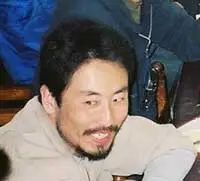
CPJ condemns murder of Japanese journalist Kenji Goto
New York, January 31, 2015–The Islamic State militant group released a video Saturday purporting to show the murder of Japanese journalist Kenji Goto, according to news reports. Japanese authorities have not yet verified the footage is authentic, according to news reports. Goto, a well-respected journalist who reported primarily on humanitarian issues, was kidnapped in Syria…
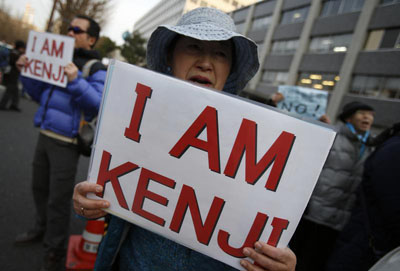
Kenji Goto’s reporting is voice of humanity in times of atrocity
Kenji Goto, the 47-year-old television journalist held captive by the Islamic State (IS), is not a typical reporter, nor is he typically Japanese. But his courage and commitment to broadcasting humane stories from some of the world’s most dangerous conflict zones would put him at the pinnacle of his profession anywhere in the world. It…
CPJ calls on Japan to explore all options for journalist held in Syria
New York, January 22, 2015–The Committee to Protect Journalists is deeply concerned by a video released on Tuesday by the Islamic State militant group in which the group said it would kill Japanese freelance journalist Kenji Goto and another Japanese citizen, Haruna Yukawa, if it did not receive a US$200 million ransom within three days.
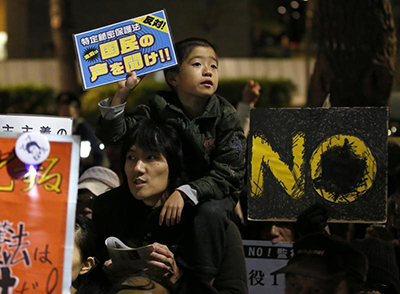
Japan’s state secrets law, a minefield for journalists
On October 14, as Japan prepared to mark Newspaper Week–an event set up to promote the public right to know–Prime Minister Shinzo Abe’s cabinet publicly announced guidelines on how the country’s security law, which was passed in December 2013, is to be implemented. This date will be remembered as the point at which the public’s…
G-7 acknowledges post-2015 agenda should include governance, human rights
New York, June 5, 2014–The Committee to Protect Journalists welcomes the declaration today by leaders of the Group of Seven leading industrial nations that democratic governance and human rights should be integral to the post-2015 development agenda. The United Nations is seeking agreement on a broad set of sustainable development objectives to replace the Millennium…