Despite the great physical risk, Dana’s commitment to his work keeps powerful images of Hebron’s clashes in the public eye. Hebron is a cauldron of religious and political tension. In a city of 150,000 Palestinians, some 400 Jewish settlers live in the center of town, protected by hundreds of Israeli soldiers.
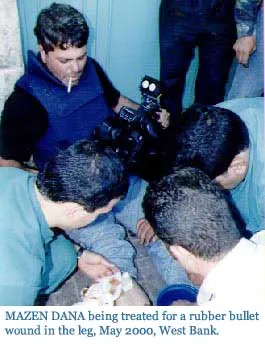
In May 2000, Dana was shot in the leg with a rubber-coated bullet while filming Palestinian youths throwing rocks at Israeli soldiers. Two months later, Jewish settlers beat him unconscious while he tried to film a conflict. The next day, an Israeli police officer slammed Dana’s head in the rear door of an ambulance while he was filming the evacuation of a Palestinian youth wounded in clashes. Dana was shot again last October, in the same leg, two days in a row.
|
MAZEN DANA: To be a cameraman, to work in a divided city, to work in a city of lost hope. We are working among tanks, helicopters, hundreds of soldiers. The situation in Hebron is to, to be a cameraman it’s very difficult for you, and always you are harassed from soldiers. Hebron is the center and the core of conflict, the Palestinian, and the Israeli conflict. So every day something happening in Hebron, even if it is calm in Palestinian areas and Israeli area. So because two hundred soldiers are living inside of Hebron city, this makes Hebron hell … Today you are working twenty four hours. And sometimes you are not able to sit with your kids. And sometimes you have no holiday, no time to rest, no time even to eat, because of the bad situation in Hebron. You are between the Israeli soldiers the Israeli tanks, and the … Palestinian stone thrower. So it’s not easy to have a picture, and a picture maybe will cost you your life. So to work in Hebron any, every day, every minute, so you are cut away from all of uh, your relation. Socially you have no friend because always you are work. Even you have no time to sit with your kids, with your family to discuss issues or to eat or to celebrate, or to do something. So the situation of camera man in Hebron really is very tough and dangerous. Since I’m working in Hebron about fourteen years as a camera man and journalist, I injured, uncounted time and arrested many, many, many times. The type of injuries that I got, to see, three times live ammunition, about seventy to eighty times rubber bullets. About one hundred time beating from soldiers. Two times my hand were broken for uncovering my stories in Hebron. Here any, always you are harassed, always you are attacked from soldier because of the bad situation in Hebron. So all the time they do not want you to publish a picture. And what about of, it is, so we are a neutral, and we are filming what’s going on. This is not satisfy the people or the soldiers what you are doing. So always you are harassed, always you are attack, and always you are forbidden to move. For example nowadays, many, I’m covering about half of West Bank, but according to the situation now I’m not allowed to go out of Hebron. About, to be not allowed to go behind, or Hebron, which, the villages of Hebron, because of the Israeli siege on the territories. Even my office, now, I am not allowed since seven years not to go in to writers office, because they do not give me a permission. So and in, the situation is bad, very, very bad in Hebron, and I have multi injuries, many, if you look to my body, you will not find one centimeter without beating, without rubber or live bullets. The situation of journalists in Hebron, really it’s going from bad to worse. I’m expected it before one year and one year and a half, when I told them the situation is going very, very, very bad. And to the worst, to the hell. Eh, now, before this we were able to move, to go, even to go to Bethlehem, to other places, to other cities. But now we are stopped. Even here now we are not allowed to go to film area which is under Israeli, in area C in Hebron which is under Israeli control. And Hebron city, which is divided to two parts, I’m able just to go two kilometers square and area which is under Palestinian control. But now under Israeli control, we are not, we are not allowed. Even my home, it’s in area C, in Kalif you are not allowed to go out of my home, even if I am journalist. They kick us now, they threaten our life and our life is going in very, very critical and dangerous situation. [PAUSE] We are journalists who are neutral. We are covering what’s going on. So, I’m able, I’m, I’m willing to put the pressure on Israeli government. To stop harassing the journalists. To be neutral with all journalists. Not to have discrimination between Israeli and Palestinian and foreign journalists. All of us the same, we have the same message. We carry a gift. We filming and we show the world what’s going on. We are not part of the conflict. We asking the Israeli government to stop and to put an end to the harassing of Palestinian journalists in the Palestinian territories. And to stop the severe attack against us and to put an end to our prejudice as a journalist. You feel sometimes that you are nothing. When you saw our kids, or a soldier twenty years old, beating you and shooting you, and spit on you, you feel that you are denigrated. We want to be as all people living in peaceful situation, working as a journalist, doing what ever we can do to help and to bring an end for the conflict all over the world. We are sitting and we are dreaming to work in a free journalism area without any punishing, without any torturing for the journalist. This is, this message I carry for the Israeli government, to put an end for what’s happening to us. And I’d like to have also international journalists to put an end for the harassing of the journalists. Freedom means to me, to work in free, no one bother you, no one beat you, no one shoot you, no one insult you. Because freedom led you to the whole kind of freedom, freedom of writing, freedom of filming, freedom of talking, freedom how to deal with your family, with people. Uh, freedom of race and really we eager, we pray for that to happen. Because here we have no freedom. We are not even allowed to do our work as it is. So our many, many times we are smuggling, and we running mountains going from roof to roof, to film. I’d like to film freely, no one can stop me, no one can bother me, no censorship, nothing at all. . The message that makes me be here, covering what’s going on and going to work, especially because all journalists have a message, and they carrying the message. They are not part of the story of the conflict. They are filming what’s going on. And journalists and especially the camera man showing the people the truth. My motive to be and to continue my work even if it is costed for me a lot of problems, and a lot of injury, my motive to continue my work, even if it cost me my life, because journalists have a message, and they carrying the message. And they carry what’s going on, and the, the lead the audience to see what’s going on, to judge, and we are only there to help, to finish any conflict maybe by, and by pictures. You know, to be a journalist and to be a camera man, especially in the situation of Hebron, when we are existed in the action, many, many, many things happen, and stop. They even soldiers they want to do something then they saw a camera, they are afraid of cameras and they stop. And many, many times they thank us because we are there, otherwise it will be a massacre. So we are stopping many, many, many things to be happen. I like my career to be a journalist even if it is created to me problems in my work, in my family among the friends, but I will still working in it. Because I know it is the business of the carrier of terrible. Even so it is nice, even so we like it. And I, any, no one, nothing can stop me from doing my work as a journalist. We have to introduce ourselves to that Israeli soldier that you are a journalist. They said, “Go back.” We got in our car and we went back, they shoot us from magazines 250 feet. They shoot three bullets. One into here and one here, and one on the ground. MAZEN DANA INTERVIEWER MAZEN DANA INTERVIEWER MAZEN DANA (END OF TAPE) |
|
Ladies and Gentlemen, colleagues, I am happy to be here and proud to receive this prestigious award from the Committee to Protect Journalists. It is the result of 14 years of continuous sweat and toil. It gives me strength to know that our colleagues around the world are supporting us in the quest for truth against those who seek to stifle it. Working in the divided city of Hebron, attacks on press freedom take place daily at the hands of the Israeli army and the settlers, who live in the center of town. To be a journalist and cameraman in a city of lost hope like Hebron requires great sacrifices. Gunfire, humiliation, beatings, prison, rocks, and the destruction of journalists’ equipment are just some of the hardships. And there is also the inability to move freely. The sad thing is that I can travel anywhere in the world, but I am unable to travel to the Reuters bureau in Jerusalem which is just 25 kilometers away from Hebron. Being here, I leave behind my colleagues of whom I am very proud and who are no less courageous and deserving of this award, especially my close Reuters colleague Nael Shyioukhi who has worked by my side for 8 years. Words and images are a public trust and for this reason I will continue with my work regardless of the hardships and even if it costs me my life. Yesterday, a tragedy befell four of our colleagues in Afghanistan. This tragedy illustrates just how costly uncovering the truth can be. The bitterness of this event is only alleviated by the knowledge that journalists around the world continue to strive for the truth. And your In closing, I would like to express my heartfelt thanks to Reuters for its unwavering support through difficult times and for making me a better cameraman. I would especially like to thank Rodney Pinder, Steve Windy, Paul Holmes Victor Antony, and Tom Kirkwood, among others. Thank you. |
 FROM TRANSCRIPT OF CPJ INTERVIEW WITH MAZEN DANA