![]() |
Afghanistan: ABDUL SAMAY HAMED |
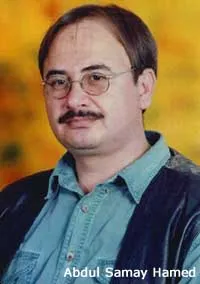
![]() Hamedan independent writer, publisher, political cartoonist, and poethas emerged as one of the most important voices for press freedom in Afghanistan today. Before being forced into exile under the Taliban regime in 1998, Hamed helped start 10 different publications in Afghanistan, including Salam, the first independent newspaper in the northern city Mazar-i-Sharif, and Sadaf, a women's magazine. In 1997, Hamed was detained and beaten unconscious on the orders of Haji Mohammed Mohaqiq, then one of the leaders of Mazar-i-Sharif and the current Minister of Planning in the Karzai government, because of his critical articles and cartoons in Salam. In early 2002, Hamed returned to Afghanistan from Denmark, where he had secured political asylum, and founded the Association for the Defense of Afghan Writers' Rights with other influential writers and editors. The association works to educate Afghan journalists about freedom of expression and advocates on their behalf when they come under attack for their work. That same year, Hamed founded the magazine Telaya. Telaya has developed a reputation in northern Afghanistan for publishing bold articles and commentaries about the political and social problems that plague the country. When authorities in the northern province of Baghlan banned the publication in the fall of 2002, Hamed secured the backing of the Information Ministry, which directed the local administration to allow the journalists to work without interference. More recently, Hamed also came to the assistance of the satirical newspaper Kalak-e-Rhaastgoy (One Who Tells the Truth), another publication he established and to which he contributes political cartoons and short satirical articles and poems. In June, after journalists at Kalak-e-Rhaastgoy began receiving threats from supporters of local commander Gen. Ostad Atta Muhammad, Hamed accompanied the paper's editor to a meeting with the warlord to complain about the harassment. General Atta promised to investigate the incident. Hamed, who is a physician by training and a frequent commentator for the BBC's Dari service, paid a high price again this year for being outspoken. In April, two men armed with knives attacked him in Afghanistan's capital, Kabul. Hamed's colleagues believe that the assault came in reprisal for a BBC broadcast in which the journalist criticized the power of local warlords. In addition to his journalistic work, Hamed currently heads Mediothek, a media center that organizes training workshops for journalists and writers, as well as seminars on subjects including journalism, press freedom, human rights, and strengthening civil society. CPJ Interview with Abdul Samay
Hamed in Mazar, Afghanistan, on October 20, 2003
CPJ: You are a physician. How come you went into poetry, literature,
and especially journalism?Abdul Samay Hamed: In Afghanistan all writers are known as culturalists, or those involved in culture. Our aim is to produce culture and reform the culture that exists already and present it to others. In the third world intellectuals have different dimensions, as they are many things simultaneously. In Afghanistan, a poet can also be a journalist. It is important that with journalism, we pave the way to democracy in Afghanistan. Most of my emphasis, regarding journalism and people, is visual and audio. We work to make the environment ripe for thinking. In my opinion, in Afghanistan, the problem is a lack of thinking. There are ideas, but there is not a thinking culture. CPJ: How do you assess the situation of journalism in today's Afghanistan and what challenges and obstacles do you see? ASH: The situation of journalism in today's Afghanistan is as if someone has been hit by a heavy hammer in the head and is slowly regaining consciousness .... In today's Afghanistan, we are experiencing for the first time freedom of speech and the press. We had some experience with freedom of speech and the press in the decade of democracy [1964 and after, following the drafting of the constitution] but that was a constitutional monarchy. But journalists did not find enough time to expand this tradition of journalism to the provinces and lay the foundation. The obstacles vary from government censorship to self-censorship, which blocks the development of free journalism in Afghanistan. CPJ: Why did you leave Afghanistan in 1998 and why did you return in 2002? ASH: When they started killing culture and intellectuals, I left for Pakistan and, eventually, Denmark. I thought I could better battle for improvement in Afghanistan from far away. When I felt that the situation for those who dared to tell the truth in Afghanistan was improving, I returned to Afghanistan. CPJ: You were attacked twice, once in 1997 and once in this spring. What happened? Also, are these attacks because of your work at Telaya or because of your public appearances? ASH: As I said before, for the first time we have experienced freedom of the press in Afghanistan, and thus we founded and published Telaya and a paper called Salaam (Peace). Currently, we have other publications such as Kalak-e-Rhaastgoy (One Who Tells the Truth), Aasmaana (Sky) and other publications in which I am directly involved and have friends who are bold and brave enough to take part. The truth is told with some degree of boldness. The first time that I was injured, it was after the riots in Mazar-e sharief, where about 100,000 citizens came out to oppose the war. In evoking these anti-war emotions, my public speeches and my articles and poetry published in Salaam played a big role. Because of that, the interior minister at the time ordered seven or eight of his bodyguards to beat me, in front of more than 200 people.... The second time I was injured was when I returned to Afghanistan and spoke at various gatherings and in poetry readings about freedom of speech. One of my talks, which I presented at the International Conference of Civil Society and Constitution Building in Berlin, hit a nerve with some people who did not want freedom of speech and press in Afghanistan. So they orchestrated an attack on me. CPJ: In today's Afghanistan, is expressing your views dangerous and if so, why? ASH: I think from every direction it is dangerous. The problem is that the ideals and culture of democracy were never laid in the thinking of intellectuals, common people, or even politicians in Afghanistan. As I said before, when it comes to religion, power, etc., we often turn to self-censorship.... I think self-censorship in journalism is the biggest problem because it creates a culture in which journalists do not dare question authority. Questioning authority is the only way to achieve accountability. CPJ: Tell us about your organization, the Association to Defend Writers of Afghanistan? ASH: The Association to Defend Writers of Afghanistan is an organization to defend Afghan writers and expand freedom of speech and press and to protect it. Almost all Afghan writers, either from inside or outside the country, came together to form this association. CPJ: What effects does your work have on your family? ASH: It has a direct effect on my family's psychology and state of mind. They have been threatened many times. We have moved from place to place five times, inside and outside Afghanistan. Every time I write something, my family worries for the next two or three weeks that any minute something will happen to me. That is why I decided to leave for Denmark so that there is less pressure on them. CPJ: What do you see for the future of journalism in Afghanistan? ASH: The most important change in Afghanistan, in my opinion, is that the process of learning has moved to self-learning. Meaning that the youth want to learn different things and there are different avenues of education. Today, most young people know a foreign language. They are used to the Internet and they are concerned about the future. For me the most important thing is that they publish and keep publishing. |