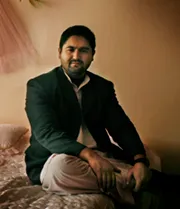
In New York, the Tribeca Film Festival showed a strong documentary, The Fixer: The Taking of Ajmal Naqshbandi, on Sunday. After the screening, I moderated a panel that featured director Ian Olds and Naqeeb Sherzad, a close friend of Ajmal, shown at left. The panel also included U.S. journalists Christian Parenti, who helped produce the movie and appeared throughout (he and Ajmal had worked closely together), and George Packer, the New Yorker staff writer who, among other things, is considered by many to be one of the best reporters on Iraq. (In a small way, CPJ helped Naqeeb get out of Afghanistan and gain asylum in Sweden.)
I had seen the film a few times in various stages of completion. For an American production it was edited at a much slower pace than what I’ve become accustomed to. Only when I saw it on a full screen, not on a laptop while riding on a train or a TV at home, did I appreciate just how powerful it was. It came as close to capturing the reality of how news is gathered in dangerous areas as anything else I have seen on screen. The pace of the editing reflected the way things actually get done–from running down false story leads to interminable rides on rough roads in cheap cars with suspensions worn away a few hundred thousand kilometers ago and flashes of duck-and-run danger with a lot of menace and very little glory–and a sense of laughing relief once you’ve made it out to safety.
There is very little glamour in the process and the film was distinctly not glamorous, but Ian and his team and Christian had pushed for something much more profound and damn near nailed it perfectly. A lot of young people ask me how they can get into international reporting–their J-school professors should make this mandatory viewing for them.
For the audience of a few hundred–most of them stayed after the screening for the discussion–it was a blunt view into how news is collected in conflict zones and chaotic countries, and the role of the people who have come to be called fixers–the local journalists with the language and cultural skills to act as the interlocutors between foreign journalists and the people they are reporting on.
CPJ became deeply involved in working to help Daniele Mastrogiacomo and Ajmal, and their driver Sayed Agha, after they were kidnapped on March 4, 2007, in Helmand province. Agha was beheaded a few days after the abduction, while the Italian Mastrogiacomo was released March 19 in exchange for five Taliban prisoners. Afghan President Hamid Karzai was criticized for having made the deal. He said he did so because Italy has 1,800 troops in Afghanistan and because Italian Prime Minister Romano Prodi had personally asked him to work for the release, according to international media reports.
With the help of Teru Kuwayama, a New York-based freelance photographer who founded Lightstalkers, a Web site for freelance journalists, filmmakers, photographers, we were able to get nearly 300 journalists to sign an open letter urging the release of Naqshbandi. We were unsuccessful. Ajmal was beheaded by the men who held him on April 8.
I didn’t know Ajmal, but those who did and have seen The Fixer: The taking of Ajmal Naqshbandi, were clearly moved. My daughter-in-law, a South Korean documentary filmmaker, had worked with him often. She watched the movie at times in tears. This film comes close to capturing what Ajmal did for a living, his role in the newsgathering process, and it seems to have come close to capturing him as a person too.
Distribution for these sorts of documentaries can be a problem, but the good news is that it has been picked up by HBO, so you will be able to see it sometime in the near future.