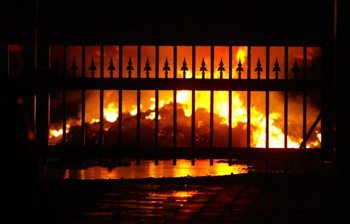
On March 2, 2006, Kenyan state agents conducted a commando-style midnight raid on the Standard Group, owner of an independent daily and KTN Television in the capital, Nairobi. The agents seized computers and tapes, vandalized a printing press, and burned roughly 20,000 copies of The Standard, Chief Executive Officer Tom Mshindi told me recently in Nairobi. On each anniversary since, the Standard Group calls for inquiries into the raid. Paul Muite, a former member of parliament from Kabete and a vocal critic of President Mwai Kibaki, made a public statement at the Standard Group’s office on this year’s anniversary–and believes that, as a result, he is now being followed.
In addition, Kibaki’s four children have since threatened to sue Muite for defamation, he told me, based on allegations that he linked them to the raid, which he denies.
I traveled to Kenya this month to investigate recent attacks on press freedom. Muite said he has mainly been targeted because he made public accusations that the government was involved in extrajudicial killings. But he said his most recent comments about the Standard Group raid “was possibly the last straw.” Earlier this month, Muite told newspapers that an elite police squad known as the “KweKwe squad” widely thought to be responsible for a series of extrajudicial killings had instructions to kill him. “I got information that I was under surveillance by the squad so I had to go public quickly,” he said.
As the former chairman of the Parliamentary Commission of Justice and Legal Affairs, Muite has repeatedly called for answers regarding the raid. The confiscated equipment has not yet been returned, and the reasons and people behind the raid remain murky. The day after the midnight raid, then–Security Minister John Michuki told the press it was a police operation to protect state security. “If you rattle a snake, you must be prepared to be bitten by it,” he was reported as saying in international news reports.
But the police commissioner, who was outside the country at the time of the raid, emphatically disputed police involvement, KTN researcher Patrick Mugo told CPJ. Muite and others allege that two Armenian brothers–commonly referred to as “the Artur brothers,” who were deported in 2006 on various criminal charges–led the raid in conjunction with state agents. A police investigation revealed that the confiscated computers were kept at their private homes, Muite and local journalists told me. Artur Margaryan and Artur Sargasyan gained notoriety for pulling a gun on a custom official at Nairobi’s Jomo Kenyatta Airport just two months after the raid, according to news reports. In June 2006, Kibaki appointed the former Commissioner of Police Shadrack Kiruki look into the Artur brothers’ activities but the findings were never released to the public.
“We at KTN believed it was individuals within the government and security services that that ordered the raid,” Mugo said.
In Muite’s view, the raid was prompted by an earlier edition of the paper that had an article concerning the first family. Just weeks after Muite’s public comments on the anniversary of the raid, Kibaki’s four children sent a letter through their lawyer demanding an apology from Muite for connecting them with the raid. Muite has dismissed the letter, saying at no time did he mention or talk about the four children at the Standard Group raid anniversary.
Whatever the reason for the raid, the incident sent a clear message to Kenya’s press that they could be censored at any time without warning. The controversial Section 88 clause in the Kenya Communication (Amendment) Act 2009 that allows the minister of security to raid media houses on state security grounds is still in effect and could be used again.
Regardless, Kenya’s independent media remains steadfast. Despite damages to their printing press during that fateful night, The Standard still managed to release an issue the following morning. Swaleh Mdoe, currently a presenter and producer with Citizen TV, used to work at KTN and remembers the raid well. “When I reached my office the following morning [after the raid] there was a sense of gloom in the air and my computer was missing,” Mdoe recalls. “But I still produced and anchored the evening news as if nothing had happened, to show that we would not be cowed into silence.”
The battle for press freedom in Kenya will undoubtedly continue. As U.S. President Barack Obama said when he visited the offices of The Standard in Nairobi months after the raid: “Press freedom is like tending a garden, it’s never done. It continually has to be nurtured and cultivated and the citizenry has to value it. It’s one of those things that can slip away if we don’t tend to it.”