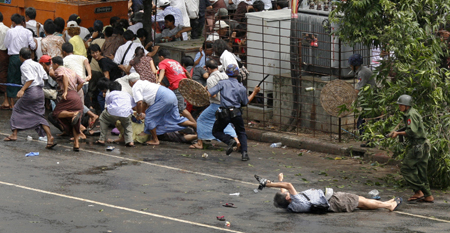
“Get that guy–he’s a reporter.” The order, shouted in Burmese amid the chilling sound of gunfire, can be heard in the preview of the new documentary, “Burma VJ: Reporting from a Closed Country” by Danish filmmaker Anders Ostergaard. The preview also includes the now-notorious footage of a Burmese soldier fatally shooting Japanese cameraman Kenji Nagai at point blank as the journalist filmed the 2007 monk-led uprising known as the Saffron Revolution.
“Who did they shoot?” we hear a man ask in voiceover. “A guy with a camera.”
More than a year later, Nagai’s murder continues to resonate in the media community. But this film, which will be screened in May at the San Francisco International Film Festival and New York’s Film Forum, sets out to remind us of the less visible reporters who helped document it. The “VJ” in the title stands for video-journalist, and the subjects are the courageous Burmese reporters and exile media groups responsible for disseminating accounts and images of the uprising in and outside Burma. Combining their footage with interviews and re-enactments, the film aims to narrate the uprising from their perspective.
Ostergaard told me about the project by telephone from Germany.
“The big coincidence was that I was already working on a film about these reporters when they became the center of attention for the world press. Foreign news crews were not allowed inside the country, and I had a contact in the satellite station Democratic Voice of Burma in Oslo, who I knew could organize reporters in-country to get footage to the outside world. I was interested in why they were doing it.”
Ostergaard said he met 10-12 reporters in Bangkok during a camera- and security- training session and was lucky to find Joshua, who became the film’s main character. An English-speaker who could be interviewed without an interpreter, the director found Joshua to be one of the most active, daring, and keen to tell his story. In Ostergaard’s view, Joshua felt that his country had been forgotten. He had to document Burma to bring it alive, both for himself and for the rest of the world, even though any success–in terms of regime change–would be hard to achieve.
The Burmese reporters were given pseudonyms to protect their identities.
“Security concerns were built in from the beginning,” Ostergaard explained, “as we couldn’t show their faces or mention names. We tried to make a virtue of necessity. The film is carried by telephone conversations between a safe house in Bangkok and reporters back in Burma. Joshua is now based in Thailand. He can’t go back to Burma, partly because of the film, which he’s helping to promote.
Ostergaard chose the term VJ in the belief that his subjects were genuine journalists, though they were also players in the events, coordinating with the monks to film what was going on, and provided momentum for the uprising through their footage. The filmmaker compared them to the underground press in Europe during World War II.
The network of reporters inside Burma, though decimated by a brutal crackdown following the uprising, has steadily rebuilt, according to Ostergaard. In fact, he said, it has even expanded; he knew of 80 in-country reporters at the moment, inspired by what the previous generation had managed to do. CPJ Asia consultant
“There were three of them in the street during the shooting of Kengi Nagai,” Ostergaard told me. “That day, they were just trying to be professional. They were just doing their job. They knew the fact that he was a foreigner would make a huge difference–it was an international story. But they also felt that he took a risk they would never have done, by filming the soldiers directly. He didn’t know any better. I don’t think they were shocked when he was shot. This was nothing new to them–they knew the danger.”