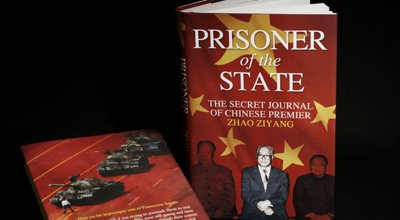
News of the coming posthumous publication of Zhаο Ziyаng’s memoirs hit the stands this week–outside China, anyway. Local media did not cover the story on Friday, and officials have yet to comment. Neither the Chinese nor the English version of the book, Prisoner of the State, reportedly transcribed while the former Communist Party general secretary was under house arrest, will be available in China after its release on May 19, international news reports say.
Zhao’s close association with the crackdown of June 4, 1989, when Chinese troops opened fire on civilians in Beijing following weeks of student-led pro-democracy demonstrations in Tiananmen Square, makes him too sensitive a subject for open discussion in the Chinese media. Zhao famously opposed the use of force and tried to convince students to leave the square, at the cost of his political career and liberty. He remained under house arrest until his death in 2005.
The Chinese Communist Party weeds out and suppresses unofficial discussion in the media and online of “Tiananmen,” “6.4,” “1989,” or other terms that evoke the tragedy, a potential rallying issue for challenges to the one-party system. It is discussed circuitously in Internet chat rooms, often through a creative use of puns and homonyms. The English-language blog Shanghaiist described it in a recent post as the “tragedy-that-must-not-be-named.”
Nearing a landmark 20th anniversary next month, Tiananmen is particularly sensitive this year. How propaganda officials respond will be fascinating. “Zhao concludes that China must become a parliamentary democracy to meet the challenges of the modern world–a remarkable observation from someone who spent his entire career in service to the Communist Party, and one that might well provoke a debate on China’s Internet discussion boards and in its chat rooms,” Adi Ignatius, one of the editors of the English version of the book, writes in a Time article.
As Ignatius predicts, the scant references to the publication on Web sites within China are the ones circulating links to online extracts in discussion forums. Those extracts are, for the moment at least, accessible. “The excerpts of Chinese language audio recordings and transcripts from Zhаο Zıyаng’s posthumously published book on The Washington Post‘s Web site are still available” online, the China-based media blog Danwei said today.
One recent case in China served as a litmus test for official tolerance of Zhao’s legacy. The magazine Yanhuang Chunqiu came under pressure in December 2008, with heavy official hints to the director, Du Daozheng, that it was time he retired. Local media analysts connected that pressure to the magazine’s September 2008 article about Zhao. The Washington Post reported that “the piece, written by a retired top editor of the official New China News Agency, was the first positive story about Zhao to appear since 1989.”
Du, an octogenarian, dodged attempts to get rid of him, according to Hong Kong-based Yazhou Zhoukan magazine. He transferred some–but not all–of his responsibilities to a colleague. Du told the weekly Yazhou Zhoukan that his magazine had not backed down. “We stick to our position,” he said. “Since we started the publication, we’ve met with nine real problems. There will come a 10th and an 11th. But broadly speaking, our articles reflect the kind of independent thinking going on among reformers within the party.”
Zhao may not be as risky a topic as he once was. On the other hand, the provocative timing of the memoir’s release may elicit a punitive response from the Chinese government for those who report on it.
Hugo Restall of the Far Eastern Economic Review–whose own blog, Traveller’s Tales, is inaccessible in China, according to Danwei–described how the careful timing of the book’s release had created a climate of secrecy. “China-hand journalists have been whispering and sending coded e-mails about the late Zhao Ziyang’s forthcoming memoirs, timed for the 20th anniversary of the Tiananmen massacre.”
The international correspondents, however, were dodging a different kind of restriction. “Publisher Simon and Schuster struck elaborate embargo agreements with the major media,” Restall wrote.