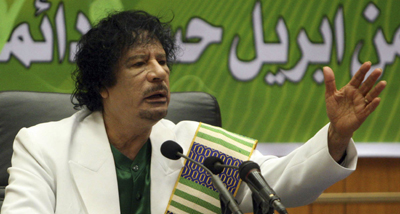
As Col. Muammar Qaddafi, 67, celebrates the 40th anniversary of his ascent to power this week, it is unlikely that any of the numerous international guests will venture to ask the Libyan dictator or his aides what happened to journalist Abdullah Ali al-Sanussi al-Darrat after his arbitrary arrest 36 years ago. Al-Darrat, a journalist and writer from Benghazi, Libya’s second-largest city, vanished following his detention without trial in 1973, according to international human rights groups and the Western Europe-based Libyan League for Human Rights.
Repeated calls on Libyan authorities over the past decades from international rights groups, including CPJ, to shed light on al-Darrat’s whereabouts have fallen on deaf ears. CPJ encouraged colleagues all over the world to write to Qaddafi, who took power in the bloodless military coup that toppled King Idriss on September 1, 1969, to inquire about al-Darrat’s fate. But the “Revolution’s Guide” and the “King of Kings,” as the longest-serving ruler in Africa and the Arab world like to be called, ignored such queries.
No information has ever surfaced as to the basis for al-Darrat’s detention, his whereabouts, or even whether he was still alive. His fate is reminiscent of the disappearance of other Libyan writers and dissidents, as well as that of the prominent Lebanese Shiite leader Musa al-Sadr and his two companions who arrived in Libya in1978 to meet with government officials. They were never heard of again. Lebanese government officials said Qaddafi was responsible for their disappearance.
Al-Darrat’s disappearance occurred at a time when Qaddafi was leading a terror campaign against freedom of association and expression. He warned his critics that the price for dissent would be execution. Later, Libyan dissidents and critical journalists living in exile, officially called “stray dogs,” were targeted. Some of them were gunned down. Others like Mansur Khikia, former foreign minister and member of the board of the Cairo-based Arab Organization for Human Rights, disappeared in December 1993 in the Egyptian capital.
Unfortunately, Qaddafi’s merciless attacks on Libyan journalists, whose sole “crime” was to expose cases of abuse of power, nepotism and corruption, did not get enough media attention. One of the victims of this unabated war on freedom of expression was Dayf al-Ghazal, a former journalist for the government-owned daily Azahf al-Akhdar and contributor to the London-based Web sites Libya Alyoum and Libya Jeel.
Like al-Darrat, al-Ghazal was from Benghazi. His disfigured body was found in the suburbs of this Mediterranean city in June 2005, after he went missing from his home for nearly two weeks, according to several sources. This happened about the same time well-known Lebanese journalist and democracy advocate Samir Qassir was killed in a car bomb in Beirut. To date, no credible and transparent inquiry into al-Ghazal’s death has been conducted. Many believe that his online articles on rising corruption among government officials led to his abduction by government agents and extra-judicial killing.
Al-Ghazal’s assassination was perpetrated after Libya started its return to the international scene and inaugurated its costly public relations campaign to improve its stained image in Western capitals following nearly two decades of ostracism spurred by U.N. Security Council sanctions.
Yet media remain tightly muzzled.
The nationalization in April of the satellite news channel Al-Libya and its sister papers Oea and Cyrene, which were launched in 2007 by Qaddafi’son and outspoken lobbyist Sayf al-Islam and his Al-Ghad Foundation, came as a reminder that there is still no genuine tolerance for independent journalism. This government decision was taken after Al-Libya broadcast material referring to the use of torture and persecution of dissidents in the country, according to news reports.
Commenting on the nationalization of these media outlets, the Libyan League for Human Rights said on World Press freedom Day that freedom of expression is not a “privilege” that can be granted and withdrawn at any time, but a constitutional right that “cannot exist without genuine political opening.” It also reported that several journalists and intellectuals, including many working for Al-Ghad Foundation, had been summoned this year for interrogation by state security and press prosecutors.
The human rights league noted that there were “serious indications” that the office of the press prosecutor had been involved in recent attacks aimed at destroying critical Web sites, and that it had issued instructions to Libyan embassies to take to court publishers and journalists critical of the Libyan regime, particularly in Africa and the Arab world. It mentioned, for instance, the complaint filed this year against the independent Moroccan dailies Al-Massae, Al-Jarida al-Oula, and Al-Ahdath al-Magrebia for defaming Qaddafi. A court in Casablanca ordered the three dailies in June to pay a crippling fine and damages to the Libyan dictator.
This trial, which was closely monitored by CPJ and prompted angry reactions among journalists and human rights defenders in the region, provided a new example not only of Libya’s “war without borders” on independent journalism, but also revealed the determination of less autocratic Arab governments to keep the media on tight leash.
“It seems that President Qaddafi, after he overthrew press freedom in Libya, has started to focus his attention and experience toward prosecuting Arab journalists outside his country. Thus, we all have to stand by these journalists, in order to preserve what is left of press freedom in the Arab world,” said the Cairo-based Arabic Network for Human Rights Information.