Graciela González-Degard is 72 years old. She has salt-and-pepper hair, long elegant hands, soft manners reminiscent of another era, and a bad knee that she blames on age. Once a Catholic nun, Graciela moved to the United States from Havana in the 1960s and now lives in New York with her husband. She teaches children with special needs.
Graciela’s sister, her grown-up children, and a brood of grandchildren live in Miami. She talks to them every week. But her baby brother, Ricardo González Alfonso, is in a Cuban jail. His crime: writing for the independent Cuban press. So, as often as is legally possible, Graciela travels to Havana to see Ricardo, his wife, and three children.
In April 2003, the Havana Provincial Tribunal sentenced Ricardo, at left, to 20 years in prison under Article 91 of the Cuban penal code for “acts against the independence or the territorial integrity of the state.” A poet and scriptwriter for state-owned Televisión Cubana, Ricardo began working for the independent press in 1995, founding an association of journalists and the award-winning newsmagazine De Cuba. He was a freelance reporter for foreign media outlets and was the Havana correspondent for the Paris-based press freedom group Reporters Without Borders at the time of his arrest. Ricardo suffers from hypertension, arthritis, allergies, chronic bronchitis, and several digestive and circulatory ailments.
In early August, Graciela called me to say that she was going to Cuba. On Monday, she called again to tell me about her trip. We met on Tuesday afternoon in an air-conditioned coffee shop in midtown Manhattan. Graciela looked tired and bruised. Her 14 days in Cuba aged her, she told me. If Ricardo weren’t there, Graciela said, she would never again set foot in Havana.
Before leaving, Graciela packed 70 pounds worth of food and medicine–not only for her brother and his family but also for the families of the other 19 journalists who have been jailed since the Cuban government’s 2003 crackdown on the independent press. Her friends said it was ridiculous for someone her age to lug so much weight but Graciela was determined.
She landed in Havana three hours late, and handed the immigration official her U.S. passport. Graciela was quickly escorted out of the line. A uniformed man pushed her on the airline’s wheelchair down a hallway and into a small room, where she was questioned mercilessly for hours by nameless State Security agents, who ravaged through her neatly prepared bags of goods for friends and relatives. The agents’ sole purpose, Graciela told me, was to get her to convince Ricardo to wear a prison uniform intended for common inmates, instead of his own clothes, which political prisoners were allowed to wear until now. Graciela refused, and the agents invoked the revolution as they continued to question her. Infuriated, she stumbled out of the wheelchair and ran for the door. “Gentlemen, we are done here. I am leaving,” she said solemnly. But before escaping, Graciela, frail from the trip and the heat, fainted in a state of panic.
This episode was only the beginning. Authorities refused to allow her to visit Ricardo on previously agreed upon dates. Their excuse: Coming from the U.S., Graciela needed to be tested for the H1N1 flu. But Graciela is relentless, and she made her way around Havana in a run-down taxi with her sister-in-law, Álida, until someone somewhere in a small bureaucratic office allowed her to see Ricardo.
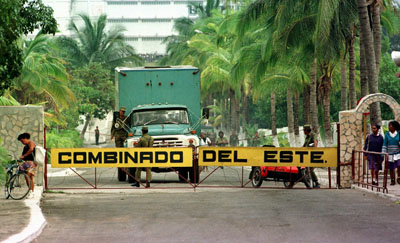
Her visit to Ricardo was not as hard as the last time, she said. He seemed to be in better spirits and in better health, though his once black hair is now a pristine shade of white. Ricardo described his life in prison with the wit of a poet, she said. He has a cat that he has been able to keep. He has reasoned with the guards and convinced them that he won’t give it up until an exterminator has gotten rid of the rats that plague his tiny windowless cell. Following a stint as a counselor to a fellow inmate, convicted of murder, he gained a devoted bodyguard who he named “The Converted Gorilla.” But Álida says prison authorities forbid Ricardo religious assistance routinely, and they have stopped allowing her to bring him clean clothes. Ricardo’s sheets–that Álida still washes and brings back to Havana’s Combinado del Este Prison–stink of humidity and are splattered with mold. Ricardo’s only complaint to his older sister, however, is the other prisoners’ poor conversation skills.
In tears, Graciela asked that press freedom advocates keep up our work, and tell the world about what is going on in Cuba. Cameras hanging on every street corner reminded her that instead of loosening up, the Castro regime seems to be tightening, and she is beginning to lose hope for her 59-year-old brother. “It’s been six years now,” she told me. “Six years that could have been the pinnacle of Ricardo’s life.”