In Zambia, the coming week will mark the anniversary of the untimely death of President Levy Patrick Mwanawasa. The late president had championed press freedom with his commitments to reform, and, with his passing, the Zambian media lost an ally. Worse, the media freedoms gained in recent years are now slipping.
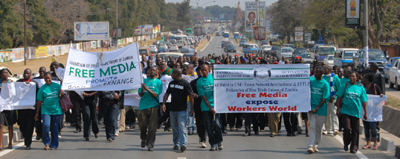
Just last week, on August 7, I was among about 400 journalists, civil society organization members, and students who gathered in Olympia Park in the capital, Lusaka, for a peaceful march against a wave of recent violence against journalists.
What really got us out in the streets that morning was a July 29 incident in which reporter Anthony Mulowa of the state-run Times of Zambia and Chibaula Silwamba of the leading private newspaper The Post were assaulted–in full view of senior police officers–by members of the ruling party. They were covering President Rupiah Bwezani Banda’s arrival from Uganda at the Lusaka International Airport.
This year alone, the Media Institute of Southern Africa Zambia (MISA) has documented 21 incidents of harassment (physical violence and threats) and hostile rhetoric against the media. Reporters from The Post newspaper, Zambia’s leading private daily, were victimized in almost all the incidents, but opposition supporters also harassed at least one state media journalist, namely Zambia National Broadcasting Corporation journalist Lackson Nthani.
The rhetoric of the current administration toward the media has been mixed. Vice President George Kunda, who received our 10-page march petition, addressed us by saying that “President Banda and the entire government leadership” was “concerned” about violence against the media. “Those who engage in violence will meet the full force of the law,” he added. While condemning violence, he then suggested the media was to blame for the violent incidents. “On the other hand, there is need to appreciate that the manner in which the media publish or carry some of their articles can be provocative and in some cases incite violence,” he declared. Information Minister Ronnie Shikapwasha also condemned the violence, but shot back with the following statement: “The president is insulted almost on a daily basis, and he has supporters who voted for him across the country. How do you expect them to feel, apart from being provoked?”
It was a year ago when tensions between The Post and the current administration escalated. During presidential by-elections for the successor of the deceased president, The Post consistently published editorials denouncing the personality and style of leadership of frontrunner, then-Vice President Banda. In response, Banda’s Movement for Multiparty Democracy (MMD) sent a complaint to the Media Council of Zambia, citing more than 20 negative editorials, which they deemed unfair. Banda even once declared at a rally that “Anyone who is a friend of The Post is the enemy of Rupiah Banda.”
The Posts news editor, Chansa Kabwela, is incidentally mired in a court case with the administration: She is accused of circulating obscene materials after she mailed to the Vice President’s office photographs of a woman giving birth on the floor of a hospital during a health workers’ strike. Her case is still in court and it is seen as a symptom of the sour relationship between The Post and the current administration.
The Zambian private press has come a long way since its inception in 1991 in the last days of the one-party rule of Zambian independence hero Kenneth David Kaunda. Then, the nascent private press backed a union leader who promised democracy and reform, Frederick Titus Jacob Chiluba. However, when a growing independent press began challenging Chiluba’s policies or reporting official corruption, the new president wavered on his electoral commitments to press freedom and repression ensued. Chiluba’s successor, late President Mwanawasa, introduced a series of positive media reform legislation in 2003, including a Freedom of Information (FOI) Bill, but the reforms have not been implemented to this day and the FOI bill is still pending in parliament. Worse, outdated laws (some dating as far back as the colonial 1930s), including sweeping presidential powers to ban publications, and sedition and criminal defamation laws, still threaten press freedom.
In response to these concerns of the media, the government and members of parliament are increasingly changing the subject of the debate to the regulation of what authorities deem to be unethical journalism undermining national interests. Information Minister Shikapwasha went as far as saying that “negative reporting by the media can put the country into flames and this is likely to kill opportunities for the future generations.” For now, however, the government has already issued an ultimatum: Come up with a draft bill for self-regulation within months or we will introduce one in parliament.
Another freedom of the Zambian media is slipping away: our freedom to self-regulate.
Henry Kabwe, the chairman of the Media Institute of Southern Africa (MISA) Zambia, is currently the coordinator of the local Media Network on Child Rights and Development (MNCRD) and a media monitoring consultant in Lusaka, Zambia.