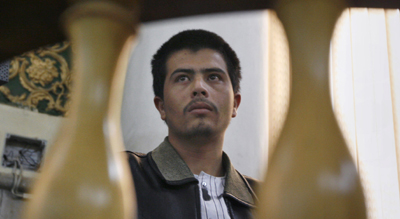
We received great news that Parwez Kambakhsh, a 24-year-old Afghan journalist and student who was unjustly convicted of blasphemy and serving a 20-year term, was released from prison. But happiness over his release—the product of intensive advocacy by CPJ and others—is tempered by deteriorating press conditions overall in Afghanistan.
First, the good news: Yaqub Ibrahimi, Parwez’s brother, confirmed the release in an e-mail to CPJ this morning. “I want to let you know that [Kambakhsh] is released and we all are really happy. I really appreciate CPJ’s strong action regarding the case. I am really happy about all of this. It is a victory for freedom of speech in Afghanistan.”
In a follow-up telephone conversation, Ibrahimi said his brother is doing fine after being set free, apparently on a presidential pardon. “He is very happy, our family is very happy, especially my parents.” Ibrahimi, a prominent journalist himself, was guarded about other details of his brother’s release.
I visited Kambakhsh in the Kabul Detention Center on July 21, part of CPJ’s efforts to provide support and to advocate for his release. Although guards were present in the room, he was adamant about his innocence. “As an Afghan and a Muslim, I call on President Karzai to release me as soon as possible. I am innocent,” he told CPJ. In short, Kambakhsh was convicted of distributing anti-Islamic literature, a charge many observers saw as retaliation for his brother’s work.
Because of the high international profile and sensitivity of the case, CPJ contacted several diplomatic entities in Kabul to ensure that they were pressing for Kambakhsh’s release. At their insistence, CPJ did not publicize the case heavily this summer but made sure that diplomatic officials kept in frequent contact with Ibrahimi. In the end, it was this combination of quiet diplomatic efforts in Kabul and widespread international advocacy that led to Kambakhsh’s release.
National Directorate of Security officials arrested Kambakhsh, a local newspaper reporter and student at Balkh University in Mazar-i-Sharif, on October 27, 2007. They accused him of distributing an article from the Internet about women’s rights in Islam. On January 22, 2008, he was sentenced to death at a closed-door trial that lasted but a few minutes. Kambakhsh had been denied legal representation. The death sentence was later commuted to a 20-year prison term.
A journalist freed from an unjust imprisonment is a very good thing, something to celebrate but only for a moment. Many other Afghan journalists have contacted us with complaints, many centering on the disputed presidential election. It has gotten so bad in Kandahar that we’ll be sending a letter to President Hamid Karzai detailing complaints from journalists in the capital and the rest of the province. Kandahar is a battleground between NATO forces and Taliban, fighting that is aggravated by the still unsettled and increasingly disputed presidential election. (U.N.-backed election monitors said today that there was “clear and convincing evidence of fraud” in many polling stations and ordered a partial recount.) Some of the journalists we have been in contact with there are concerned about threats from officials connected with the provincial council, which is headed by Karzai’s brother and election campaign manager, Ahmed Wali Karzai.
Of course, the pressure is not limited to Kandahar. During the elections August 20 election we reported that Afghan police beat and detained Afghan and foreign journalists during the campaign in Kabul and several other places around the country as they were enforcing an official gag order on news of violent incidents during the presidential election.