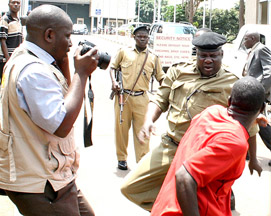
Last week in Uganda, authorities reacted to violent anti-government demonstrations, at left, by yanking at least four radio stations off the air and banning political programming and some journalists from the airwaves. I have been covering the Ugandan blogosphere for Global Voices for more than two years. News of the violence first reached me on Thursday afternoon, not through the BBC or The New York Times, but on Twitter. It came in seven words, sent via SMS to the micro-blogging service by my friend Solomon King, a Web developer in the capital, Kampala: “Okay. We’re like running for our lives.”
Political tensions are mounting in Uganda in the lead-up to presidential elections in 2011. Last month, incumbent President Yoweri Museveni warned the media against “inciting the public” against the government and several journalists face criminal prosecutions or police interrogation for their critical coverage of current affairs. Thursday’s deadly violence erupted after the government banned the ruler of the traditional kingdom of Buganda, home to Uganda’s largest ethnic group, from visiting an area north of Kampala.
I spent most of the night and the rest of the weekend glued to my laptop, feverishly refreshing Twitter application TweetDeck and paging through Ugandan blog aggregator Blogspirit, hoping for news of friends in Kampala, the city I called home in 2006 and 2007.
I wasn’t the only one having difficulty finding information on the riots. The government’s clampdown on the Ugandan private broadcast media, including Friday’s arrest of talk show host Kalundi Sserumaga on sedition charges, and an indefinite ban on the registration of new radio stations, had severely restricted coverage.
In fact, according to residents of Kampala, most Ugandan television stations were operating under restricted broadcasting conditions, airing little or no news during the riots. “TV Uganda is playing music videos and NTV Uganda is showing That’s so Raven,” wrote Sarah Malan, a South African expat living in Kampala, in her blog on Friday. Trisha Olsson, a development worker who tweets at CamaraAfrica, noted, “Wow…everyone hurry and turn to [Ugandan television station] NBS for a riveting report on…wait for it…how to play golf.” Though newspapers were allowed to continue reporting, their news was often delayed by hours, if not an entire day. The absence of real-time coverage led many Kampalans to seek out alternative sources of information.
Within 24 hours of the first violence, volunteers in Kampala launched Uganda Witness, a crisis reporting site where Ugandans can share news of deaths, looting, presence of government forces and other riot-related information. As of Tuesday, 45 separate reports had been submitted via SMS.
Twitter proved an especially rich source of information. On Friday, the second day of the violence, Uganda Telecom announced that it would provide free Twitter access to its customers. Users like Solomon King and journalist Tumwijuke Mutambuka posted information on where rioters and police forces were gathering and which journalists had been detained.
Bloggers also stepped up to fill the information void, populating Blogspirit with their personal stories, observations and experiences during the riots.
The difference in coverage can be largely attributed to the increased availability of Internet and Internet-connected mobile phones. According to the International Telecommunications Union, the percentage of Uganda’s population with Internet access has almost doubled since 2007. When combined with the advent of Twitter, which is accessible by mobile phone, better Internet access enabled more real-time coverage, filling the gap left by mainstream media closures and keeping both Kampalans and people in the rest of the world informed.
In the aftermath of the riots, Ugandans have continued to serve a socio-journalistic role, reporting on political developments and documenting the extent of last week’s violence on Uganda Witness. If the government continues to restrict broadcast media, Uganda’s citizen journalists will likely play an increasingly important role in sharing information.
Writes Jon Gos, an American software entrepreneur living in Kampala, “We still don’t quite know what we’re dealing with in Kampala. It’s either the beginning or the end of a wider-scale confrontation. For those of us on the ground, we’re starved for information. The mobile phone and its users are essentially the only reports we can rely on for timely info.”
Rebekah Heacock writes about access to information issues in East Africa for Global Voices Online and on her own blog, Jackfruity.