An excerpt from Marked for Death: Dying for the Story in the World’s Most Dangerous Places, by Terry Gould:
At first glance there is nothing particularly threatening about Khulna. Like most regional capitals in Bangladesh, it is hot and crowded, but its remote location in the waterlogged southwest has preserved its rural nature. Around Khan J. Ali traffic circle, bicycle rickshaws outnumber cars a hundred to one. Down the palm-lined lanes where a million people live, roosters crow from every backyard. And the city air, even near the jute mills and brick kilns, smells like tropical heaven.
Two unbridgeable rivers, the Ganges and Brahmaputra, are responsible for Khulna’s back-country ambience. They inundate the plain to the north and east, cutting off land travel to Dhaka, and spawn a thousand other rivers that zigzag west of town, isolating it from Calcutta. All this water pools in the Bay of Bengal’s tidal creeks, forming a mangrove wilderness called the Sundarbans, which walls Khulna on the south. The four-thousand-square-mile roadless jungle, a UNESCO World Heritage site, is the country’s last refuge of the Bengal tiger and the sundari tree, Asia’s most coveted hardwood.
There were no tourists in Khulna when I arrived after my time in the Philippines. The twenty-four-hour trip by river from Dhaka and the lawlessness of the countryside both discouraged visitors. Khulna Division, of which Khulna city is the capital, had been plagued for years by Maoist and Islamic extremists who assassinated officials, set off bombs and raped the wives of farmers who refused their extortionate demands. The fanatically motivated violence resembled the insurgencies in Colombia and the Philippines, but Khulna added its own twist to the mayhem. Here, among the shifting rivers and jigsaw islands, terrorists whose goals were radically opposed conducted joint operations, and most of their crimes were overseen by the Bengal Mafia, the real power in the division. Indeed, nowhere else in the world were alliances of murderous forces so oxymoronic. Neither theology nor ideology kept jihadists and communists from hiring themselves out to Khulna’s gangsters, known in the city as “the seven godfathers.”
According to local journalists, the seven godfathers wore “white clothes”—that is, they were public figures who ran Khulna’s city council, chamber of commerce and mayor’s office. Offered impunity in return for delivering money and votes to the government in Dhaka, the godfathers employed the extremists to illegally log the Sundarbans, steal thousands of acres a year from farmers, murder competitors and pillage Bangladesh’s ocean trade at the Port of Mongla. Meanwhile, a black-uniformed unit of the federal police, the Rapid Action Battalion, maintained the appearance of law by arresting the first hapless criminal the godfathers pointed to after an assassination. “Main suspect killed in a cross fire,” RAB usually stated in its press releases. Case closed.
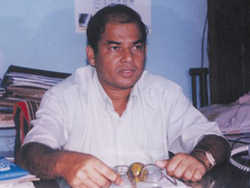
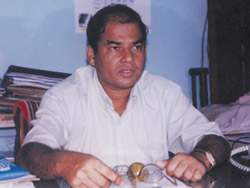
The sanctioned gangsterism of Khulna Division was a good part of the reason Transparency International consistently rated Bangladesh at the bottom of its worldwide corruption index, and why the Committee to Protect Journalists named the country one of the five most murderous places in the world to report the news. Between 1998 and 2006, sixteen journalists were murdered in Bangladesh, eight in Khulna Division after they’d detailed the government’s alliances with “the underground groups.” The most prominent on the kill list was Manik Chandra Saha, above, the former president of the Khulna Press Club and a winner of Transparency International’s Integrity Award.
Saha was different from the slain journalists I’d encountered in Colombia and the Philippines. The division’s 14 million citizens considered him a saint, and even some officials acknowledged he was Khulna’s most reasoned and likable reporter. The deputy inspector general of the Khulna police wept in public when he heard Saha had been killed on January 15, 2004—the first time local journalists had ever seen him show emotion. Saha’s murder precipitated a week of hysterical mourning. Nationwide hartals, or strikes, paralyzed the country. The prime minister’s spokesman and the leader of the opposition arrived in Khulna to comfort the population. And the street where the forty-nine-year-old Saha had fallen was turned into a shrine and renamed
For all the devotion he inspired, Saha was a rather unassuming man. He was stockily built, of middle height, with thinning hair and a voice that could barely be heard when he asked questions at press conferences. What distinguished him in a crowd of reporters were his huge brown eyes, tilted up like wingtips by high cheekbones, which gave him something of a Confucian smile, even when he was being told to shut up by one of the seven godfathers. “Manik did not know how to get angry or raise his voice,” said Mainul Islam Khan, director of a Dhaka-based NGO that attempts to protect journalists. “He had no aggressive side to him, no personal agenda, no ego or inner turmoil. He was a purely innocent person. Whatever he wrote, he just laid the facts out, appealing to reason. He was motivated only by love.”
That love apparently gave Saha tremendous drive. Sleeping at most four hours a night, he divided his days between exposing the region’s torments and laboring to rectify them. He founded schools, libraries, cultural organizations, rural poverty councils, human rights committees, women’s shelters, clinics, a theater group, a music academy, a foundation for working children and an international action forum to save the Sundarbans. Each of the underground groups had threatened to torture him to death, but he regularly traveled alone to remote villages to investigate atrocities. “If they use rape and murder as weapons,” he told his worried brother Prodip, “if they steal the land and no one arrives to tell the world, then their wrongs take place in a vacuum.” Trained as a lawyer, Saha exclusively represented the godfathers’ penniless victims—and was penniless himself most of the time because he gave away the $250 a month he earned from his groundbreaking journalism. “There is no God to answer the prayers of the poor,” he told his wife, Nanda. “It’s a human universe and therefore up to humans to fulfill prayers.”
Three days before his murder, Saha delivered a lecture on his brand of investigative journalism to a reporters’ training session in the nearby town of Jessore. “Use the scientific method and the rules of evidence to gather facts about what is unjust and harmful,” he advised. “When conveying those facts, be neither subtle nor angry. If threatened, take courage by reminding yourself that you speak for those who have no voice. Place your skills in the service of the poor and you will be happy.”
Before I arrived in Bangladesh, I had searched for the motivations of journalists who had given their lives for a story and had discovered complex emotional sources for their bravery. Personal atonement, angry resistance to public enemies or compensation for infirmity had played a part with some; manly pride or religious intoxication had fueled the courage of others. But in Manik Saha I found something more difficult to explain: selflessness that seemed to come from pure goodness.
Excerpted from Marked for Death: Dying for the Story in the World’s Most Dangerous Places, by Terry Gould. Copyright 2009 Terry Gould. Published by Counterpoint Press. Reproduced by arrangement with the publisher. All rights reserved.