Three years ago today, an independent journalist named Bradley Roland Will was killed in Mexico while reporting on a heated protest movement in the capital city of the southern state of Oaxaca. Today, the crime remains unresolved. A man from Oaxaca, Juan Manuel Martínez Moreno, who many close followers of the case believe is innocent, was accused of the murder in October 2008. Martínez remains imprisoned awaiting trial.
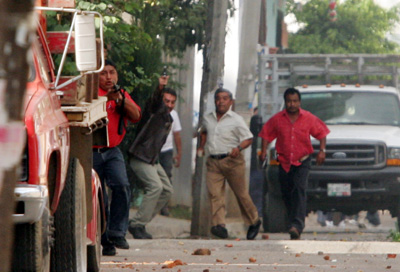
Meanwhile, a group of armed men who were widely photographed shooting directly in the direction where Brad stood—men who many human rights groups, independent investigators and Brad Will’s family believe are responsible for the crime—remain free.
Will, 36, died on October 27, 2006, as he reported from the Oaxaca state capital for New York-based news Web site Indymedia. He had arrived there in early October, anxious to document a teacher-led protest against Oaxaca’s governor, Ulises Ruiz, that had mushroomed into a catchall leftist movement.
On the afternoon of his death, Will covered a street battle between armed plainclothes pro-government men and protesters, including members of the Popular Assembly of the People of Oaxaca (APPO), the organization leading the anti-government movement. During the clash, Will and other journalists stood alongside the demonstrators, who hurled rocks while the armed men fired shots. A photographer for a Mexican newspaper was shot in the leg, while another local photojournalist heard bullets whiz by his head. Minutes later, two bullets killed Will.
The Oaxaca medical examiner’s office and an independent study conducted in Mexico by the Boston-based nonprofit Physicians for Human Rights (PHR) concluded that the bullet wounds on Will’s body corresponded to shots fired at long range—at a distance corresponding to witness accounts of the armed men shooting into the crowd of protesters where Will stood. Days after the shooting, Mexican authorities questioned two local government officials identified at the murder scene as being part of the armed group of men. They were released after a state judge concluded they were not close enough to have shot Will.
In October 2008, Mexican federal prosecutors charged Martínez with the murder. The arrest was largely based on the claim that the shots fired at Will came from close range and likely originated from one of the protesters standing near him—a claim that cleared the pro-government gunmen of the crime. Groups such as the PHR, along with Amnesty International and Mexico’s National Human Rights Commission, strongly question the imprisonment of Martínez, a baker by trade who lived in the capital’s impoverished outskirts, where Will had embedded himself and videotaped extensive interviews with protesters.
Martínez admitted to participating in the APPO protests, but the government has not produced a witness to the murder who can also place Martínez at the scene. Mexican officials also have not detailed a motive for the killing or produced a weapon.
The Will family emphasizes that their son’s murder case is marred by irregularities and is politicized. Ruiz, the Oaxacan governor who remains in office, saw his power heavily tested in 2006 during the APPO-led movement, which accused him of rigging the 2004 state elections. Mexico’s National Human Rights Commission, along with Amnesty International and PHR, also continue to fault Mexico for failing to conduct a probing murder investigation, one that incorporates an exhaustive study of witness reports, photographs, and video from the murder scene and other forensic evidence.
These groups, along with the Will family, also voice strong concern over the lack of investigation and arrests in the killing of at least 18 other protesters during the 2006 conflict in Oaxaca.
On October 14, Mexico’s Supreme Court ruled that Ruiz is responsible for rights abuses during the 2006 protests in Oaxaca. However, the ruling does not carry any binding consequences or criminal penalty.
Monica Campbell, CPJ’s former Mexico representative, is a 2009-10 fellow at the Nieman Foundation for Journalism at Harvard.