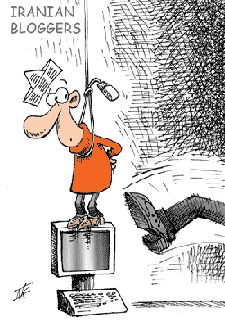
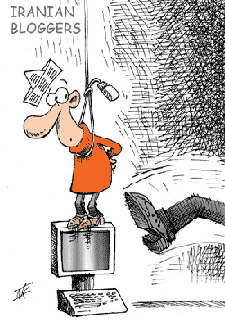
I’m a cartoonist so even when writing a story or working as radio correspondent, I’m checking out the empty half of the glass. As blogger it’s no different; my inner cartoonist lurks in the dark. I’ve followed the Iranian “Bloggistan” since day one, and started my Persian blog after learning how to type. Funny? Not at all! Many Iranian journalists didn’t start typing until 2002, when they found out that they could publish their censored stuff under different pseudonyms.
In late 2001, Hossein Derakhshan (known as the “Blogfather” in Iran) started writing instructions on how to blog in Persian. Living in Canada at the time, he could avoid the dangers that threatened journalists such as Sina Motalebi who promoted blogging in different papers. Sina was summoned by police numerous times in 2002, until he was finally arrested and harshly interrogated in May 2003.
Since those days, many bloggers have been arrested, been harassed, died, or committed suicide. Omidreza Mirsayafi was one of them. He died in 2009, in the notorious Evin Prison. He wasn’t lucky enough to survive it. When tens of thousands of bloggers saw his dead body online, they possibly felt that being a blogger was not a hobby.
(Nikahang Kowsar)
If in 2003 people enjoyed blogging to share ideas and thoughts, today it’s a war. It’s a struggle. In the past five years, bloggers have empowered themselves by joining social networks. In 2004, it was Orkut.com, but today, the Iranian government has to face something much bigger: Facebook.
I have almost 9,000 friends on two different profiles. It’s hard to estimate how many people eventually follow a link that’s posted on my pages, but when hundreds of my friends share those links, I get the idea that the information is multiplying like the H1N1 virus.
Another network that’s working powerfully is Balatarin.com. Thousands of bloggers are sharing links through Balatarin.com. Today, it has become such an important source that journalists and politicians are addicted to this Web site. Last week, I was speaking to a close adviser to Hashemi Rafsanjani. He was checking out the hottest links on Balatarin while answering my questions. This advisor was complaining that many younger Internet users in Iran are not able to check out Balatarin and other important news sources because of the firewalls that block information from entering the virtual borders of Iran.
This was kind of shock to me. Rafsanjani promoted censorship in his own way during his years as a president. He did his best to control media and never helped the journalists who were imprisoned since 2000. Today, his team and advisers feel marginalized by Ahmadinejad and are seeking help from the very bloggers who never liked the “Shark.” (Rafsanjani is called the Shark in Iran.) They want to read more controversial posts against Ahmadinejad and Ayatollah Khamanei, and are willing to leak some information.
It’s weird to know that an old school Ayatollah who possibly didn’t care for intellectuals, especially the ones who were killed during his presidency, is trying to create a powerful network through a few sympathizers in the media and the Iranian “Bloggistan.” Today, the leaders of the “Green Movement”, such as Mir-Hossein Mousavi and Mehdi Karroubi rely heavily on bloggers and active members of Facebook to spread the word.
Gholamhossein Karbaschi, the former Tehran mayor and close ally to Karroubi, was tweeting on an hourly basis during this year’s election, and many Iranians all around the globe were following events through his tweets. His tweets were published through numerous blogs and Web sites as well as Facebook and Balatarin. I spoke to Karbaschi, who was once my publisher in the ‘90s, on how effective he thought tweeting was. He believed that people liked it, as long as everything looked crystal clear to them.
Mousavi had an online TV channel, although that didn’t last long. While Iranian politicians do no seem comfortable with YouTube, Mohsen Sazegara, a former politician now residing in Washington, has produced tens of videos to promote resistance and defiance against the regime through YouTube.
It tells me that many Iranians above 50 are trying to catch the attention of the younger generations through social networks and blogs. It might be hard for them to change their literature and rhetoric due to the age gap, but this will eventually happen. Many bloggers and Internet users are followers of Ahmadinejad and true believers of Ayatollah Khamanei—but, today, being connected somehow shows that you are defying the rules.
If George Orwell were alive, he would have added a chapter about the cyber-clash in Iran to his novel, 1984. Why not? In an “Animal Farm” like Iran, you have to cross the “Big Brother” to live.
Nikahang Kowsar is an Iranian cartoonist, blogger, and reporter currently living in Canada.