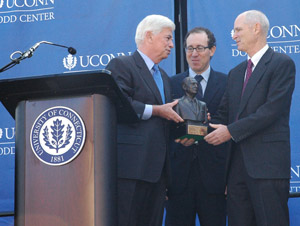
Yesterday, CPJ received the Thomas J. Dodd Prize for International Justice and Human Rights at an outdoor ceremony at the University of Connecticut. It was one of those perfect, crisp fall mornings in New England with a strong wind blowing clouds across the sun and shaking the first leaves from the maples, which have already turned red and orange. CPJ co-founder Michael Massing and I accepted the award, selected by the national advisory board of the Dodd Center. Journalist Mariane Pearl spoke at the ceremony and described how her husband, Daniel Pearl, once told her he “loved life” but was prepared to risk it for his work. She spoke inspirationally about journalists around the world who are willing who make sacrifices to tell stories that must be told.
In presenting the award to CPJ, Connecticut Sen. Christopher Dodd praised the role of the press in bringing hidden injustices to the world’s attention. He noted that as a prosecutor at Nuremberg, his father, Thomas, had befriended a young journalist named Walter Cronkite. As Michael pointed out in his remarks more than 30 decades later, Cronkite helped create CPJ.
Before and after the ceremony, we met with students and faculty and participated in a panel discussion on our Global Campaign Against Impunity, which is supported by the Knight Foundation.
It was a great day for CPJ and press freedom, and we couldn’t be more grateful to the Dodd Center, the Dodd family, and our gracious hosts at the University of Connecticut.
Here is the prepared text of the speech I gave in accepting the award:
Thank you, President Hogan. Thank you to Senator Dodd and the Dodd Family. Thank you to the National Advisory Board of the Thomas J. Dodd Research Center. Thank you, Mariane Pearl. I’d also like to thank Professor Maureen Croteau, who nominated CPJ for this award. Students, faculty and guests:
The Committee to Protect Journalists was founded nearly 30 years ago to fight for the rights of journalists around the world to report the news freely, without fear of reprisal. In the course of our existence, we have fought against repressive laws, helped win the release of countless journalists imprisoned around the world, and beaten back censorship. In the 11 years that I have worked at the Committee to Protect Journalists, I have met hundreds of journalists from around the world whose bravery and courage inspired me. I recognized that they did their work at tremendous risk, and I knew that some of them might not make it.
Let me tell you about a few of them who didn’t.
Mazen Dana, a cameraman for Reuters in the West Bank city of Hebron.
Mazen was a giant man, 6 foot 3 and built like a linebacker. But he was one of the most gentle and forgiving people I’ve ever known. While documenting clashes in Hebron, Mazen was shot with rubber bullets, beaten, and detained. He saw all of this as part of his job. His fearlessness and determination earned him a promotion. He was sent to Iraq to cover the aftermath of the 2003 invasion. While filming outside of Abu Ghraib prison Mazen was shot by a U.S. tank gunner who mistook his camera for a rocket-propelled grenade launcher.
I remember Russian investigative reporter Anna Politkovskaya.
She was the opposite of Mazen–guarded, severe, and sometimes scolding. She had gray hair and thick glasses. I never saw her smile. She believed that she had an obligation to document the brutalities of the Chechen war and was indignant at her fellows Russian, but ultimately at people all around the world, who went about their business oblivious to the slaughter. She was repeatedly threatened; once she was detained by Russian soldiers and kept in a pit. She survived a poisoning attempt. She knew they would get her eventually and yet she continued to report and write her stories. The killers caught up to her on October 6, 2006, and executed her in the elevator of her Moscow apartment building.
I didn’t know Lasantha Wickramatunga, the Sri Lankan editor who was shot to death in January, but I felt like he spoke for all murdered journalists in a famous letter he wrote from the grave. Wickramatunga was the editor of the Sunday Leader in the capital, Colombo. He was one of the country’s best known journalists, and one of its most critical. He wrote about corruption and the brutality of the war against Tamil separatists. In an editorial he ordered to be printed in the event of his death he wrote the following:
“People often ask me why I take such risks and tell me it is a matter of time before I am bumped off. Of course I know that: it is inevitable. But if we do not speak out now, there will be no one left to speak for those who cannot, whether they be ethnic minorities, the disadvantaged or the persecuted.”
What compelled these journalists to essentially sacrifice their life for their profession? I think about this every day.
First, I believe that curiosity, the need to know and understand our surroundings and to communicate our knowledge to others, is an essential element of the human condition and the basis of human society. These needs are so intrinsic that governments can only suppress them at great cost and determination. Information empowers people to take action and control their own destiny. This is why every totalitarian system is at its core an elaborate system of information control.
Journalists who risk their lives are usually guided by a deep faith in the essential goodness and power of humanity. They do their work because they believe people will act if they know the truth and that things will change if people act. On occasion they have been proven right. Journalism played a key role in the collapse of many powerful and brutal governments, from the Soviet Union to apartheid South Africa.
We are humbled and inspired by journalists like Anna Politkovskaya and Lasantha Wickramatunga.
But we are also angry.
We are angry because in a just and decent society no journalist should have to make the sacrifice that they made.
CPJ has no greater responsibility than fighting for justice when our colleagues are murdered. According to CPJ research, in nearly 90 percent of the 543 journalist murders since 1992 the killers got away scot free.
This record of impunity has a devastating effect on the local press, breeding fear and self-censorship and allowing criminals to define the terms of public dialogue.
CPJ is fighting against these injustices. With support from the Knight Foundation we are waging a Global Campaign Against Impunity.
In the first year and half, we have focused on Russia and the Philippines, two countries where journalists are routinely murdered and the killers are almost never punished.
Last month, we issued a new report in Moscow called Anatomy of Injustice. It chronicled the failure of Russian authorities to achieve justice in 17 murder cases. Our delegation in Moscow met with investigators, confronted them with the facts, and pushed them to do their jobs. We are under no illusions regarding the challenges ahead; but we are confident the Russian leadership now understands that the country’s record as one of the most lethal for journalists does grave damage to its standing in the world.
Seeking justice for our slain colleagues is just part of our work in defense of press freedom.
Through our journalist security program we are seeking to educate journalists about the best way to do their jobs safely.
Our journalist assistance program provides direct support–from medical assistance to help with resettlement in exile.
We have helped evacuate dozens of journalists from Iraq, Somalia, Zimbabwe and other countries where they face persecution. We have supported the families of imprisoned journalists. We routinely visit journalists in jail. We show up in the courtroom when they are put on trial–as a reminder that the world is watching.
Through our advocacy, we are seeking to bring down the number of journalists in jail around the world, which we currently estimate at around 150.
China and Cuba have been the world’s worst jailers of journalists for years but they have a new rival for this dubious honor. Dozens of journalists have been arrested in the massive post-election crackdown in Iran. About 20 remain in jail.
CPJ successfully campaigned for the release of Iranian-American freelancer Roxana Saberi, who was arrested in January, sentenced in March to eight years in prison on trumped up charges of espionage, and released in May after her sentence was reduced on appeal.
Today, we are focusing attention on Maziar Bahari, the correspondent for Newsweek magazine who was arrested shortly after the June 12 elections. Bahari was pressured to make a false confession and has been denied access to a lawyer. His wife, who lives in England, is expecting their first child.
CPJ’s advocacy has helped win the release of jailed journalists from China to Cuba, from Morocco to Afghanistan. Our 1997 campaign in Turkey led to the release of dozens of journalists in that country.
But one reality which makes our job more difficult is the fact the United States military routinely jails journalists.
More than a dozen journalist, some working for international media organizations, have been detained by U.S. forces in Iraq and Afghanistan and held for extended period times without being charged with any crime. One journalist is being held today. Ibrahim Jassam, a photographer for Reuters, has been imprisoned for over a year in Iraq. An Iraqi court ordered that he be released because of a lack of evidence–but the U.S. military will not comply.
Ibrahim Jassam should be charged or released. It is appalling that he can be held indefinitely without due process. This is a practice which must end.
Any American journalist who has traveled the world knows that the U.S. media, despite our current struggles, remains an inspiration to journalists in every corner of the globe. Journalists around the world know about Watergate. They know about our First Amendment. They know of our tradition of independent and objective reporting.
It is this tradition which gives the U.S. government a platform to be an advocate for press freedom around the world.
But the U.S. can only play this role effectively if our own house is in order.
Journalists in most democratic counties, and even some less democratic ones, enjoy legal safeguards which allow them to protect their sources.
U.S. journalists have no such protection at the federal level.
We need an effective federal shield law which provides broad protections for all news gatherers. I commend Senator Dodd for championing a federal shield law in the Senate.
Senator Dodd has also introduced a bill, named in honor of Daniel Pearl, which would require the State Department to include a section on press conditions in its annual human rights report. This measure is essential for ensuring that the promotion of press freedom is part of our foreign policy. We urge the Senate to move toward quick passage of this important legislation.
Keeping the press free today doesn’t just mean defending individual journalists. It means defending the medium through which journalism is disseminated–and in our current era that means the Internet.
The Utopian notion that the Internet is impossible to censor or control has been superseded by a new reality: According to CPJ research, online reporters now represent the largest group behind bars, surpassing print journalists for the first time. In countries like China and Iran, citizen bloggers are filling the function of traditional journalists, providing on-the-ground accounts and critical commentary. These journalist/bloggers are uniquely vulnerable to arrest because they work alone, without institutional support. Both governments are capable of controlling or even shutting down the Internet. CPJ is fighting to keep the Internet free for journalism.
According to our census data, freelancers also make an ever-increasing percentage of journalists imprisoned around the world.
While well-funded foreign bureaus continue to exist, increasingly international news is being gathered by a new generation of journalists who work for smaller media outlets or for themselves. Local journalists are providing front line reporting for U.S. media outlets, especially in Iraq and Afghanistan. They are also bearing the greatest risk. In Iraq, the most deadly conflict for the media in history, nearly 200 journalists and media workers have been killed. The vast majority are local Iraqi reporters.
In Afghanistan, New York Timers reporters Stephen Farrell, who is British, and Sultan Munadi, who is an Afghan were recently kidnapped by the Taliban. A British commando unit launched a daring rescue operation and Farrell was saved. But Munadi died in the operation.
While American celebrated the return of journalists Euna Lee and Laura Ling after four months of captivity in North Korea, some called their reporting along the China border region reckless.
But as major news media outlets cut back on foreign coverage, freelancers are taking up the slack. We as a society benefit enormously from the work of U.S. journalists who travel to remote and dangerous places and report back on what they see. Journalism in dangerous places involves calculated risk. If things go wrong this new generation of reporters must have confidence we will stand behind them even if they don’t work for a major media organization.
CPJ is an organization of journalists that defends the rights of our colleagues around the world. We do it not because we think journalists are different, or are entitled to special rights. We do it because we believe that by standing up for press freedom, we are defending the public’s right to be informed. We want journalists to be able to shine a light on the worst human rights abuses. We want people around to know if their governments are corrupt, and to hold officials accountable.
We are humbled by the honor bestowed on us by the Thomas J. Dodd prize and grateful that this generous award will allow us to continue our work on behalf of journalists everywhere.
Anna Politkovskaya, Lasantha Wickramatunga, and countless other journalists gave their lives for their profession.
But they also gave their lives because they wanted us to know what was happening in their countries.
By standing up for justice whenever journalists are killed, by defending press freedom wherever it is threatened, CPJ is standing up for your right to information in a globalized society.
The recognition bestowed on us today will allow CPJ to continue this important work.
Thank you.