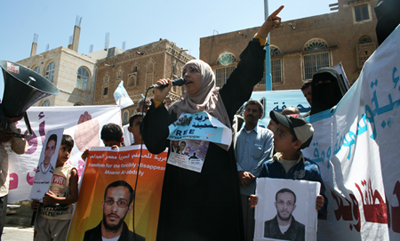
Swathed in the traditional black face veil, or niqab, Yemeni women brandish banners with images of disappeared and imprisoned journalists. Every Tuesday, in Yemen’s capital city of Sana’a, Tawakul Karman, chairwoman of Women Journalists Without Chains (WJWC), leads these women into
She stands surrounded by a small circle of male demonstrators, who are enclosed in a larger circle of women. Sexes are separated, but men listen in silence to Karman’s speech, occasionally nodding in agreement or applauding when she stops to take a breath. She radiates confidence. Even the soldiers there to keep watch are transfixed by her narration, like children watching television; every so often they jolt back to reality, glance around to see if their superiors are scowling, stand up straight, and readjust their guns.
“We want to show the world that women can do everything,” Karman said. “We have done something very unusual for our community, an organization like this run by women. Women are strong; we have helped newspapers get permits back.”
On this particular Tuesday, WJWC is calling for the release of journalists including Muhammad Al-Maqaleh, editor of Aleshteraki, a Web site that reported on the conflict in northern Yemen. The group is also protesting for the re-opening of the daily Al-Ayyam newspaper, which was shut down earlier this year.
Attacks and kidnappings of journalists have been on the rise in 2009 and many media outlets have been closed as Yemen’s stability has deteriorated. One of the poorest countries in the Arab world, Yemen is struggling on three fronts. The war in the North between the government and Houthi rebels continues with no end in sight. A secessionist movement in the South is gaining momentum and there is a persistent threat that Al-Qaeda will exploit the situation to create a new stronghold. Amid all the fighting, the government is diligently working to quiet the media’s reporting on the country’s troubles.
“2009 has been a bad year for Yemen as a whole with all the political unrest,” Abu Bakr Al-Qirbi, Yemen’s Minister of Foreign Affairs, said recently in an interview with the Yemen Times. “Unfortunately, that leads to Yemen’s insecurity and instability and it is not a time to really allow irresponsible publicity aimed at damaging Yemen’s image by national newspapers.”
CPJ has documented the persistent harassment of the country’s press this year, including a security force raid on a newspaper office and the banning of multiple papers. Journalists have gone missing and been thrown in jail.
“They kidnapped journalist Muhammad Al-Maqaleh, and several more journalists have now been in prison for more than five months,” Karman told me. “This year alone, State Security has barred the sale of eight newspapers, blocked Web sites, and denied us the right to protest.”
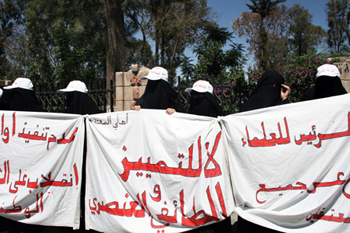
Karman’s resentment is not aimed at the government as a whole, but at State Security, which deals specifically with political parties and the media. “When we gained NGO status in 2005, we were called Women Journalists Without Borders,” Karman said. She explained that State Security “created a twin company with the same name and the same logo. They took our license and granted it to a fake company.” The group changed its name.
“Conditions for journalists are much worse,” she went on. “State Security will also create twin newspaper companies to block licenses. But they will not only copy the name. They will employ people to work for them and the papers will be published.”
Karman described how she has been bombarded with phone calls and text messages threatening to throw her off the mountains that encircle the ancient city of Sana’a. “If they take me to prison, it is better than to deny me a free press,” she said. “It is a type of violence, not just to hit me, but to prevent me from reading newspapers, watching TV, or listening to the radio.”
WJWC demonstrates in
Oliver Holmes is a freelance writer reporting from Sana’a, Yemen.