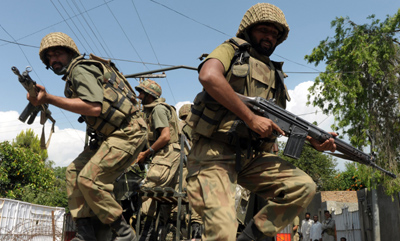
 During the height of the Pakistani military’s assault on militants, hundreds of local journalists were forced to flee the Swat Valley and neighboring areas. Coverage of the fighting was left in large part to Pakistani reporters from outside the region who had embedded with the military. These journalists faced their own set of challenges.
An important part of the military’s offensive was to turn public opinion against militants who had enjoyed widespread, if somewhat ambivalent, support. To turn public opinion around, the military had started embedding reporters with its units as soon as the fighting started. Although the limits on coverage were strict, few journalists for Pakistan’s mainstream media could risk covering the fighting without being under the protective wing of the military. The military had used the embedding tactic at times in the past, but this was the first time it had been used so extensively.
The embedding was part of a public relations move that included changing the name of the offensive from “Operation Black Thunderstorm” to Rah-e-Rast, roughly translated as “Back on the Right Path.” It was part of an attempt to wrest the moral high ground from the insurgents, a “hearts and minds” tactic aimed at making the chaos of war more palatable to civilians.
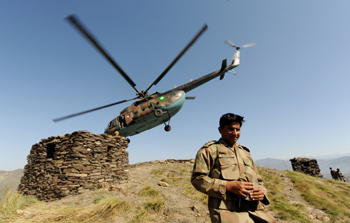
More than a year earlier, Maj. Gen. Athar Abbas had been appointed as the military’s spokesman. With several brothers prominent in the media—his brother, Mazhar Abbas, headed the Pakistan Federal Union of Journalists for several years and was a 2007 CPJ International Press Freedom Awardee; another, Zafar, is editor of the English-language daily Dawn—Maj. Gen. Abbas is media savvy and understands the importance of supportive news coverage.
Journalists were ambivalent about the embedding. Muhammad Arshad Sharif, the defense and foreign affairs correspondent for Dawn TV News, and several of his colleagues spoke with me recently in the station’s modern, air-conditioned newsroom in Islamabad.
Sharif is articulate and persuasive. He has the self-assurance of a successful on-air personality, but he was not able to hide the personal impact of his war reporting. “I know many people argued that this was America’s war, but over the years with the terrorism we have seen, it’s very much a war against militancy. It goes back to the nurturing of the militants and jihadis and the ideological relationships they developed over the years,” Sharif said. “But this is going to be a long, protracted war. We saw in the tribal areas and Swat these militants attacking people, beheading people, flogging people in public, extorting people. Obviously the government had to act against this militancy.
“It’s a difficult story to cover. Either you cover it from the side of the militants or go over and cover it from the side of the government. Cover it independently and your life is at risk. Your life can be taken away because you could be a target of either of the two sides,” Sharif said.
Matiullah Jan, a Dawn TV producer who also covers Pakistan’s Supreme Court, said he resented the necessity of working closely with one side or the other. “Embedded journalism is just another form of hostage-taking,” he interjected as Sharif spoke.
“Yes,” Sharif argued, “embedding has its merits and demerits. For example, you can’t show the damage and dead bodies if it’s bad for the military. But at least you’re part of history as it is happening, even if you can’t tell the whole story.” He acknowledged that some events are not disclosed in news reports from embedded reporters. “Maybe we can show all our footage later, to show the violation of human rights of war—but at this stage we can’t do that.”
Matiullah contended that too much is sacrificed. “It has taken its toll on objective reporting, but we’re not really talking about it. Civilian casualties are nowhere to be mentioned, let alone military casualties. A lot of journalists have started using the term ‘collateral damage.’ Journalists are paying a lot for covering the war this way. It’s part of the ‘collateral damage’ too.”
The series:
Part 3: Coverage of the fighting was left in large part to Pakistani reporters from outside the region who had embedded with the military.
Part 4: Hayatullah Khan was murdered in 2006 in the Federally Administered Tribal Areas. The government investigated—and then kept its reports secret.
Part 5: Government, media can undertake reforms to improve security.