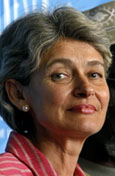
Irina Bokova is the quintessential diplomat—elegant, gracious, and fluent in five languages. But she must have a sharp elbow or two to have emerged victorious in the rough-and-tumble battle last September to lead UNESCO, the Paris-based U.N. agency that promotes culture, education, science, and, occasionally, press freedom around the world.
Bokova had a long career in Bulgaria’s foreign service before being named her country’s ambassador to UNESCO. Her main rival for the organization’s top job was the Egyptian candidate, Farouk Hosny, who was backed by most Arab countries. Hosny supported censorship when he served as Egypt’s culture minister and many freedom of expression groups spoke out against his candidacy.
Bokova is in the U.S. this week to meet the media and policy makers. She also met with a delegation from CPJ at UNESCO’s New York office.
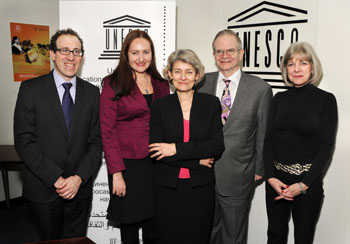
CPJ Chairman Paul Steiger, board member Anne Garrels, Europe and Central Asia Program Coordinator Nina Ognianova and myself emphasized the importance of UNESCO’s principled commitment to the values enshrined in Article 19 of the Universal Declaration of Human Rights, which states that “Everyone has the right … to hold opinions without interference and to seek, receive and impart information and ideas through any media and regardless of frontiers.”
“Freedom of expression and the freedom of journalists are important,” Bokova told us.” I am convinced that passing a principled message to convey that is essential.”
Each year, an independent jury selects a courageous journalist to honor with the UNESCO/Guillermo Cano World Press Freedom Prize, named in honor of the slain Colombia editor. The honorees have included China’s Gao Yu, Mexico’s Lydia Cacho, and murdered Russian reporter Anna Politkovskaya, who was recognized posthumously. U.N. member states have not always been pleased with these selections, and have complained to UNESCO. Bokova pledged to stand firm. “The opinion of an independent jury should be respected,” she insisted.
UNESCO has a broad mandate that includes supporting education and scientific research. Bokova repeatedly emphasized that the budget for media support is relatively modest.
Acknowledging these financial constraints, CPJ’s Ognianova pointed out that UNESCO “does not need a lavish budget to exercise moral authority when it comes to press freedom causes.”
CPJ welcomes Bokova’s election as UNESCO’s new director general and urges her to maintain a strong and consistent policy in support of press freedom. Journalists need her support more than ever, and U.N. members states must recognize that cornerstone of the U.N. system is a shared recognition that certain rights, among them freedom of expression, cannot be compromised or negotiated away.
UPDATED: We’ve updated to correct Bokova’s new title, which is director general.