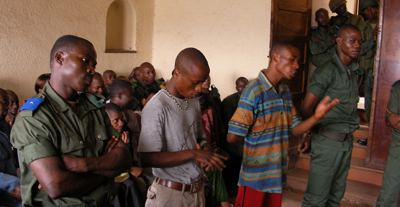
Didace Namujimbo, a journalist for Radio Okapi, was shot dead on the night of November 21, 2008. Now, after repeated delays, a military court in Bukavu, capital of the province of South Kivu in eastern Democratic Republic of Congo, is putting on trial a dozen people charged in connection with the murder.
According to investigations by military prosecutors and statements from the accused, three army officers—Adjutant Tshimanga aka Dureman (now deceased), 1st Quartermaster Sgt. Seba Tandema, and Warrant Officer Oscar Tshenda Kashama—and a civilian, Mushamuka Bashengezi, ambushed Didace at the stone and cement stairs descending from Bukavu’s Vamaro Avenue toward Mukukwe Valley on that Friday evening in 2008. The other defendants were tracked down from records of Didace’s stolen phones after the murder. They face various criminal charges for handling items stolen from the victim.
Proceedings began in January, during which the defendant Tandema declared that the now-dead suspect Dureman was the shooter. Motives and roles in the killing, though, remain uncertain.
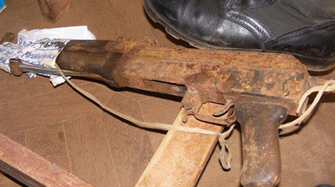
Prosecutors say this AK-47 is the murder weapon. (JED)
In the courtroom, laid on a table before the clerk of the court one recent day, are some key pieces of evidence: a now-rusty AK-47 assault rifle, cartridges, including a spent round found at the crime scene, among other things. The audience holds its breath, suffocating in intense heat tempered only by breezes from nearby Lake Kivu. A battalion of lawyers—20 of them—pour into oratorical contests. As the trial began, Joel Mapatano, counsel for the plaintiff, the family of Peter Namujimbo (the father of the slain journalist), contested the competence of the military tribunal to try the two female civilians among the charged. Lawyers for the defendants pointed out that some of their clients had already spent as many as 14 months in prison. Adjournments ordered by the panel of five magistrates leave the audience to disperse, disappointed and speculative.
In the bars and restaurants of Bukavu, the trial is a popular topic of conversation. At the Pretoria bar on Lumumba Avenue in the district of Ibanda, where Didace’s elder brother Déo was a regular, you can overhear speculation about the trial as people savor skewers of goat meat, sip bottles of beer, and listen to Werrason’s “Techno Malewa” hit album. They wonder why the main suspects, who left Nyamugo district around 7:30 p.m. and arrived at the Vamaro Avenue stairway to await and kill Didace past 9 p.m., did not attack any other person that night. “It would be a setup,” they say, or “balimuvizia,” meaning in Swahili that Didace was targeted.
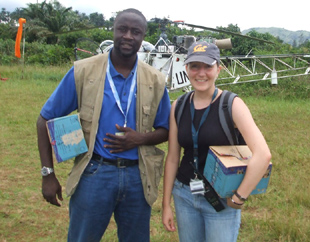
In this family photo, Didace Namujimbo is seen on assignment with an unidentified colleague.
The trial occurs more than one year after Didace’s death. In contrast, the murder trial of Didace’s friend and colleague at Radio Okapi, Serge Maheshe, had opened the day after Maheshe’s assassination. Unlike the Maheshe trial, whose hearings were held outdoors at the central police station of Bukavu, this trial takes place in a narrow courtroom, slightly withdrawn from the city center, in a certain seclusion. The hearings are not broadcast live on local radio or television. I am covering the proceedings on behalf of Radio Maendeleo along with journalists of Radio Okapi and Radio Nene la Uzima. Attending the hearings are representatives of the Division of Human Rights of the UN Mission in DR Congo (Monuc).
I have a personal connection to the case. Didace was the younger brother of Déo Namujimbo, a former colleague with the Syfia Great Lakes news agency who is now a refugee in France. Déo said he was threatened after the murder of his little brother. Didace, whose childhood name was Munyi, was a good player and a good referee in basketball. The local association of basketball organizes each November a tournament in his memory.
Dieudonné Malekera Bahati is a freelance journalist based in Bukavu, South Kivu, in eastern Democratic Republic of Congo.