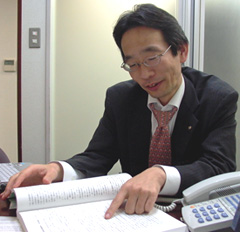
Kazuo Hizumi holds his hands up before him, shoulder-width apart. He is demonstrating the size of the blade he kept under his pillow when sleeping at the bureau in his days as a rookie reporter in Osaka in 1987. The journalism community was still reeling from a shooting attack on Asahi Shimbun’s Osaka bureau the month before, which had left one writer injured and another, Tomohiro Kojiri, killed. No one was prosecuted for that murder and the statute of limitations for initiating legal proceedings has passed.
• 日本語版
But it still resonates for Hizumi, now a lawyer who specializes in free speech issues. He was himself threatened following the attack while investigating a religious cult, he said. “Do you want to end up like Asahi newspaper?” he was told. “I learned that journalists are always exposed, always risking their lives,” he said.
Prior to CPJ’s February 16 panel event in Tokyo to mark the launch of our 2009 book, Attacks on the Press, Hizumi sat down with me and a translator at the Tokyo Kyoto Law Office to discuss his work. At 10 a.m. on a Saturday, his workplace buzzed with activity.
“Although deaths are rare, there exist very sophisticated conditions that prevent journalists from being active,” Hizumi explained of present-day Japan. In early February, an aide involved in corruption allegations against Democratic Party of Japan (DPJ) Secretary-General Ichiro Ozawa was detained for several hours without charge and denied access to a lawyer during questioning, he said. Only one weekly magazine, Shukan Asahi, chose to cover this angle of a story that has otherwise dominated the country’s front pages. “Journalists were afraid because they need the police and prosecutors as a source—they don’t want to make enemies of them,” Hizumi told me.
But the magazine story began to circulate online. At the Foreign Correspondents Club of Japan following the CPJ panel, I met the story’s author, Takeshi Uesugi. He confirmed Hizumi’s account: On February 4, the freelance journalist and blogger announced on Twitter that public prosecutors had telephoned to summon the magazine’s chief editor for questioning about the piece. Hizumi, himself an active blogger, said he believes the publicity stemming from that announcement caused the prosecutors to back down: the summons was withdrawn the same day, ostensibly because the editor was out of town.
The DJP’s recent victory in the 2009 elections is good news for journalists, according to Hizumi. Their publicly stated attitude toward the media differs from that of their predecessors, the Liberal Democratic Party (LDP), who introduced legislative measures Hizumi ways were designed to inhibit the media and maintain the party’s 54-year hold on power. Still, media advocates are asking how committed the DJP is to overhauling existing regulations. Hizumi gave me an English copy of an article he authored two years ago as part of a Japanese-language book on media control that lays it all out in detail:
- The LDP dismantled a post-World War II independent broadcasting regulatory commission in1952. Since then, the Ministry of Internal Affairs and Communications has had the power to grant broadcasting licenses and issue warnings about conduct, or “administrative guidance.” Licenses are subject to renewal every five years.
- With unregulated cross-ownership of media outlets, the effects of this dependence on government licensing are magnified. Each of the country’s five major newspapers has a corresponding television station.
- Japanese advertising agencies, which represent multiple companies in the same industry, and multiple media outlets in the same market, exert correspondingly large pressure on publishers and broadcasters. Hizumi quotes from a book on advertising agency Dentsu, published by the weekly magazine Shukan Kinyobi in 2006, about the weekly magazine Gekkanshi. An unidentified company “threatened to pull its ads from all magazines published by Shogakukan, the magazine’s publisher, and to pursue a recall of the offending magazine. To appease the company, Shogakukan edited out all mention of the company and reprinted tens of thousands of issues.”
- The Protection of Personal Information Law, first introduced in 2002 and enacted in 2005, inhibits investigations, Hizumi asserts. The Japan Newspaper Publishers and Editors Association have repeatedly called for the law’s revision, citing “growing refusals to grant media access to information on the grounds of personal information protection,” according to the April 2009 edition of its bulletin.
- The LDP government increased the incentive for publicly known figures to pursue defamation lawsuits against media outlets by urging courts to raise the amount of compensation payouts. At the time of his report, Hizumi found average damages awarded had risen from 1 to 5 million yen (from US$11,200 to US$56,000).
Defamation is also a criminal offence in Japan. Yasunori Okadome, editor and publisher of notorious muckraking weekly Uwasa-no-shinso, (The Truth of Rumor) was given an eight-month suspended sentence before rising defamation claims based on his scandalous—and often hard-hitting—stories eventually pushed the magazine out of business in 2005, Hizumi said. That year, Toshiyasu Matsuoka, editor of Kami no Bakudan (Paper Bomb) served 192 days before being given a four-year suspended sentence for reports on police involvement with the (technically illegal) trillion-dollar pachinko game industry.
The DPJ has taken some initial steps toward reform, including investigating the press clubs that restrict access to press conferences. Mizuho Fukushima, the newly elected cabinet minister for consumer affairs, has also called for a review of the personal information laws, according to a Japan Times editorial from November 2009. But the administration hasn’t said much yet on Internet control, Hizumi says. The LDP passed child protection laws for the Internet that encourage content filtering apparently stringent enough to discourage Sony from marketing a Web-capable television in Japan this year (critics say bad sales were the primary factor). They were also trying to apply the potentially restrictive broadcast laws to new media outlets, according to Hizumi.
The culture the laws have fostered among media practitioners may also be hard to dismantle. On February 15, Hizumi was in court again to represent Greenpeace’s “Tokyo Two,” who face a possible six-month jail term for stealing a crate of whale meat as part of an embezzlement exposé, Hizumi said. The hearing was adjourned till March 8. At a recent press conference for the pair, Junichi Sato and Toru Suzuki, Hizumi anticipated a sympathetic hearing. “These activists had been doing this investigation for six months—their work was basically that of a journalist,” he said. “But in Japan, they think, why question the police? No Japanese mainstream media outlet reported this story. I thought every journalist must support them—but it’s not the case.”