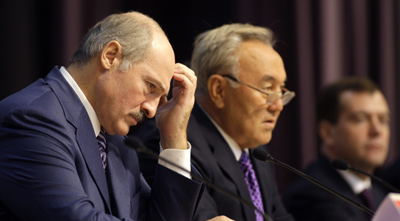
Belarus has been termed Europe’s last dictatorship because of its long intolerance of dissent and press freedom. So accustomed is the world to the clampdowns of President Aleksandr Lukashenko’s regime that neither a recently issued decree on Internet access, which requires that providers record users’ personal data, nor last week’s police raids at a number of independent news offices, came as much of a surprise to anyone. “Belarus—reliably repressive” would be the country’s bumper sticker were press freedom groups to make one.
What is interesting is that a number of other Eurasian countries—notably Kazakhstan, the current chair of the Organization for Security and Co-operation in Europe (OSCE)—are adopting tactics very similar to those of Belarus in order to curb critical media coverage, particularly on the Internet. Recent increases in the numbers of online users in both countries have undoubtedly contributed to authorities’ perceived need to control the Web.
Both Belarus and Kazakhstan have passed restrictive laws that equate Internet publications with traditional media, making the former subject to the same repressive regulations as the latter. Lukashenko signed his country’s law in August 2008; Kazakhstan’s president, Nursultan Nazarbayev, signed similar legislation in July 2009. In the case of Belarus, the law demands that all news media, including online publications, be approved by the government. The Kazakh law expanded the definition of mass media to include social networking sites, chat rooms, online forums, and personal Web pages and blogs—giving state agencies broad authority to block or shut them down. The vaguely worded law also allows for the blocking of international Web sites if those are found in violation of Kazakh legislation.
When it comes to the Internet, Kazakh and Belarusian policies are disturbingly similar. But while Belarus has been recognized as a repressive regime, Kazakhstan has been rewarded with the stature of leading the OSCE, the region’s leading human rights and security organization.
Since its assumption of the OSCE chairmanship in January, Kazakhstan’s press freedom and human rights records have come under somewhat greater scrutiny. But the international community has been too cautious in confronting Astana on journalist imprisonments, impunity in anti-press attacks, and politicized prosecutions of the press.
It is time the international community recognizes Kazakhstan’s record, demands demonstrable improvements from Astana, and ensures that the OSCE’s mission of promoting human rights and democracy is not compromised by its leader.