Uganda’s anti-homosexuality bill has received considerable international attention, particularly concerning its harsh criminal sanctions, but another piece of repressive legislation threatens to criminalize the activities of another maligned group: the vibrant independent press in this East African nation at the confluence of Africa’s largest lake (Victoria) and the world’s longest river (Nile).
Uganda is not above putting restrictions on journalists and politicians deemed as opposing President Yoweri Museveni, the former guerilla leader who has ruled the country since 1986. The police here have a special “media crimes” division. One journalist, Andrew Mwenda, is battling more than 20 separate criminal cases alleging libel, sectarianism, and sedition for his reporting. Under the Ugandan 2002 Anti-Terrorism Act, journalists risk lengthy prison sentences or death while reporting on the activities of groups the government deems “terrorists.”
Now, it appears the government wants to go much further, at least judging by a leaked copy of cabinet-approved principles for a bill amending the 1995 Press and Journalist Act.
The proposal would introduce new licensing conditions for newspapers, invigorate the rather moribund Media Council, and empower the council to punish media outlets. Especially disturbing is section 5.1.8, which aims:
To amend the existing Act to create offences and penalties against media houses that publish material prejudicial to national security, stability, and unity, or utterances that are injurious to Uganda’s relations with her neighbors or friendly countries or utterance and publish materials that tantamount to [sic] economic sabotage. [Bold in the original]
In an interview in January, Minister of Information and National Guidance Kabakumba Masiko told me the bill aims to ensure that journalists are penalized if they “are going to injure or give information that will cause instability that will affect our economy.”
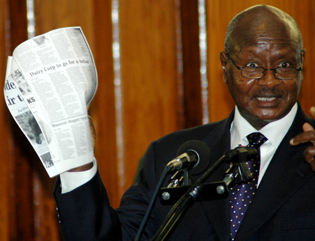
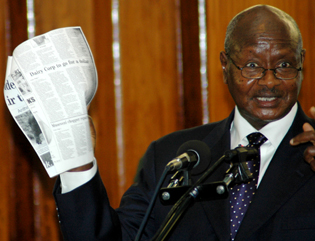
Fears of “economic sabotage” by the media are nothing new in Uganda. In a June 2008 parliamentary session, Museveni brandished a copy of a 2005 article from Uganda’s leading independent newspaper, Monitor, which alleged the government wanted to “sell” the state-owned Dairy Corporation Ltd. to a Thai investor for a nominal fee. “What right do such saboteurs have to sabotage our investment? What right do you have to damage our future?” he asked. The newfound focus on economic interests now likely refers to Uganda’s nascent oil wealth. With the recent discovery of oil in the western part of the country, the proposed law would likely seek to control media-stoked controversy over the contentious and secretive oil deals being made.
Some independent journalists scrutinizing the government and oil multinationals over their Production Sharing Agreements (PSA) are already facing problems. Monitor reporter Richard Wanambwa said he received death threats over a January 3 article that cited a leaked report on alleged oil deal irregularities. In February, a magistrate dismissed a freedom of information petition on oil deals that was filed by Monitor journalists
In a country where much of the national budget comes from foreign aid, donor criticism over Museveni’s handling of the media has put the state in a difficult bind: How does it to maintain the illusion of a press that is wholly free while ensuring that underlying regime and economic interests are secured? The government’s stance appears to be one of freedom for the media in exchange for their implicit collaboration. Minister Masiko echoed this sentiment in a Monitor article in January when commenting on the government’s ongoing ban of prominent broadcaster Central Broadcasting Services (CBS). She said, “As a government, we are willing to forget and forgive if the CBS management is cooperative.”
The bill, in the context of the ongoing suspension of CBS, a ban on popular debate programs, and prosecutions of journalists, has many concerned that with election season about to begin in earnest, further clampdowns and repressive measures will be taken. In an interview with The Independent, Masiko dismissed such concerns. “We are trying to streamline the operations of the media,” she said.
Many journalists fear the only thing the government wants to streamline is penalizing the news media for loosely defined offenses.
Despite the ruling NRM’s party’s 24 years in power, attempts to rid the country of corruption and patronage have proved largely unsuccessful. Uganda rates 130th out of 179 in Transparency International’s 2009 Corruption Perception Index, a drop of four spots from the previous year. New laws that curb the media’s ability to scrutinize government irregularities could erode imperil transparency and accountability.
The proposed amendments seem to be worryingly in line with Freedom House’s 2009 assessment of Uganda’s press freedom climate, one in which “the government’s aggressive application of several repressive laws to control the media has led to widespread self-censorship.”
Ariel Rubin is a freelance journalist who recently relocated to New York City after working in Uganda with The Independent newsmagazine.