When a coup occurs somewhere in the world, journalists are usually the first to be sidelined. Beyond the classic scene of a new leader addressing the nation and promising democracy, stability, and wealth, reporters are usually simply undesirable within the new leadership’s entourage.
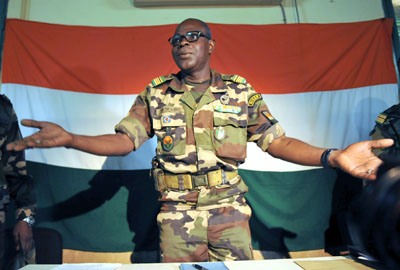
In Niger, things were a little different last February, when a military junta put an end to President Mamadou Tandja’s ambitions to stay in power by means of a constitutional amendment. The video showing the junta members surrounded by local reporters impelled me to propose covering the coup’s aftermath.
Once I got the go-ahead from my employer in Qatar, Al-Jazeera, I applied for accreditation. But, the cameraman who was going to accompany me had an Iraqi passport and therefore needed a visa. So began an ordeal. Uncertainty was haunting Niger’s diplomatic representations to the point that the consulate would not take the “risk” to give my colleague the visa without Niamey’s green light. Ironically, we received a prompt positive response to our accreditation request. After two weeks of waiting, finally came the long awaited visa.
Before my mission to Niger, I knew little about this country but I had an idea about its media landscape. Last year, I met with Nigerien journalist Seidik Abba in Doha, and he dedicated his book Niger’s Press: State of Affairs and Outlook to me. Previously, the names of Moussa Kaka or Abdoulaye Tiémogo were often cited by media or organizations defending press freedom.
We arrived at Niamey airport around midnight. Plainclothes policemen intercepted us. A camera always draws police attention in such circumstances. After a quarter of an hour of waiting, we were allowed to move. Our fixer was waiting for us. Djibril Saïdou is a young journalist I knew through his articles for a pan-African agency based in Dakar. Outside the airport, it was very hot, and the city was badly lit.
But beneath this stifling atmosphere, there was a fresh air trickling into the country. It came from journalists who managed to restore nobility to their job.
When Tandja overstayed his term in office last year, journalists were at the forefront of a nationwide protest movement. Tiémogo, editor of the independent Le Canard Déchaîné, paid a heavy price for his critical articles. When he received me at his tiny office, he was breathing a sigh of relief. “I struggled for one year and a half,” said Tiémogo, the last journalist to be sent behind bars by Tandja’s regime. Now that Tandja has been dethroned, Tiémogo said he will keep up pressure on the new ruling elite. “I am ready to resume my pen against any other regime that would dare to violate the constitution,” he said.
The ruling military junta has already been subject to strong criticism. The local press has doubts over the willingness of the military regime to overcome the current political crisis and it raised fears that the situation could drag on. The junta has already ruled through the duration of the transition period, but it is still dithering over the way to deal with local and foreign journalists, sowing more uncertainty. During our trip, they were unwilling to give us an interview. However, we made our stories without any kind of interference, which is a breakthrough considering the circumstances.
Since Tandja’s ouster, no journalist has been prosecuted and no newspaper has been confiscated. Quite the contrary: Two journalists have been appointed members of the Advisory Board, which is assigned the task of assisting the military junta in preparing the transition period. This state of affairs left me perplexed. In other countries where political stability is real fact, there is less freedom. For example, when you compare Niger’s press landscape to the one in the Arab world, the gap is wide. For example, while Nigerien journalists are questioning the military nature of the new local leadership, it is unthinkable that their colleagues in the Arab world could devote an article to military institutions, even if it is to discuss accomplishments.
Although I won’t immediately dare talk of a turning point, there is much hope for a better tomorrow for the Nigerien press after several years of asphyxiation.
Bassam Bounenni is a Tunisian journalist who works for Al-Jazeera in Doha, Qatar.