French journalists are flabbergasted. One of their colleagues, Augustin Scalbert, a journalist with Rue89, a leading news Web site, has just been indicted by a Paris prosecutor under the charges of “stealing and keeping” a video belonging to the public television channel France 3. If the journalist is found guilty, this indictment can land him in jail for five years or leave him with a 375,000 euro (US$458,000) fine.
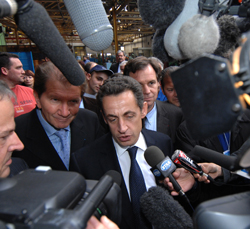
Revenge, as the French saying goes, is a dish that you eat cold. More than two years ago, French President Nicolas Sarkozy was taped chatting with journalists in a France 3 studio a few minutes before an on-air interview. The images show him reprimanding a TV technician who refused to salute him, then asking a journalist, Gérard Leclerc—who had co-signed an op-ed in Le Monde criticizing the government’s plans to reform public broadcasting—how much time he had not been on screen and half-joking that he had been “put in a cupboard” (a French expression for “demoted”). A few seconds before going live, the president finally suggests to the news director a question that he would like to be asked during the interview.
On June 30, 2008, this video footage was uploaded on Rue89, along with a related article by Scalbert. It was immediately carried by a number of video-sharing sites, but also triggered a sharp reaction from the presidential palace and, interestingly enough, from France 3.
The station began an internal investigation to determine who had leaked the video to Rue89, and, in a move that baffled other French media, France 3 decided to sue the journalist who had revealed it.
Very few people in Paris actually believe that France 3 did all that on its own initiative. Indeed, the French media scene has been rife for years with stories of presidential interventions in editorial content. Since his arrival at the Elysée in 2007, Sarkozy has regularly shown that while he entertains very friendly relations with top media moguls, he does not appreciate journalists who step out of line and stray away from the narrative he has scripted for his private and public life.
Media critics and journalist unions point to a cascade of examples of such intrusions. In one instance, Sarkozy allegedly asked one of his publisher-friends to fire an editor-in-chief who had published confidential information about his ex-wife. In another, Sarkozy gave himself the prerogative of naming the top brass of the public service broadcasting system. In yet another case, he recently summoned the current editor-in-chief of the reputable but financially strapped Le Monde to discuss the economic future of the paper.
Most media lawyers believe that the case against Scalbert will go nowhere and that the European Court of Human Rights would certainly quash a guilty verdict. However, they consider this indictment a new example of a pattern of intimidation tactics aimed at chilling journalists’ freedom by restricting their right to protect their sources.
More fundamentally, they see this as a disturbing episode in the tug-of-war that has traditionally confronted the French press, and particularly public service broadcasting, with the concept of “L’Etat c’est moi,” i.e. the idea that the French president not only owns the public media but also expects decency and decorum from the private ones. This is a losing proposal in a French media scene that inevitably has its sycophants but is too diverse and too vibrant to be browbeaten.
(Reporting from Brussels)