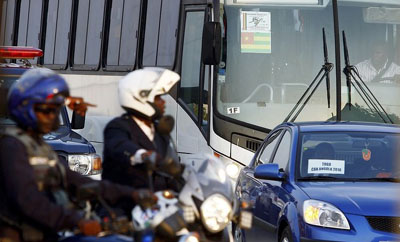
On January 8, while Angola was hosting the African Cup of Nations, the country made worldwide headlines after a deadly attack on the Togolese national soccer team, which left a coach and a journalist dead. With international attention turning to the story, a shroud of state censorship and self-censorship by the Angolan media obscured the factual circumstances of the attack and its aftermath.
Cabinda, the volatile enclave where the attack took place, is familiar territory to me because of my experience investigating the human rights situation there. The government’s shifting positions on the attack—blaming the shooting on the separatist group Front for the Liberation of Cabinda (FLEC), and then shifting responsibility onto Togo by claiming the team had failed to notify authorities of its itinerary—led me to believe that some crucial parts of the story had been obfuscated. My conversations with several journalists, members of the security forces and local officials highlighted a pattern of state manipulation of information, with the complicity of a private press working under intense political pressure.
Cristóvão Luemba, a reporter with the Catholic-run Radio Ecclésia, experienced the shooting firsthand as bullets flattened the tires of the vehicle of the state newspaper Jornal de Angola he happened to have hitched a ride on. According to Luemba, the Togolese team, which had driven from Pointe Noire in Republic of Congo, was welcomed at the Angolan border by a delegation of Cabinda officials headed by the vice governor of Cabinda, Macário Lemba, around 1:30 p.m. on January 8. The Togolese delegation was then transferred to an official bus provided by the government and escorted in a convoy of 10 vehicles, including two more buses, and more than 30 members of the special police force, colloquially known as “Ninjas.” It was 2:15 p.m. when the convoy came under fire for about half an hour, at a bend near the town hall of the communal administration of Massabi. Stanislas Ocloo, 35, a sports reporter for Togo’s national broadcaster Télévision Togolaise (TVT), and assistant coach Hamelet Abulo were killed.
During the shooting, Luemba was the only journalist reporting live from the scene, but his station never aired his report. When I asked Rádio Ecclésia editor
Interestingly, Father Camuto called Luemba that day to congratulate him on his brave reporting. “The priest told me that they liked my work a lot and that thanks to it the world learned about the tragedy,” Luemba told me on February 20. But Luemba could not listen to his own radio station, for it only broadcasts in FM to the capital Luanda. When I informed him that his report had been censored, having checked this fact with his station’s management, he did not hide his disappointment. “I risked my life on that coverage,” he said.
Luemba was not the only journalist whose account and local knowledge were ignored that day. Beyond broadcasting the government’s statement condemning the attack, not once did official media solicit the insights of state media journalists travelling with Luemba to help audiences understand what happened.
As a result of this censorship most international coverage relayed only the following: the minutes of horror the team endured on the bus, as described by some players; statements by the Angolan government and comments from purported separatist groups claiming responsibility for the attack. The Togolese players could only describe their ordeal on the bus, and had no further idea of the realities surrounding them in a foreign territory. International media did not scrutinize the statements of one Rodrigues Mingas, who presented himself as a spokesman of a purported organization called “FLEC-Military Position” (which claimed responsibility for the attack). People with knowledge of the area appeared to find the attack shocking, citing the fact that it took place in an open area offering little cover for a hit-and-run attack and ringed by several troop garrisons in this heavily militarized region. They also said the Cabinda police had cleared the usually busy traffic on the 55-mile (90-kilometer) stretch between the border and the Cabinda city center.
The censorship compounded with the dearth of knowledge among international media allowed the government to rewrite the narrative unchallenged. Authorities sought to garner international sympathy on antiterrorism grounds, then passed blame onto the Togolese team itself. “If we had been informed, surely, we would have sent an aeroplane to bring [the Togolese] from Pointe Noire, in Congo, to Cabinda province. We had no knowledge that Togo had chosen to travel by land to Cabinda,” declared Justino Fernandes, the head of the Angolan host committee and president of the Angolan soccer federation, in a January 20 press conference. The statement contradicted a January 8 Jornal de Angola print edition story reporting the departure of an official delegation, including Alberto Macaia, deputy to the director of the Cabinda organizing committee, to welcome and drive the Togolese national team inland. Yet neither the state media nor Rádio Ecclésia, which covered the press conference where Fernandes made these remarks, made use of the material evidence to question him. Based on this perception, Togo was sanctioned after withdrawing from the tournament while the host country received only praise.
Rafael Marques de Morais is an Angolan investigative journalist and the editor of MakaAngola, a Web site reporting on corruption in Angola.