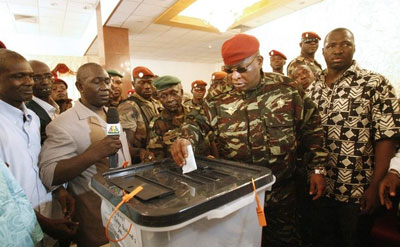
Guinea’s historic presidential elections and new constitution are changing the media landscape in the West African country. Since last month, the military-led Transitional National Council has passed two new laws decriminalizing defamation and created a new media regulatory body.
This country’s progression toward embracing democracy makes it hard to believe that the “Guinean Massacre” occurred less than a year ago. On September 28, 2009, military soldiers violently dispersed a banned opposition rally at a stadium in the capital Conakry, killing dozens of people and assaulting at least a dozen journalists covering the gathering. Nasser Diallo, a reporter with Conakry private station Radio Nostalgie, managed to escape death on that tragic day and has continued broadcasting from exile. “This new law is a huge relief for me,” said Diallo, who broadcasts a radio show on Blogtalkradio from a mini studio in his Brooklyn home. “Its entry into force will give us a hope of having an independent press.”
The new press laws replaces a 1991 press code that infamously allowed, among other things, dead people to be plaintiffs in defamation lawsuits against journalists accused of causing outrage to their memory.
In lieu of prison sentences, journalists now face fines, ranging from 500,000 to 20 million Guinean francs (US$100 to US$4,000). “The paradox is that the fines are so high that journalists think they prefer prison,” said Boubacar Algassimou Diallo, political editor of the private weekly Le Lynx, the largest circulation newspaper in the country. He explained that printing costs could account for as much as 67 percent of the budget of producing a newspaper, let alone pay a fine. “When you say 5 million Guinean francs (US$975), a journalist prefers to go to prison for three days. He knows that once in prison, with the pressure of Media Foundation of West Africa, CPJ, and Reporters Without Borders, he will be released,” he added.
In a special report released this week—“Guinea: Journalists are the Forgotten Victims of Violence”—London-based anticensorship organization Article 19 expressed concern that the new law upholds “a number of restrictions incompatible with international standards and good practice” such as “offenses of libel against the Head of State, slander and false report.”
Notwithstanding, for the first time, the press law includes provisions recognizing the country’s growing electronic media: More than 20 news websites (often based abroad) have correspondents in Guinea. “Online media is filling the gap of information resulting from the absence of private dailies. They are inevitable,” according to Diallo of Le Lynx. Under the new law, online journalists will be entitled to press cards so long as they can show a master’s diploma in journalism or two years of professional experience, explained Amadou Tham Camara, who heads the Guinean Association of Online Press (AGUIPEL). The new law requires all news sites to register with the new media regulatory agency and identify their local correspondents, who will act as their legal representatives, he told CPJ. The agency will have the power to order the suspension or ban of websites after repeated offenses.
Abdoulaye Diallo, New York bureau chief of Guinéenews, a leading independent news site based in Canada, participated in the drafting of the new legislation, welcomed the law creating a new media regulatory agency known as HAC. “It essentially provides guarantees for the body to become more independent from state/government control by providing more representation and control over media and press to private news organizations and corporations,” he wrote in an e-mail.
The online platforms have opened the doors for Guineans all over the world to participate in the electoral process and influence the debates at home. On Election Day in New York for instance, the nonprofit organization Alliance Guinea enlisted volunteers at Columbia University to sift through thousands of text and e-mail messages reporting voting incidents in Guinea. The reports were collected through crisis reporting platform Ushahidi. Alliance Guinea co-founder Jennifer Swift-Morgan, told CPJ via e-mail that their efforts included regular TV and radio spots “encouraging everyday people to be active in monitoring the elections themselves and texting in what they see” before, during, and after the polls. In Conakry, Diallo of Le Lynx pointed out that the Ushahidi citizen reporting initiative faced the challenge of verifying the credibility of the reports it received. Swift-Morgan said they collected several hundred useful messages that were mapped and shared with the electoral commission CENI as well as national and international media tracking the elections.
As the international community praises Guinea for having a successful democratic election, the country awaits a scheduled runoff on July 18. The Supreme Court has to make a decision regarding recent allegations of politicians manipulating the counting of votes to confirm the accuracy of the numbers of the two leading candidates. Earlier this month, AGUIPEL suspended the membership of Guinee24 news website on the grounds that it violated electoral regulations by publishing undocumented polls favoring candidate Alpha Condé, Camara told CPJ.
Mariama Keita is an intern in CPJ’s Africa program. Mohamed Keita is CPJ’s Africa advocacy coordinator.