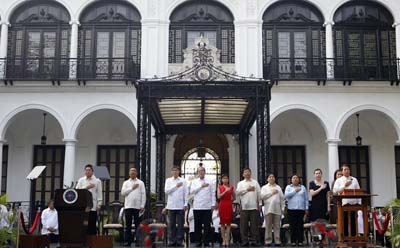
What could have been a pro forma discussion turned out to be a dynamic 90-minute exchange with young government officials keen on coming to grips with many of the same issues as CPJ. Here was the lineup: On the government side was Geronimo Sy, assistant secretary of the Department of Justice, and Richard Anthony Fadullon, the assistant chief prosecutor in charge of the Maguindanao case at the presidential offices in Malacañang Palace. Manuel Quezon, undersecretary in the presidential Office of the Press Secretary, a former journalist led the way. The CPJ delegation included board member Sheila Coronel, Impunity Campaign and Journalist Assistance Coordinator María Salazar-Ferro, Senior Southeast Asia Representative Shawn W. Crispin, and me.
Coronel stressed the significance of the Philippines’ terrible ranking–third worst in the world–in our Global Impunity Index. Assistant Justice Secretary Sy questioned the validity of the study, citing the type of journalists being included–generally heavily partisan radio commentators in politically divided provincial towns–and Fadullon, the lead prosecutor in the Maguindanao case, questioned CPJ’s methodology in accounting for motive in the killings. It was the same sort of criticism we had gotten from Justice Department officials in the previous administration of President Gloria Macapagal-Arroyo. This time we were able to confront the criticisms face to face, and convince them that the index does indeed reflect a legitimate statistical assessment, one that we have presented and discussed with the World Bank.
Salazar-Ferro, who had worked for years in CPJ’s Latin America section, pointed out that Colombia and Brazil had problems very similar to the Philippines’–provincial journalists using confrontational rhetoric and muckraking reporting against well-entrenched politicians. It was an exciting moment when the staffers pressed her to pass on contacts and references in those countries to start an exchange of information. It now appears that Salazar-Ferro is on the speed dial of several staffers at Malacañang.
The Aquino staffers were clearly concerned about the need to address impunity and the broader problems of the criminal justice system–the shortcoming of the witness protection program, the lack of police forensic capability, and overworked and under-resourced prosecutors, not to mention a creaking criminal justice code that was written in 1932 and repeatedly patched over the years. They were frank in their assessments and struck all of us as genuinely sincere in their desire to rebuild the Philippines’ broken justice system.
Despite the hostage tragedy of the night before, the feeling remained that the Aquino administration is in a honeymoon period, with mounds of domestic and international political goodwill stemming from Aquino’s personal integrity and his family heritage–his mother Corazon Aquino took over after the fall of the Marcos dictatorship. The current President Aquino and his justice secretary have repeatedly addressed issues like impunity and journalists’ rights and media freedom in a manner that demonstrates that they aim mightily to confront those problems head-on–along with so many others their country faces. They might not be able to fix all those problems, but it seems clear they have the intent and hopefully the skill to leave the country in better condition than the way they found it when their terms of office end six years from now.
(Reporting from Manila)
Updated: We updated this entry to correct a reference to the World Bank in paragraph four. CPJ has discussed and presented the index to the World Bank. Our original entry said it was “recognized” by the World Bank.