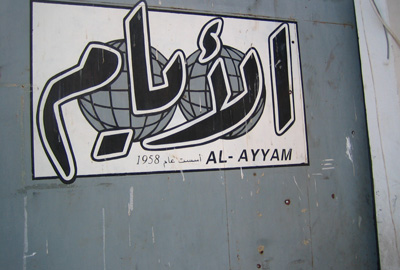
Today marks the anniversary of the beginning of the multiday siege by Yemeni police and security personnel of the compound that houses the offices of the independent daily Al-Ayyam. During its assault on the headquarters of the critical daily, the government used automatic machine guns, rocket-propelled grenades, and heavy weaponry. The siege and the ensuing violence was apparently initiated in response to journalists from Al-Ayyam and other outlets conducting a sit-in outside the compound to protest the daily’s suspension since May.
The siege was not a first for Al-Ayyam. On May 13, 2009, government forces stormed the paper’s compound after showering it with a hail of bullets. The ensuing firefight between government forces and the daily’s guards, which the paper’s management said lasted about an hour, left a passerby dead and two of the paper’s guards injured.
Al-Ayyam was once the country’s highest-circulation publication, reaching more than 70,000 readers, before it was effectively banned from publication in May 2009. Founded in 1958, Al-Ayyam has long been Yemen’s most popular daily, dwarfing the circulation of the government-owned dailies combined. Prior to the ban, it was the only private newspaper to be distributed in every governorate of Yemen. The paper’s popularity was rooted in its readiness to tackle Yemen’s biggest red lines: corruption in the upper echelons of government, social unrest in the southern half of the country, and the years-long government offensive against Houthi rebels in the country’s northern tip.
I was in Yemen in July to conduct research for a report on the deterioration of press freedom in the county. Naturally, I visited with Al-Ayyam and its management. Two things in particular stood out.
First, the damage done to the compound was gruesome. Even after close to six months of more or less continuous renovations, I saw exterior walls extensively scared by bullet holes of all sizes, gaping holes in interior walls large enough for an adult to crawl through (apparently caused by rocket-propelled grenades), as well as charred furniture, broken glass, and molten children’s toys. The scene resembled Baghdad or Beirut, both of which still contain an abundance of battle-scarred buildings, a testament to the ghastly clashes that were waged there.
Second, during a short 15-minute drive through Aden with Al-Ayyam‘s executive manager, Mohammad Bashraheel, random passersby on three separate occasions asked him when the car was stopped at traffic lights or stuck in traffic when the paper would be back on newsstands. One of them said that he had sworn off reading papers until Al-Ayyam returned. The sentiment appeared sincere and seemingly universal, at least among the small sample of people I encountered on the streets that day.
At this most politically precarious time for Yemen–when the government is fighting a seemingly losing battle against al-Qaeda and other extremist groups, is suffering from the highest poverty rates in the region, and is seeking to do away with presidential term limits in what will almost certainly be a rigged 2011 vote– the void left by Al-Ayyam‘s absence is as strongly felt as ever.