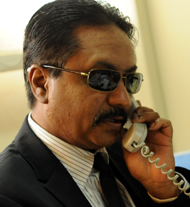
American author Mark Twain once quoted a Mauritian as saying that heaven was copied after this Indian Ocean island paradise. Mauritius is cited today as one of the few havens of press freedom in Africa, but for Raj Meetarbhan, left, editor-in-chief of the island’s largest newspaper L’Express, the country is fast losing its glow.
Meetarbhan was literally shaking with anger one recent day as I walked into his newspaper’s office in Riche Terre, just outside of Port Louis, the island’s largest city.
He had just been visited by two senior police officers who, he told me, were trying to strong-arm him into publishing, on the front page, a retraction to a story his paper had published a few days earlier on corruption. “We published a story a few days ago on alleged unethical business practices and corruption by a company whose owner is a very close friend of our prime minister, Navin Ramgoolam,” he said. The company sent a rebuttal that was published in the newspaper within three days as required by law. “And now, today, I have received this visit from two senior policemen harassing me for not publishing the company’s response on the front page of the newspaper!” exclaimed Meetarbhan.
L’Express, which publishes in Creole and English and has a daily circulation of 40 000, is owned by the private media group La Sentinelle, which holds L’Express Dimanche, 5 Plus Dimanche, and Radio One in its stable. What did Meetarbhan think was going to happen next? “Well I really don’t know. I could be arrested or they could continue to harass me…I don’t know but we have to stand up to this repression of the media,” he responded.
In an interview with CPJ, Dan Callikhan, director of the state-run Mauritian Broadcasting Corporation, MBC, rejected any suggestion that the media was being repressed in Mauritius. “Freedom of the press is very old and very concrete in the Mauritian psyche. There are certainly no threats against media freedom,” he declared. “The prime minister is very clear that freedom of expression is critical but that it must come with responsibility,” he added.
Still, a 2008 report of the Commonwealth Human Rights Initiative (CHRI) quoted Ramgoolam as calling for stricter measures to control the press during an address to the National Assembly on November 20, 2007. The report quoted the prime minister as saying that it would be “totally in order for legislation to be introduced with a view to strengthening existing provisions aimed at preventing abuse of freedom of the press amounting to unwarranted intrusion in the privacy of citizens and scurrilous and defamatory, if not untrue, allegations against citizens of our country.”
The comments referenced the case of three journalists–Editor-in-Chief Gérard Cateaux of the private weekly Week-End, and reporters Josian Valère andAnabelle Volbert of Radio Plus–who were arrested a few months earlier on charges of publishing false news in connection with a story that said a large sum of money was found in a officer’s locker at a police station. The three, the first journalists to be arrested in the country in 13 years, were released on bail and charges were eventually dropped.
The government views La Sentinelle Group as supporting opposition leader Paul Berenger, an assertion denied by Meetarbhan. Tensions between the media group and the administration began to mount in 2006 following the group’s critical coverage of the Ramgoolam party’s campaign efforts during parliamentary elections, he said. “When Ramgoolam won, during a media briefing, he publicly warned the editors of L’Express that they would now pay the price for supporting the opposition,” he added.
In May 2010, the group petitioned the Supreme Court to issue an injunction preventing state officials from denying its journalists access to public events. This came after the deputy prime minister and minister of finance, Rashid Beebeejaun, barred a Radio One journalist from attending a press conference at Government House. A few days later, the minister for foreign affairs, Arvind Boolell, refused to allow a photographer working with L’Express to cover a ceremony involving French and Mauritian officials on Tromelin Island. An out-of-court-settlement was reached between the two parties, and journalists from the La Sentinelle Group were once again allowed to cover government events. In a June 2010 editorial, Touria Prayag, editor of the L’Express English service, asked: “The tug-of-war between La Sentinelle and the political leaders holding the levers of state power has come to an end. Or has it?”
The price, according to Meetarbhan, was a directive from the prime minister’s office to Air Mauritius and Mauritius Telecommunications, in which the state owns majority shares, to stop placing advertising in any of the group’s newspapers and to stop carrying the newspapers on Air Mauritius flights. “This has been hugely damaging to us and we have lost millions in revenue. The only way we have survived is because we are a popular newspaper; otherwise, we would have been forced to close down.”
Callikhan points out an increase in the number of privately owned newspapers as evidence of a vibrant press climate. But is the press freedom climate also strong? In a June 2010 editorial, Prayag wrote: “Did we really need a court judgement, a judge, a string of lawyers, and the attorney general to tell us that journalists should be allowed into government offices for press conferences held by government ministers in a country which misses no opportunity to boast about the freedom of the press and access to information?”