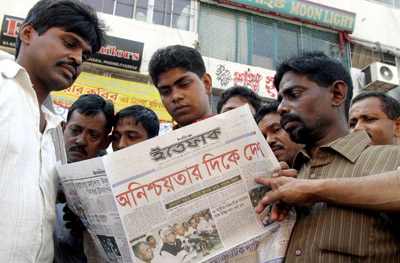
In the last decade, the growth of print and electronic media and a new generation of journalists have changed the face of the media in Bangladesh. But there is a long way to go until there is true press freedom. Politicians, criminals, and businessman exert undue influence, and the industry itself lacks the professionalism to withstand it.
Pressure from political quarters is much less than it was when the military-backed government was in power only two years ago, Nazrul Islam, chief reporter of the English-language Daily Sun, told me in a telephone interview. Still, progress is slow to take hold. In 2009, the ruling Awami League government adopted the Right to Information Act. Journalists who had fought for transparency welcomed it, but the government needs to provide more information, because people still do not know how to take advantage of it. So we remain deprived of information from government offices.
Other limits are still in place. Zahid Newaz Khan, news editor for the private television station Channel I, told me that some topics are off-limits, because of limited access, or fear of official reprisal. “It’s very tough to report the inside story of the armed forces and judiciary,” he told me by telephone from Dhaka. In August 2010, Amar Desh newspaper editor and former politician Mahmudur Rahman was sentenced to six months in prison for publishing an article that accused the Supreme Court of bias towards the state.
There is still pressure from powerful groups, particularly on broadcast and electronic media, journalists say. Increasingly, these groups include businesses as well as political organizations, according to journalists I spoke with. The media in Bangladesh used to be primarily government-owned. Now, it is primarily owned by private enterprises. News is published or broadcast by big businesses that pay good salaries and benefits to journalists–but also have the power to make them report what suits their interests. Ownership of the media is influenced by politics, and both the government and big businesses use advertizing as a weapon to control the media.
“Journalists try their best to maintain professionalism amid pressure from these many adversaries,” Islam told me. “In a transitional society like in Bangladesh, I believe, lack of democratic practices in almost all spheres of life hinders the growth of purely professional journalism. The state-owned media is highly controlled by the government and lacks professional standards. They work as mouthpiece of the government, regardless of which party is in power.” That is significant in a country which is increasingly partisan, “pathologically divided,” in Islam’s words, “between two major political camps,” the Awami League, and the opposition Bangladesh National Party.
Anwar Hossain Manju, former deputy chief news editor of national news agency Bangladesh Sangbad Snagstha, agreed. “It’s not a matter of which party is in power,” he told me. The ruling parties, whether in government or opposition, don’t like criticism, and as a result, many journalists are facing not only defamation cases, but also death threats, said Manju, now special correspondent for the New York-based weekly Ekhon Shomoy. Both media outlets and journalists are under the close scrutiny of government agencies, he said. “Democracy in Bangladesh has not brought full press freedom,” he told me.
Media is widely seen as a tool of empowerment in Bangladesh and successive governments have come to realize that it is safer to let it work freely than to curb it. However, media freedom will significantly improve if the government allows state-run media outlets to enjoy freedom of expression. At the same time, the media should work to raise their own professional standards and reduce political bias.