Go »

CPJ

2010


Blog | USA
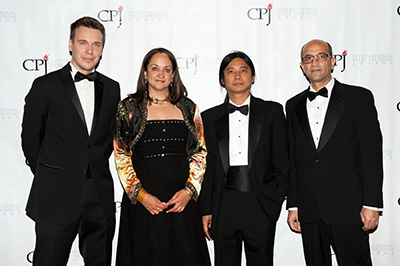
Holbrooke with his wife, the author Kati Marton, at CPJ's International Press Freedom Awards in November. (Getty Images for CPJ/Michael Nagle)

Richard C. Holbrooke, "one of the giants of American foreign policy" in President Barack Obama's words, was also an ally of press freedom and a good friend to CPJ. In a statement marking Holbrooke's death at age 69, Chairman Paul E. Steiger said: "CPJ mourns the passing of Ambassador Richard C. Holbrooke. He was a champion of human rights and a great friend to press freedom. Our thoughts are with his family, especially his widow, CPJ board member and former chair, Kati Marton." 

Blog | CPJ

Harvard International Review ran a feature article called "Murdering With Impunity: The Rise in Terror Tactics Against News Reporters," by CPJ's Journalist Security Coordinator Frank Smyth in its Fall 2010 issue, billed as a symposium focused on changes in journalism and press freedom. Editors-in-Chief Collin Galster and Gloria Park write in the printed issue's foreword: 

Blog | CPJ
Laura Linney and Brian D'Arcy James play  journalists pulled apart by their wartime experiences in "Time Stands Still." (Joan Marcus)

It takes a certain kind of person to cover a war up close and personal, day after day. One such journalist is Sarah Goodwin, the photographer in "Time Stands Still" by playwright Donald Margulies.

The Obiang prize, named for and funded by one of Africa's most notorious dictators, was a very poor idea from the start and our goal, bluntly, was to kill it. We didn't quite succeed in getting an outright cancellation, but the prize, while technically alive, is in a deep coma with virtually no chance of recovery. How the prize came to a halt is detailed in a press release available on the website of the Open Society Institute's Justice Initiative, but here's the story in a nutshell.

The line of people at the stairs leading down to the Great Hall at Cooper Union in lower Manhattan formed early and turned into an audience of 500. They came to hear prominent Mexican and U.S. writers and free expression advocates assess, denounce, and seek solutions to the wave of violence wracking Mexican media.

Blog | CPJ
Until now, CPJ's Asia program has relied largely on email blasts to get the word out when we post something new on CPJ.org. Today we launched our Facebook and Twitter pages. Like us and follow us for an inside look at the Asia program and quick, timely updates on our alerts and blogs. We also hope you'll take the opportunity to interact with each other on these social networks.

"Tell them not to kill me!" pleads a man in the opening lines of a fascinating tale of violence with the same title by one of Mexico's most esteemed writers, Juan Rulfo. It is, sadly, the same cry for help that Mexican journalists are sending out to the world today. On Tuesday, October 19, prominent writers and journalists from Mexico and the United States will gather in New York for "State of Emergency: Censorship by Bullet in Mexico," an evening of readings and discussions about the threats facing members of the Mexican press who report on drug-related violence.

How do you crack Russia's vaunted security service? You go to low- and mid-level officials for information, say Russian journalists Andrei Soldatov and Irina Borogan, authors of the new book, The New Nobility: The Restoration of Russia's Security State and the Enduring Legacy of the KGB. At a luncheon for CPJ supporters on Thursday, Soldatov and Borogan detailed how today's Federal Security Service, or FSB, enjoys the impunity of the noble classes of bygone eras. And, of course, the authors discussed how they managed to get information about the secretive agency.

Blog | CPJ

We're pleased to launch CPJ's official Facebook page in Spanish, CPJ en Español. We hope to engage our followers throughout Latin America in an ongoing conversation about press freedom challenges in the region.

Blog | CPJ

You may have noticed a few changes we've made to the CPJ Blog recently. Here's what's new (with much thanks to our Web developer, John Emerson):

Our bylines are now clickable. You can see a staffer's (or guest blogger's) entries on one page by clicking, giving you an overview of blogs written by, say, Bob Dietz, our Asia program coordinator.

We've also added small photos and brief bios at the tops of pages and at the bottom of individual entries.

We've also created tag clouds on the blog. Look at the right-hand column: Topics are prominently displayed, as are categories, below that.

Another new feature is the drop-down list of authors, also in the right-hand column: "Entries by Author."

By showing you a little more about who we are and where we come from, we hope this brings our work within closer reach. Our goal is to get you reading, and caring, about journalists and the press in danger around the world. 

News from the Committee to Protect Journalists, August 2010

President Porfirio Lobo during a televised press conference in January. (AP/Esteban Felix)

Honduras report citing official failures draws a response

In a few short months, seven journalists were gunned down in Honduras. While the country has been beset by crime and political turmoil, it had not been known as a particularly dangerous place for the press. Is someone targeting the media?

CPJ dispatched consultant Mike O'Connor to Honduras to find out. His detailed report chronicling all seven murders paints a complex picture in which journalists covering crime and corruption are also tainted by it. While there is no evidence of a government conspiracy in the killings, there are plenty of indications of official indifference and incompetence in carrying out investigations. The failures, CPJ found, may be fueling additional violence.

New York, August 12, 2010--The United Nations Educational, Scientific, and Cultural Organization should cancel the Obiang prize at its next session in October 2010, the Committee to Protect Journalists and 95 partner groups said in a letter to UNESCO Executive Board members today.

CPJ’s Senior Program Coordinator for the Americas Carlos Lauría was live on the national radio show “The Takeaway” this morning talking about the ongoing deterioration of the media environment in Mexico. Lauría was joined by New York Times correspondent Elisabeth Malkin from Mexico City.

Using https to secure the Web for journalism

From today, you now have an alternative web address to visit the CPJ website. As well as our usual http://cpj.org/ address, you can visit our site securely at https://cpj.org/. We've turned on this feature to help protect our readers who are at risk of surveillance and censorship, and as part of a wider advocacy mission to encourage social networking and media sites to do the same.

News from the Committee to Protect Journalists, July 2010

Newly freed political prisoners at a press conference in Madrid. (AP/Emilio Morenatti)

Cuba begins releasing journalists

For weeks, CPJ staff had been getting hints that Cuba, under a deal brokered by the Catholic Church and Spanish government, would release imprisoned journalists and political dissidents. Some families had been told to buy suits for their jailed loved ones, a sure sign that something was up. After years of painstaking reporting, contact-building and campaigning on Cuba, we were in a great position to move quickly when at last on July 13 the Cuban authorities put six journalists on a plane for Madrid. CPJ Europe Consultant Borja Bergareche was there to welcome the new exiles, the first in what is expected to be a series of releases by the Castro regime. Three more journalists have since been freed. Prior to the releases, CPJ research had identified 21 journalists in Cuban prisons for their independent reporting and commentary. All but one of the journalists had been detained in March 2003, in the massive government crackdown on political dissent and independent journalism that came to be known as the Black Spring.

Last week, I attended an unusual event called the Courage Forum at which half a dozen speakers, from tightrope artist Philippe Petit and Sudanese rapper Emmanuel Jal to Virgin founder and chairman Richard Branson, talked about about overcoming fear.

A bill pending in the Russian parliament would give state security alarming new censorship powers, CPJ’s Nina Ognianova told the Congressional Tom Lantos Human Rights Commission in testimony in Washington today. During a hearing on human rights issues in Russia, Ognianova also voiced concern about continued impunity in journalist murders. 

María Teresa Ronderos and Sergei Sokolov at CPJ's Impunity Summit at Columbia. (CPJ)

Every day at CPJ, we count numbers: 18 journalists killed in Russia since 2000, 32 journalists and media workers slaughtered in the Maguindanao massacre, 88 journalists murdered over the last 10 years in Iraq. But on Tuesday night at CPJ’s Impunity Summit at Columbia University, CPJ Executive Director Joel Simon clarified why we were gathered: “At the end of the day, it’s not about numbers,” he said. “It’s about people.”

Blog | CPJ
How many journalists does it take to change a light bulb? If anyone has an answer to that, he or she was probably in the crowd that gathered last night for Commedia dell Media, the journalists’ stand-up comedy gala benefitting CPJ and other press freedom groups. Follow the link for details.

Colombo, March 10, 2010—In a meeting with a CPJ delegation today, Sri Lankan Attorney General Mohan Peiris said he was prepared to offer protection to any of the nation’s journalists who return to the country from exile.

On SaturdayTunis airport customs officials confiscated two copies of CPJ’s annual report, Attacks on the Press, as well as five copies of the Arabic-language translation of the Middle East and North Africa section of the book from Tunisian rights lawyer Mohamed Abbou and journalist Lotfi Hidouri on their return from Morocco, the two men told CPJ. 

Joel Simon at CPJ's Japan launch of Attacks on the Press. (Reuters)

On February 16, CPJ held an ambitious international launch of our annual report Attacks on the Press. We coordinated events in six cities on four continents in order to expand the reach of our international headlines while also focusing on specific issues in each region. So how did we do?

Blog | CPJ

On Tuesday, CPJ released its annual report, Attacks on the Press, with a global launch in six citiesTokyo, New York, Brussels, Bogotá, Cairo, and Nairobi. We’ve noticed that different media reports, using our data, have cited slightly different numbers in regards to two key statics, the number of journalists killed and the number imprisoned in 2009—the global benchmarks for press freedom. We want to clear up any confusion. 

Maziar Bahari (Newsweek)

The two venues for the launch of Attacks on the Press in New York couldn’t have been more different. On Tuesday morning I was joined by Newsweek’s Maziar Bahari, and CPJ Asia Program Coordinator Bob Dietz in the hushed auditorium of the Dag Hammarskjöld Library at United Nations headquarters. The event was so well attended by the U.N. press corps that we ran out of copies of the book. The press conference went for more than an hour until I was slipped a note saying the U.N. spokesman needed the podium for the U.N. daily briefing.

Uribe (AP)

Bogotá, February 17, 2010—Colombian  President Alvaro Uribe Vélez said on Tuesday that those who illegally spy on the press are “enemies of his government” during a meeting with a delegation from the Committee to Protect Journalists and the Foundation for Freedom of the Press (FLIP). 

Uribe issued the statement at the urging of the CPJ and FLIP delegation, which met with the president and top government officials including Vice President Francisco Santos; Minister of Interior Fabio Valencia Cossio; Felipe Muñoz, the director of national intelligence, or DAS; the director of the national police, General Oscar Naranjo Trujillo; and other high-ranking officials in a two-hour-long meeting at the presidential palace, known as Casa Nariño.

Abdulle (CPJ)

“I didn’t wear the bulletproof jacket and helmet that Reuters gave me,” explained veteran Somali journalist Sahal Abdulle to a packed crowd at Nairobi’s Serena Hotel for CPJ’s launch of Attacks on the Press. “It didn’t seem right when my colleagues, local journalists, were risking their lives trying to cover the same event.” Abdulle, like all Somali journalists, faces immense challenges in covering the story in his war-ravaged country. According to this year’s findings in Attacks, nearly all the journalists killed in the line of duty in 2009 were local journalists—and nine of them were killed in Somalia.

Blog | CPJ
Bokova (AP)

Irina Bokova is the quintessential diplomat—elegant, gracious, and fluent in five languages. But she must have a sharp elbow or two to have emerged victorious in the rough-and-tumble battle last September to lead UNESCO, the Paris-based U.N. agency that promotes culture, education, science, and, occasionally, press freedom around the world.

Today, more than year after landing in the United States to receive medical treatment for severe injuries sustained while reporting in Baghdad, Jehad Ali boarded a plane at the Detroit Wayne County Airport en route to Beirut.

Blog | CPJ
It’s happening again: Journopalooza II, the rock ‘n’ roll journalists’ extravaganza that a year ago turned the often quiet National Press Club into one of the best parties in town. This coming Friday night two repeat-performing bands, Nobody’s Business and Suspicious Package, will be back along with Dirty Bomb and Charm Offensive. Journalists—including unemployed ones—are in every band. The gig should run the gauntlet, from some original material to covers of Springsteen and Lou Reed. A cash bar, a few of them in fact, will be on hand. Proceeds will go to CPJ’s Journalist Protection Fund, Reporters Without Borders, and the Eric Friedheim National Journalism Library. Tickets are available at journopalooza.com.
AP

The relentless crackdown on the press in Iran is, well, relentless. In the last few days we have received word that 11 more journalists have been arrested, including former CPJ International Press Freedom Award winner Mashallah Shamsolvaezin, at left.

There are 23 other journalists already in prison in Iran, according to the global census CPJ carried out on December 1. Scores of other journalists have been arrested and released; mores still have been intimidated, beaten and harassed.

« Previous Year: 2009 | Next Year: 2011 »

  Go »
Text Size
A   A   A
Subscribe

CPJ Atom Feed