Go »
  Go »

Belarus

2010

Pages: 1 2 or All


New York, December 29, 2010--Belarusian authorities continued their massive crackdown on critical news media on Tuesday as security agents raided offices shared by the independent weekly Nasha Niva and the Belarusian PEN Center.

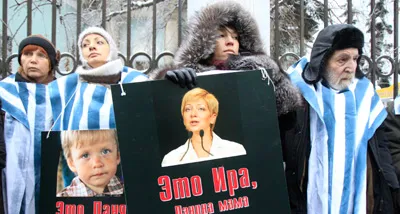
Demonstrators hold signs for jailed journalist Irina Khalip and her son. (Reuters/Sergei Karpukhin)

New York, December 27, 2010--Belarusian authorities must immediately halt their assault on independent and pro-opposition news media, a crackdown that has led to unjust detentions, raids, and seizures, the Committee to Protect Journalists said today. 

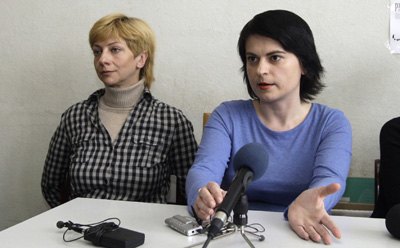
Belarusian journalists Irina Khalip, left, and Natalya Radina. They are currently held by the KGB in Minsk. (AP/Sergei Grits)
New York, December 23, 2010--The Committee to Protect Journalists is outraged by the ongoing detention and potential prosecution of Belarusian journalists Natalya Radina, editor of the pro-opposition news website Charter 97, and Irina Khalip, local correspondent for the Moscow-based independent newspaper Novaya Gazeta. Both are considered suspects in organizing and participating in mass disorder--a charge that carries up to 15 years in prison if convicted, according to the website of the State Department of Internal Affairs (GUVD) in Minsk. It is not clear whether the two have been officially charged yet.
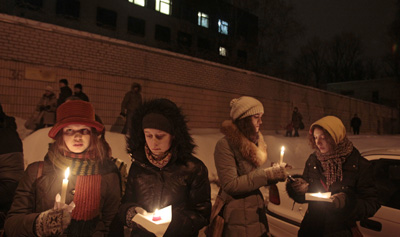
Supporters light candles today outside prison walls in Minsk for those detained in Belarus' Sunday opposition protests. (AP/Dmitry Brushko)

New York, December 21, 2010--The Committee to Protect Journalists condemns the prison sentences handed down to journalists who reported on post-election protests in Belarus, and the anti-media rhetoric by President Aleksandr Lukashenko.

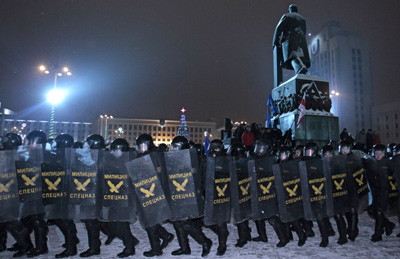
Riot police officers move to block thousands of opposition supporters in Belarus trying to storm the main government building to protest alleged vote-rigging in Sunday's election. (AP/Sergey Ponomarev)

New York, December 20, 2010--The Committee to Protect Journalists condemns the violent government crackdown against journalists covering demonstrations in Minsk against Sunday's flawed presidential vote won by President Aleksandr Lukashenko. Security police have arrested at least 20 journalists and beaten at least 20 more between the outbreak of rallies Sunday evening and their forcible dispersal in the early morning, according to local news reports.

As I mentioned last Friday, local journalists in Belarus were preparing for targeted disruption to Internet communications during Sunday's presidential elections. The online news site Charter '97, which has experienced more than its fair share of denial-of-service (DOS) attacks and police raids in the past, was already warning its readers last week to use their Facebook page as an alternative, in the event of its main site being attacked.

The extent of the widespread press crackdown in Minsk is still being measured, but I've been reading reports from within Belarus that spell out the drastic Internet side of the restrictions. Not only was Charter '97 attacked over the weekend, but apparently sites like Facebook and Twitter were also blocked by Belarus ISPs. Even more significantly, there has been widespread filtering of the channels that encrypted communications like "https" and secure email use. These filters aren't specific to one site, but block traffic based on how it connects to remote sites. That means that not only news or social networking sites, but banking, financial and most website login pages would be disrupted. It also means that journalists on the ground have been unable to access services like Gmail, or even send email directly from mail clients.

Hal Roberts at Berkman has more details. As the Charter '97 English Twitter feed notes, when your electricity is cut off and editors are being detained, such subtle technical censorship is somewhat of a side-note for journalists working within the country. But during key events, when reporters and eye-witnesses are working with foreign news media, such blocking can seriously hamper the ability to gather information and describe what is happening to the world at large.

Six stories: Online journalists killed in 2010

Greek blogger Giolias (AP)

This week, CPJ published its year-end analysis of work-related fatalities among journalists. Six of the 42 victims worked online. While you can read the full statistics and our special report elsewhere, I want to highlight the stories of these six journalists who worked on the Web.
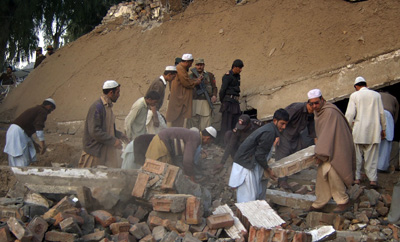
At least 42 journalists are killed in 2010 as two trends emerge. Suicide attacks and violent street protests cause an unusually high proportion of deaths. And online journalists are increasingly prominent among the victims. A CPJ special report

A December suicide attack in Pakistan's Mohmand tribal district claimed the lives of two journalists. (Reuters/Umar Qayyum)
New York, December 10, 2010--Belarusian authorities must stop harassing independent media outlets and journalists and allow them to cover the December 19 presidential elections without fear of reprisal, the Committee to Protect Journalists said today.

Fighting bogus piracy raids, Microsoft issues new licenses

CPJ has documented for several years the use of spurious anti-piracy raids to shut down and intimidate media organizations in Russia and the former Soviet republics. Offices have been shut down, and computers seized. Often, security agents make bogus claims to be representing or acting on behalf of the U.S. software company Microsoft.

2010

Pages: 1 2 or all
Next Page »

« Previous Year: 2009 | Next Year: 2011 »

  Go »
Text Size
A   A   A
Killed in Belarus

2 journalists killed since 1992

2 journalists murdered

2 murdered with impunity

Attacks on the Press 2012

10th Most censored country, with prosecutions and travel bans used against critics.

Country data, analysis »

Contact

Europe and Central Asia

Program Coordinator:
Nina Ognianova

Research Associate:
Muzaffar Suleymanov

nognianova@cpj.org
msuleymanov@cpj.org

Tel: 212-465-1004
ext 106, 101
Fax: 212-465-9568

330 7th Avenue, 11th Floor
New York, NY, 10001 USA

Facebook: CPJ ECA Desk

Blog: Nina Ognianova
Blog: Muzaffar Suleymanov