The Hungarian press law is again drawing fire from the European Union; the amendments adopted by the Hungarian Parliament on May 24 have not placated Brussels.

The Hungarian press law is again drawing fire from the European Union; the amendments adopted by the Hungarian Parliament on May 24 have not placated Brussels.
The celebration Tuesday of the 50th anniversary of the Association of European Journalists (AEJ) should have been a joyful and lighthearted affair. Dozens of journalists from all parts of the European Union had traveled to Brussels to share memories, new projects, champagne, and petits fours.
The state of press freedom inside the European Union has a significant effect on press freedom outside the EU. That was the message that CPJ Senior European Adviser Jean-Paul Marthoz and I delivered this week when Brussels' leading think tank, the European Policy Center (EPC), hosted us for a policy dialogue marking the launch of our annual survey, Attacks on the Press.
In the EU, some countries appear more immune than others to scrutiny and reproach. Anti-terror laws, political and economic concerns, and a lack of common standards all challenge the credibility of the EU's diplomacy. By Jean-Paul Marthoz
On January 1, 2011, the day Hungary assumed the rotating presidency of the European Union, a restrictive new media law came into force. The law created a National Media and Infocommunications Authority--staffed with appointees of the ruling Fidesz party--that was given vast powers to regulate news media. The law established heavy fines for violations such as carrying "imbalanced news coverage" or running content that violates "public morality." The law applied to all news media, reaching beyond national borders to foreign outlets "aimed at the territory of Hungary." The measure triggered protests in Hungary and throughout Europe, where it was seen as violating the Charter of Fundamental Rights enshrined in the Lisbon Treaty. Hungarian lawmakers agreed to minor changes in response to pressure from the European Commission. In December, the country's Constitutional Court struck down a provision that would have obliged journalists to reveal confidential sources. The court also exempted print media from the law as of May 2012, although it left intact most other anti-press provisions. The domestic media scene reflected deep polarization between supporters and adversaries of the center-right Fidesz. Political pressures were rife in public broadcasting: In July, 570 employees of the four state-run media companies were dismissed, representing about 16 percent of the workforce. Authorities reassigned the broadcast frequency of the largest opposition radio station, Klubradio, to an entertainment broadcaster in December, citing a higher bid.
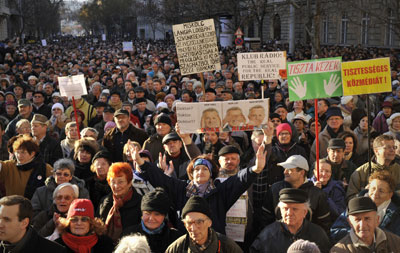
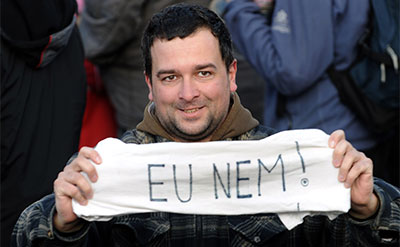
"Klubrádió solely wants to provide news and present different opinions and never meant to play any emblematic role. But, because of the decision of the Media Authority, it has became the symbol of free speech in Hungary," stated the broadcaster's CEO, András Arató, on Sunday when addressing thousands of demonstrators who gathered in central Budapest to express their support for the station. Once this popular talk radio broadcaster loses its frequency license (which was reallocated to a previously unknown media group that tendered a higher price) in a matter of weeks, pro-government dominance will be nearly complete in terms of broadcast news programs in the country.