Go »
  Go »

Bahrain

2012


Syrian violence contributed to a sharp rise in the number of journalists killed for their work in 2012, as did a series of murders in Somalia. The dead include a record proportion of journalists who worked online. A CPJ special report

A journalist dodges gunfire in the Syrian city of Aleppo. (AFP/Tauseef Mustafa)

New York, October 24, 2012--CPJ is alarmed by a Bahraini court's acquittal of a police officer accused of torturing a journalist in custody in 2011.

A criminal court in Manama on Monday acquitted police officer Sara al-Moussa on charges of torturing Nazeeha Saeed, a reporter for France24 and Radio Monte Carlo Doualiya, while the journalist was in custody in May 2011, according to the official Bahrain News Agency (BNA). The agency reported that the court ruled that Saeed's testimony was full of "contradictions" and not "consistent." Saeed told CPJ that she and her lawyer are urging prosecutors to reopen the case.

New York, September 13, 2012--The Committee to Protect Journalists is concerned about the ongoing imprisonment of Ahmed Radhi, a freelance journalist who was first detained four months ago after making critical comments about Bahraini-Saudi relations. Radhi now faces terrorism and other anti-state charges which he says were lodged after he was abused and forced into making a false confession.

New York, September 6, 2012--Bahraini authorities should toss out the unjust conviction and life sentence handed to an online journalist who was imprisoned for exercising his right to free expression during the country's 2011 popular uprising, the Committee to Protect Journalists said today.

From left: Anas al-Tarsha, 17, Syria; Ahmed Addow Anshur, 24, Somalia; Mahad Salad Adan, 20, Somalia; Hassan Osman Abdi, 24, Somalia; Mazhar Tayyara, 24, Syria.

The 17-year-old videographer Anas al-Tarsha regularly filmed clashes and military movements in the city of Homs in Syria, and posted the footage on YouTube. On February 24, he was killed by a mortar round while filming the bombardment of the city's Qarabees district, according to news reports. The central city had been under attack for more than three weeks as Syrian forces stepped up their assault on opposition strongholds.

For journalists, danger lurking in your email

A protester in Jidhafs, Bahrain. (AP/Hasan Jamali)

This week, Morgan Marquis-Boire and Bill Marczak of the University of Toronto's Citizen Lab provided a disturbing look into the likely use of a commercial surveillance program, FinFisher, to remotely invade and control the computers of Bahraini activists. After the software installs itself onto unsuspecting users' computer, it can record and relay emails, screenshots, and Skype audio conversations. It was deployed against Bahraini users after being concealed in seemingly innocent emails.

Protesters hold tear-gas canisters at an anti-U.S. protest held to condemn the sales of arms to Bahrain, in the village of Diraz west of Manama Thursday. Reuters/Hamad I Mohammed)

New York, May 17, 2012--A journalist who criticized Bahrain's proposed union with Saudi Arabia was seized from his home near Manama on Wednesday and his whereabouts are unknown. The Committee to Protect Journalists called today for his immediate release.

King Hamad bin Issa al-Khalifa's government breaks a promise to allow an international mission to assess free expression in Bahrain. (AP/Hasan Jamali)

Reneging on a promise made just weeks earlier, Bahraini authorities have denied visas to representatives of several free expression organizations who planned to travel to the kingdom next week to assess press and free speech conditions. CPJ is among several organizations that have signed a joint letter to Bahrain's director of human rights organizations condemning the action.  

Police check journalist IDs outside the Formula One races on Sunday. Authorities have restricted and suppressed journalists in the run-up to the races. (AP/Hassan Ammar)

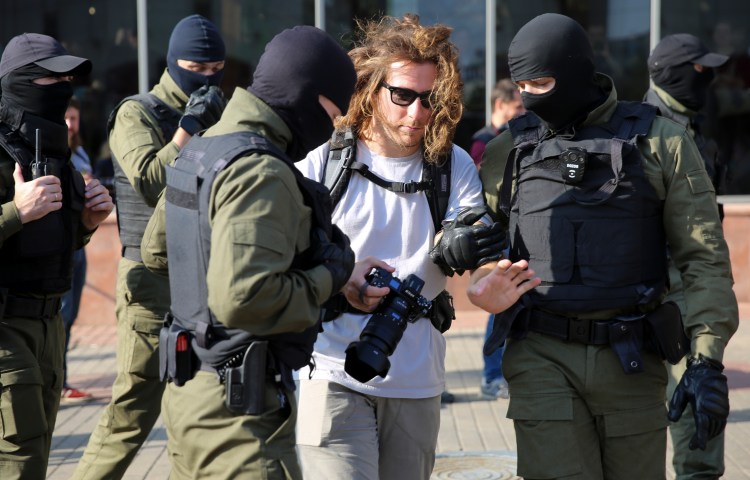
New York, April 23, 2012--Bahraini authorities, intent on suppressing coverage of the restive political conditions that were a backdrop to the Formula One Grand Prix in Manama on Sunday, arrested at least seven international journalists who were seeking to report on anti-government demonstrations, according to news reports.

Police used sound grenades Wednesday to disperse an anti-government rally demanding the release of human rights activists in Manama. (Reuters/Darren Whiteside)

CPJ is among 50 organizations that have signed a joint letter to Bahrain's king calling for the release of detained bloggers, activists, and human rights defenders and to drop all charges that violate the right to peaceful expression ahead of the Formula One motor racing event to be held in Manama on April 22.

A still from one of Hassan's videos of a protest in Manama last year. Hassan was killed by an unknown assailant on Saturday. (YouTube)

New York, April 4, 2012--A Bahraini videographer died Saturday morning after being shot while filming a protest outside the capital, Manama, according to local journalists and news reports.

CPJ awardee Natalya Radina.

How does one negotiate the choice to stay and report potentially dangerous news, rather than take a less risky assignment, leave the profession, or flee the country? The recipients of the 2011 International Press Freedom Awards explain. By Kristin Jones

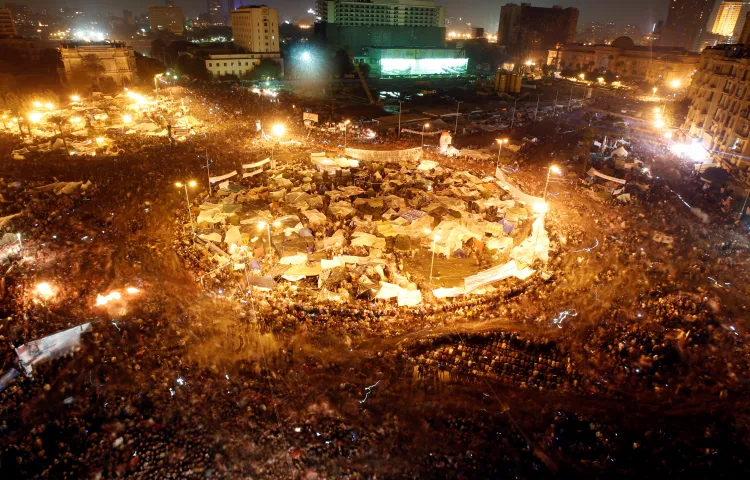
Photographers take cover during November protests in Tahrir Square. (AFP/Mahmud Hams)

The Middle East's political shifts changed conditions for journalists dramatically. The emerging trends favor free expression, but are filled with ambiguity and depend on the political configurations to emerge after the revolutionary dust has settled. By Mohamed Abdel Dayem

Iran is the world's worst jailer of the press. Detentions rise in the Middle East and North Africa.

Murders decline, but fatalities rise during coverage of protests. Photographers and freelancers pay an especially high price. Pakistan is the world's most dangerous nation.

The government waged a brutal multifaceted crackdown against independent news media covering the country’s months-long protest movement. Security forces subjected journalists to assaults, expulsions, detentions, politicized trials, prison terms, and lethal mistreatment in custody. Both international and local reporters were targeted: A journalist for the U.S. broadcaster ABC was beaten and his camera was confiscated in February; a photographer for the independent domestic daily Al-Wasat was beaten while covering a March protest. Authorities used live ammunition against protesters and reporters: The New York Times reported that two of its journalists came under helicopter fire in February. The Ministry of Information expelled CNN correspondent Mohammed Jamjoom over coverage of the unrest, and detained members of a CNN crew trying to interview human rights activist Nabeel Rajab. In June, a court convicted two critical journalistic bloggers on a series of antistate charges and sentenced them to lengthy terms. Reports of torture and mistreatment of detainees were common: Two journalists, one a founder of Al-Wasat, died in government custody under circumstances authorities would not fully explain. Al-Wasat, the country’s premier independent paper, was in the crosshairs throughout the year: Armed assailants stormed its printing facility in March; the Information Ministry briefly shut the paper in April; and the government filed criminal charges against three senior editors for “false news” the same month. CPJ honored Al-Wasat founder and editor Mansoor al-Jamri with its 2011 International Press Freedom Award.

Journalists from Al-Wasat newspaper leave a Bahraini court after being fined US$2,650 each for publishing false news. (Reuters/Hamad I Mohammed)

In the year since peaceful protests began in Bahrain on February 14, 2011, the government has targeted the press corps with assault, detention, harassment, and torture to obstruct their coverage. My organization, the Gulf Centre for Human Rights, has documented a systematic campaign by authorities to silence coverage of our country's unrest. Here are just some of the many attacks on the press:

New York, February 9, 2012--Bahrain has rejected at least six journalists' applications for entry visas ahead of the anniversary of antigovernment protests that swept the country in February 2011, according to news reports. The Committee to Protect Journalists calls on authorities to allow journalists into the country to carry out their work freely.

« Previous Year: 2011 | Next Year: 2013 »

  Go »
Text Size
A   A   A
Killed in Bahrain

3 journalists killed since 1992

Attacks on the Press 2012

1 Journalist imprisoned on December 1, a blogger serving a life term.

Country data, analysis »

Contact

Middle East
and North Africa

Program Coordinator:
Sherif Mansour

Research Associate:
Jason Stern

smansour@cpj.org
jstern@cpj.org

Tel: +1 (212) 300-9018,
+1 (212) 300-9017
Fax: 212-465-9568

330 7th Avenue, 11th Floor
New York, NY, 10001 USA

Twitter: @CPJMena

فيسبوك : لجنة حماية الصحفيين بالعربية

Blog: Sherif Mansour
Blog: Jason Stern