Tunisia
2011
More than a dozen journalists assaulted in Tunisia
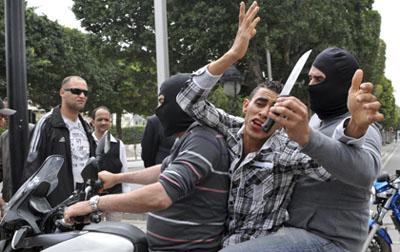
New York, May 9, 2011–The Committee to Protect Journalists called on the Tunisian authorities today to restrain from attacking journalists reporting on anti-government demonstrations after plainclothes police physically assaulted 15 local and international journalists on Friday.
The 10 Tools of Online Oppressors
The world’s worst online oppressors are using an array of tactics, some reflecting astonishing levels of sophistication, others reminiscent of old-school techniques. From China’s high-level malware attacks to Syria’s brute-force imprisonments, this may be only the dawn of online oppression. A CPJ special report by Danny O’Brien
Audio Report: The 10 Tools of Online Oppressors
In our special report, “The 10 Tools of Online Oppressors,” CPJ examines the 10 prevailing strategies of online oppression worldwide and the countries that have taken the lead in their use. In this accompanying podcast, CPJ Deputy Director Robert Mahoney notes that these strategies range from sophisticated cyber-attacks to traditional brute-force techniques. Listen to the…
Attacks on the Press 2010: Middle East and North Africa Analysis
Suppression Under the Cover of National Security By Mohamed Abdel Dayem Relying on an extensive network of sources in the military, government, and Islamist groups, Yemeni freelance journalist Abdulelah Shaea had become a frequent and pointed critic of the administration’s counterterrorism efforts. By July, President Ali Abdullah Saleh’s government had enough, dispatching security agents to…
Attacks on the Press 2010: Tunisia
Top Developments • Targeting journalists, government criminalizes contact with foreign organizations. • Private broadcast licenses are controlled by Ben Ali’s family and friends. Key Statistic 5: Years of imprisonment for violations of new law barring contact with foreign groups. Tunisia remained one of the region’s most repressive nations even as it sought to project an…
Tunisian TV station’s suspension reflects tenuous freedom
On Sunday, the privately owned broadcaster Hannibal TV was forced off the air for more than three hours. The state-owned news agency Agence Tunis Afrique Presse (TAP) issued a statement stating that an arrest warrant had been issued for the station’s owner on charges of “high treason” for an alleged “plot to destabilize national security.”…
Will Tunisia’s ‘Internet revolution’ endure?
There has been a great deal written online about how much of a positive role the Internet played in recent events in Tunisia (if you’d like to catch up, Alex Howard’s link round-up provides a good summary of the many sides, both for and against). At CPJ, our focus is on slightly different questions: How…
Freed! Fahem Boukadous released in Tunisia
For those who have spent countless hours exposing and combating Tunisia’s vast press freedom abuses, today is truly a glorious day. Tunisian authorities released the ailing imprisoned journalist Fahem Boukadous, a day after CPJ called on the transitional government to honor its pledge to free all political prisoners. Today, we can loudly proclaim that no…
Internet censorship halts in Tunisia
So much has happened in Tunisia since I last blogged on the large-scale phishing attacks against activists and journalists in the country. With the fall of Zine El Abidine Ben Ali, and a new interim government in place, online censorship seems to be ending. Opposition media and human rights sites are viewable, and CPJ’s Tunisia…